Controversial Muslim preacher, feared Turkish intriguer—and “inspirer” of the largest charter school network in America
Ruth Fremson/The New York Times/Redux
Gülen in his Pennsylvania compound
With the American economy in shambles, Europe imploding, and the Middle East in chaos, convincing Americans that they should pay attention to a Turkish preacher named Fethullah Gülen is an exceedingly hard sell. Many Americans have never heard of him, and if they have, he sounds like the least of their worries. According to his website, he is an “authoritative mainstream Turkish Muslim scholar, thinker, author, poet, opinion leader and educational activist who supports interfaith and intercultural dialogue, science, democracy and spirituality and opposes violence and turning religion into a political ideology.” The website adds that “by some estimates, several hundred educational organizations such as K–12 schools, universities, and language schools have been established around the world inspired by Fethullah Gülen.” The site notes, too, that Gülen was “the first Muslim scholar to publicly condemn the attacks of 9/11.” It also celebrates his modesty.
Yet there is a bit more to the story. Gülen is a powerful business figure in Turkey and—to put it mildly—a controversial one. He is also an increasingly influential businessman globally. There are somewhere between 3 million and 6 million Gülen followers—or, to use the term they prefer, people who are “inspired” by him. Sources vary widely in their estimates of the worth of the institutions “inspired” by Gülen, which exist in every populated continent, but those based on American court records have ranged from $20 billion to $50 billion. Most interesting, from the American point of view, is that Gülen lives in Pennsylvania, in the Poconos. He is, among other things, a major player in the world of American charter schools—though he claims to have no power over them; they’re just greatly inspired, he says.
Even if it were only for these reasons, you might want to know more about Gülen, especially because the few commentators who do write about him generally mischaracterize him, whether they call him a “radical Islamist” or a “liberal Muslim.” The truth is much more complicated—to the extent that anyone understands it.
To begin to understand Gülen, you must start with the history of the Nurcu movement. Said Nursî (1878–1960), a Sunni Muslim in the Sufi tradition, was one of the great charismatic religious personalities of the late Ottoman Caliphate and early Turkish Republic. His Risale-i Nur, disdained and sometimes banned by the Republic, nevertheless became the basis for the formation of “reading circles”—geographically dispersed communities the size of small towns that gathered to read, discuss, and internalize the text and to duplicate it when it was banned. Nurcus tend to say, roughly, that the Risale-i Nur is distilled from the Koran; non-Nurcus often find the claim inappropriate or arrogant.
These reading circles gradually spread through Anatolia. Hakan Yavuz, a Turkish political scientist at the University of Utah, calls the Nurcu movement “a resistance movement to the ongoing Kemalist modernization process.” But it is also “forward-looking,” Yavuz says, a “conceptual framework for a people undergoing the transformation from a confessional community (Gemeinschaft) to a secular national society (Gesellschaft). . . . Folk Islamic concepts and practices are redefined and revived to establish new solidarity networks and everyday-life strategies for coping with new conditions.” To call this movement “fundamentalist” or “radical” is to empty both terms of meaning. It is equally silly to dismiss it as theologically primitive. I confess that I have not read all 6,000 pages of the Risale-i Nur, but I have read enough to be convinced that Nursî is a fairly sophisticated thinker.
Gülen’s movement, or cemaat, arose from roughly a dozen neo-Nur reading circles. Gülen was born in 1941 in a village near Erzurum, the eastern frontier of what is now the Turkish Republic. This territory was bitterly contested by the Russian, Persian, and Ottoman empires and gave rise to interpretations of Islam strongly infused with Turkish nationalism: when nothing but the Turkish state stands between you and the Russians, you become a Turkish nationalist, fast. Likewise, contrary to a common misconception among Americans who view the Islamic world as monolithic, Gülenists do not consider Persians their friends.
Two notable points about Gülen’s philosophy. First, he strongly dissuades his followers from tebliğ, or open proselytism. He urges them instead to practice temsil—living an Islamic way of life at all times, setting a good example, and embodying their ideals in their way of life. From what I have seen in Turkey, the embodiment of these ideals involves good manners, hard work, and the funding of many charities. It also involves a highly segregated role for women. I would not want to live in the segregated world that they find acceptable here; neither, I suspect, would the Western sociologists who have enthusiastically described the Gülen movement as analogous, say, to contemporary Southern Baptists or German Calvinists.
Second, Gülen holds (publicly, at any rate) that Muslims and non-Muslims once lived in peace because the Ottoman Turks established an environment of tolerance. To restore this peaceful coexistence worldwide, he says, Turks should become world leaders in promoting tolerance among religions—and Turks following his teachings should become world leaders.
Gülen’s detractors, however, inevitably point to a speech of his that surfaced in a video in 1999:
You must move in the arteries of the system without anyone noticing your existence until you reach all the power centers. . . . Until the conditions are ripe, they [the followers] must continue like this. If they do something prematurely, the world will crush our heads, and Muslims will suffer everywhere, like in the tragedies in Algeria, like in 1982 [in] Syria, . . . like in the yearly disasters and tragedies in Egypt. . . . The time is not yet right. You must wait for the time when you are complete and conditions are ripe, until we can shoulder the entire world and carry it. . . . You must wait until such time as you have gotten all the state power, until you have brought to your side all the power of the constitutional institutions in Turkey . . . . Now, I have expressed my feelings and thoughts to you all—in confidence . . . trusting your loyalty and secrecy. I know that when you leave here, [just] as you discard your empty juice boxes, you must discard the thoughts and the feelings that I expressed here.
By this point, Gülen had decamped from Turkey to the United States for medical treatment. Nonetheless, in 2000, he was tried in absentia by a state security court for endeavoring to replace Turkey’s secular government with an Islamic one; the indictment alleged that his movement had attempted to infiltrate Turkey’s military schools. His followers say that the video was altered to incriminate him, but they have never produced the putatively innocuous original videotape. After years of legal wrangling, Gülen was acquitted in 2008.
Gülen’s cemaat is by far the strongest Nurcu group in Turkey, described by many as Turkey’s third power, alongside Prime Minister Recep Tayyip Erdoğan’s increasingly authoritarian Justice and Development Party (known as the AKP, its initials in Turkish) and the military. The structure and organization of the cemaat are a subject of controversy. Members tend to be evasive not only about their relationship to Gülen but about the very existence of the cemaat; of late, some have urged Turks to use the word camia in its place. What’s the difference? Not much. Camia conveys looser ties; cemaat can mean “congregation,” whereas a camia is more like a circle. But the word cemaat has become so fraught with sinister overtones that rebranding was in order. Gülen himself calls his movement Hizmet, or service.
The movement’s supporters say that its structure is informal—that being “inspired” by Gülen is akin to being “inspired” by Mother Teresa. Critics, including many people who have left the movement, observe that its organizational structure is strict, hierarchical, and undemocratic. Gülen (known to his followers as Hocaefendi, or “master teacher”) is the sole leader, they say, and each community is led by abis, or elder brothers, who are privy to only a limited amount of information. Sociologist Berna Turam has argued that the abis make strong suggestions about, and perhaps dictate, whom members should marry. Even if prospective spouses are not within the cemaat, the cemaat should benefit from them; a spouse from a rich or powerful family would be an asset, for example. This sounds plausible: we often see this approach to marriage in societies with weak institutions and low social trust, and Turkey is certainly such a society.
The movement, according to researchers such as Yavuz, has three coordinated tiers: businessmen, journalists, and teachers. The first tier, the so-called Anatolian bourgeoisie, provides financial support: it funds private high schools, universities, colleges, dormitories, summer camps, and foundations around the world. The journalists of the second tier own one of the leading Turkish dailies, Zaman; its English-language counterpart, Today’s Zaman (which is often not a faithful translation); the Turkish television station STV; the Cihan news service; many magazines and academic journals; several lesser dailies and TV channels; and many Internet-only news outlets. Finally, teachers operate the schools.
An e-mail message released by WikiLeaks and written by Reva Bahalla, an employee of the private intelligence company Stratfor, details the first two tiers. The e-mail describes “hanging out with hardcore Gülenists” in Istanbul. It begins with a visit to the headquarters of Zaman:
The way they represent their agenda is that this is about democratization in Turkey, human rights, world peace, etc. The guy was actually quoting Western liberal philosophers trying to show how much in common they have with them in respect for these democratic values, and this is what’s essential for Turkey’s candidacy in the EU. The irony, they claim, is that people think because they’re Islamist, they’re fundamentalist and not modern, whereas the authoritarians (in their view) i.e. the military, are the ones who are seen in the West as modern. . . . (my note—what Emre and I noticed is that in all our meetings with Gülenists, they recited almost the same lines verbatim. . . .)
The next day, Emre and I visited a major Gülenist organization that puts together these massive conferences all over the world to promote their agenda, raise funds, recruits, etc. Their office is in a very expensive part of Istanbul. They’ve got the best facilities, this beautiful theater system. In short, they’ve got money. Now you have to ask yourself, where is the money coming from? . . . Their funding comes mainly from co-opting the Anatolian business class. . . .
After getting a very long tour of the entire building, top to bottom, they sat us down for a Gülen propaganda film in their theater. . . . The Gülen guy is so overcome by the speech shown in the video by Fethullah Gülen, that he starts crying. Meanwhile I’m trying really hard not to laugh.
Well, it’s funny unless you have to live here.
Wherever the movement establishes itself, it seems to follow a particular pattern. Sociologist Jonathan Lacey has studied its activities in Ireland, where the Gülen-inspired Turkish-Irish Educational and Cultural Society (TIECS) organizes one-week trips to Turkey for non-Turkish people:
I established that these trips are subsidized by businessmen, who are members of the Gülen Community. Members of TIECS claim that these trips are subsidized in order to promote intercultural dialogue. However, given the fact that the Gülen Community is actively engaged in trade as well as education in Central Asia, I proposed that these businessmen subsidize these trips, at least partly, to increase trade between Ireland and Turkey. Another possibility for these subsidies may lie in the hope of promoting a positive impression of Turkey in Europe and thereby securing entry into the European Union.
French researcher Bayram Balcı, who is of Turkish origin, describes something similar in the movement’s activities in Central Asia:
Businessmen from a particular city in Turkey, for example Bursa, will decide to concentrate their efforts on a particular Central Asian city, for example Tashkent. Nurcu investment will then become important in Tashkent, and a kind of twinning . . . between the two cities results. Nurcu group members—whom we can consider as missionaries—are sent by the movement with the aim of making contact with important companies, bureaucrats and personalities in order to appraise local needs. They then invite some of these important personalities to Turkey. . . . Nurcu organizations receive them and show them the private schools and foundations of the cemaat, without ever mentioning this word.
Whether one should admire the cemaat or be disturbed by it depends on the answer to this question: What is it after? And to arrive at that answer, we should explore two things about it that are known to be troubling. First, there is evidence that the cemaat is internally authoritarian, even cultlike. Ilhan Tanır, a Turkish journalist who was in the cemaat but who left it, has expressed particular concern about the blind obedience demanded of its members:
Confusing the real world with the cosmic one, the movement sees itself many times as self-righteous and blessed in every occasion, and surrounded with miracles. Consequently, when hearing any criticism against its wishes and work, it equates suspicious inquirers either with iniquity or having ulterior motives. “Itaat,” or obedience, therefore becomes the first and the most important characteristic of a “good” and “trusted” member. . . . Living in such an environment for so long, many of these people simply become afraid to face the outside or are too weak to live in a real world.
Moreover, Tanır holds, the cemaat believes that its cosmic mission “justifies any conduct to achieve its ends at any cost.”
In 2008, the Dutch government investigated the movement’s activities in the Netherlands. Ella Vogelaar, the country’s minister for housing, communities, and integration, warned that “in general terms, when an organization calls for turning away from society, this is at odds with the objectives of integration.” It was, she noted, incumbent upon the government to “keep sharp watch over people and organizations that systematically incite anti-integrative behavior, for this can also be a breeding ground for radicalization.” Testifying about one of the schools in the investigation, a former member of the movement called it a “sect with a groupthink outside of which these students cannot [reason]”:
After years living in the boarding school it is psychologically impossible to pull yourself away; you get guilt feelings. Furthermore, it forces the students to live, think and do as the Big Brothers [the abis] instruct them to. Furthermore, through psychological pressure, these students are told which choice of career is the best they can make for the sake of high ideals. . . . Another very bad aspect is that students no longer respect their parents and they do not listen if the parents do not live by the standards imposed by the group; they are psychologically distanced from their parents; here you have your little soldiers that march only to the orders of their abis. The abis are obliged to obey the provincial leaders, who in turn must obey the national leaders, who in turn obey Fethullah Gülen.
Following the investigation, the Dutch government, presumably concluding that the Gülen schools did indeed promote “anti-integrative behavior,” reduced their public funding.
The belief that the movement commands or inspires blind obedience is not confined to those who have left it—its spokesmen are proud of it. In 2010, American journalist Suzy Hansen, writing for The New Republic, visited the Golden Generation Worship and Retreat Center in Saylorsburg, Pennsylvania, where Gülen lives. The president of the facility, Bekir Aksoy, explained to her that “our people do not complain. . . . They obey commands completely. . . . Let me put it this way. If a man with a Ph.D. and a career came to see Hocaefendi, and Hocaefendi told him it might be a good idea to build a village on the North Pole, that man with a Ph.D. would be back the next morning with a suitcase.”
The second troubling fact about the cemaat’s activities is that the Turkish media organizations associated with it are clearly pursuing an agenda at odds with the movement’s publicly stated ideals. The English version of Zaman is often significantly different from the Turkish one. Remarks about enemies of Islam, perfidious Armenians, and Mossad plots are edited out of the English version, as are other comments that sound incompatible with the message of intercultural tolerance. For example, Today’s Zaman last year published Gülen’s criticism of the government for failing to solve long-standing issues over the rights of Kurds, but omitted his ambiguous prayer: “Knock their homes upside down, destroy their unity, reduce their homes to ashes, may their homes be filled with weeping and supplications, burn and cut off their roots, and bring their affairs to an end.” Gülen’s supporters will insist that he was referring only to the Kurdistan Workers’ Party, or PKK, which the United States quite properly considers a terrorist group. But many ethnically Kurdish citizens of Turkey heard this as a call for genocide and were terrified by it.
Or consider Gülen’s reasonable rebuttal, printed in Today’s Zaman, to the common charge that his followers have infiltrated the organs of the state: “To urge fellow citizens to seek employment at state institutions is not called infiltration. Both the people urged and these institutions belong to the same country. . . . It is a right for them to be employed in state posts.” Those ellipses indicate something from the Turkish-language Zaman that has been omitted from the translation. What has been omitted is “Kastedilen manadaki sızmayı belli bir dönemde bu milletten olmayanlar yaptılar,” meaning roughly that in the past, the state was infiltrated—by those who “weren’t part of this nation.” Those who know Turkey will immediately recognize the statement as part of a common understanding of history in which infiltration explains the state’s actions as far back as the nineteenth century. The clear intimation is that the state was once infiltrated by non-Muslims or people only pretending to be Muslim—among them Atatürk, of course. (Though expatriates in Turkey read Today’s Zaman for roughly the reasons that Kremlinologists once read Pravda, I should note that it seems to be influential among foreign observers and is apparently beloved of Anne-Marie Slaughter, recently the State Department’s director of policy planning.)
But to understand the strongest case against the Gülen media empire, we must explore some recent Turkish history. In June 2007, police discovered a crate of grenades in an Istanbul slum. Investigators claimed that they belonged to a shadowy clique of conspirators called Ergenekon. The organization was supposedly an outgrowth of the so-called Deep State—a secret coalition of high-level figures in the military, the intelligence services, the judiciary, and organized crime, which surely existed at one point and doubtless still does. Ergenekon allegedly planned to stage a series of terrorist attacks throughout Turkey and use the ensuing chaos as the pretext for a military coup.
Since the day this news broke, thousands of Turks have been arrested by the AKP-led government, including military officers, academics, theologians, and journalists. In 2009, a new round of mass arrests began, targeting Kurds and leftists, as well as their attorneys. Journalists who witness these trials come away shocked, unable to believe the absurdity of the spectacle. I’ve watched a presiding judge, for example, ask a defendant why—if the evidence against him had been forged, as the defendant claimed—he had not caught the forger. Beyond the irrelevance of the question (that isn’t the job of the accused), there was the obvious fact that the defendant had been in a prison cell since his arrest and thus hardly in a position to do freelance police work.
It’s impossible not to conclude that something is rotten in the way the judicial process works in these cases, which until recently were under the control of the so-called Special Authority Courts. These were sold to the public as an advance upon Turkey’s loathed military courts, but as far as I can tell, they have represented no great improvement in the justice system. You don’t have to be a forensic specialist to see this; you only have to spend 15 minutes looking at the quality of the evidence upon which they rely. The most famous example involves the admission as evidence of coup plans that refer to entities that did not yet exist in the year that they were allegedly drafted; but anyone who wants other examples is spoiled for choice.
Yet the Gülenist media have cheered on these arrests and mass trials—representing them as the cleansing of the Deep State; describing them as a move against “terrorist networks”; calling those who question the cases’ legal standards darbeci, or coup-mongers; and failing to retract or correct misleading claims in their reporting. In other respects, by the way, journalists employed by the Gülen-“inspired” media are often better reporters than those employed by Turkey’s older media, so it’s not convincing to suggest that they’re just dumb and sloppy. They are careful and professional when they want to be. For these trials, they apparently don’t want to be.
Now to America. Gülen lives in the United States, and he has received praise and support from high-level figures in the American government. Bill Clinton and James Baker have delivered encomiums to his contributions to world peace, for instance, and President Obama has made an admiring visit to the Gülen-inspired Pinnacle School in Washington, D.C. Former CIA officer Graham Fuller—also former vice chairman of the National Intelligence Council and the author of The Future of Political Islam—vouched for Gülen personally in his green-card application process, as did former CIA officer George Fidas and former ambassador to Turkey Morton Abramowitz.
All this support fuels conspiracy theories in Turkey and feeds deep anti-American sentiment among those who fear Gülen. They don’t understand why these former spooks and diplomats have been helping him. Frankly, neither do I. Nor can I dismiss their fears as absurd Oriental delusions; on the face of it, it might make sense for the United States to back Gülen. He is pragmatically pro-American; he has been quoted as saying that he would do nothing to undermine America’s interests in the region. He is suspicious of Russians and Iranians, as are we. He is influential enough in Turkey that it’s at least plausible to imagine that America wants to placate him or use him. I understand why many Turks believe that Gülen is reposing himself in the Poconos because, for some inscrutable imperial purpose, we’re protecting him.
Unfortunately, I know enough about American foreign policy to be confident that we’re not that smart. Our government is often astonishingly incompetent, with branches habitually failing to communicate important information with one another and even senior officials uninterested in following the details of complex events in Turkey. I also know that Americans are on the whole very kind and decent and want very much to be friends with Muslims who say that they denounce terrorism. But they don’t understand that by befriending Gülen, they infuriate Muslims in Turkey who likewise denounce terrorism but who also loathe Gülen as a power-hungry opportunist.
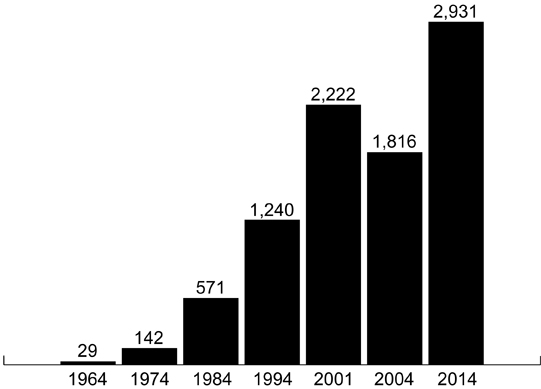
Gülen has used his time in America to become the largest operator—or perhaps merely inspirer—of charter schools in the United States. Sharon Higgins, who founded the organization Parents Across America, believes that there are now 135 Gülen-inspired charter schools in the country, enrolling some 45,000 students. That would make the Gülen network larger than KIPP—the runner-up, with 109 schools. The schools, in 25 states, have anodyne names: Horizon Science Academy, Pioneer Charter School of Science, Beehive Science and Technology Academy. Thousands of Turkish nationals, almost all of them male, have come to America on H-1B visas specifically to teach in them. The schools focus on math and science, and their students often do well enough on standardized tests. The administrators say that they have no official ties to Gülen, and Gülen denies any connection to the schools. But federal forms required of nonprofits show that virtually all the schools have opened or operate with the aid of Gülen-inspired groups—local nonprofits that promote Turkish culture. The Ohio-based Horizon Science Academy of Springfield, for example, cosigned a five-year building lease with Chicago’s Niagara Foundation, which explicitly promotes Gülen’s philosophy of “tolerance, dialogue and peace.”
The FBI and the Departments of Labor and Education have been investigating the hiring practices of some of these schools, as the New York Times and the Philadelphia Inquirer have reported—particularly the replacement of certified American teachers with uncertified Turkish ones who get higher salaries than the Americans did, using visas that are supposed to be reserved for highly skilled workers who fill needs unmet by the American workforce. The schools claim, according to an article written by Higgins in the Washington Post, that they are unable to find qualified teachers in America—which seems implausible, given that we’re in the depths of the worst economic downturn in postwar memory, and given that some of these new arrivals have come to teach English, which often they speak poorly, or English as a second language, which often they need themselves. They have also been hired as gym teachers, accountants, janitors, caterers, painters, construction workers, human-resources managers, public-relations specialists, and—of all things—lawyers.
Two of the schools, located in Texas, have been accused of sending school funds—which are supplied by the government, of course, since these are charter schools—to other Gülen-inspired organizations. Last year, the New York Times reported that the charters were funneling some $50 million in public funds to a network of Turkish construction companies, among them the Gülen-related Atlas Texas Construction and Trading. The schools had hired Atlas to do construction, the paper said, though other bidders claimed in lawsuits that they had submitted more economical bids. Meanwhile, Atlas may have played a part in protecting Gülen charter schools; Folwell Dunbar, an official at the Louisiana Department of Education, has accused Atlas’s vice president, Inci Akpinar, of offering him a $25,000 bribe to keep mum about troubling conditions at the Abramson Science and Technology Charter School in New Orleans. Dunbar sent a memo to department colleagues, the Times-Picayune reported, noting that “Akpinar flattered him with ‘a number of compliments’ before getting to the point: ‘I have twenty-five thousand dollars to fix this problem: twenty thousand for you and five for me.’ ” Abramson is operated by the Pelican Foundation, which is linked to the Gülen-inspired Cosmos Foundation in Texas—which runs the two Texas schools.
Utah’s Beehive Science and Technology Academy, another Gülen-inspired charter, was $337,000 in debt, according to a financial probe by the Utah Schools Charter Board. The Deseret News tried to figure out where all this taxpayer money had gone. “In a time of teacher layoffs, Beehive has recruited a high percentage of teachers from overseas, mainly Turkey,” the newspaper reported. “Many of these teachers had little or no teaching experience before they came to the United States. Some of them are still not certified to teach in Utah. The school spent more than $53,000 on immigration fees for foreigners in five years. During the same time, administrators spent less than $100,000 on textbooks, according to state records.” Reports have also claimed that the school board was almost entirely Turkish.
A reporter for the leftist magazine In These Times noted in 2010 that the Chicago Math and Science Academy obscured its relationship to Gülen. And the school board was strikingly similar to Beehive’s: “When I went to the school’s board meeting on July 8, I was taken aback to see a board of directors comprised entirely of men. They all appeared of Turkish, Bosnian or Croatian descent. Although I have nothing against Turkish, Bosnian or Croatian men, it does seem that a school board serving students who are 58 percent Hispanic/Latino, 25 percent African American, 12 percent Asian and 5 percent white might be well served by some women board members and board members from ethnic backgrounds the school predominantly serves.”
Federal authorities are also investigating several of the movement’s schools for forcing employees to send part of their paychecks to Turkey, the Inquirer reports. Also worrying is that some of these schools, after being granted the right to issue large, tax-free public bonds, are now defaulting on them. The New York Times recently reported that Gülen-inspired schools in Georgia had defaulted on $19 million in public bonds, having granted hundreds of thousands of dollars in contracts to businesses associated with Gülen followers.
There is no evidence that Islamic proselytizing takes place at the American Gülen schools and much evidence that students and parents like them. Most seem to be decent educational establishments, by American standards; graduates perform reasonably well, and some perform outstandingly.
So what are the schools for? Among other things, they seem to be moneymakers for the cemaat. They’re loaded with private, state, and federal funding, and they have proved amazingly effective at soliciting private donations. The schools are also H-1B visa factories and perhaps the main avenue for building the Gülen community in the United States. In 2011, 292 of the 1,500 employees at the Gülen-inspired Harmony School of Innovation, a Texas charter school, were on H-1B visas, the school’s superintendent told the New York Times. The feds have investigated Concept Schools, which operate 16 Horizon Science Academies across Ohio, on the suspicion that they illegally used taxpayer money to pay immigration and legal fees for people they never even employed, an Ohio ABC affiliate discovered. The feds’ suspicion was confirmed by state auditors. Concept Schools repaid the fees for their Cleveland and Toledo schools shortly before the ABC story broke, but it’s unclear whether they have repaid—or can repay—the fees for their other schools.
Perhaps to deflect scrutiny from the schools, people “inspired” by Gülen are constantly inviting high-ranking leaders to dinners to speak and lavishing them with awards. And remember those trips to Turkey that the Turkish-Irish Educational and Cultural Society organizes? The same thing happens in the United States. Dozens of Texans, ranging from state lawmakers to congressional staff members to university professors, have taken trips to Turkey financed by Gülen’s foundations. The Raindrop Foundation, for instance, paid for State Senator Leticia Van de Putte’s travel to Istanbul, according to a recent campaign report. Last January, she cosponsored a state senate resolution commending Gülen for “his ongoing and inspirational contributions to promoting global peace and understanding.”
Steve Terrell, a reporter at the Santa Fe New Mexican, did a bit of digging and found that a remarkable number of local lawmakers had recently taken trips to Turkey courtesy of a private group, the Turquoise Council of Americans and Eurasians, that is tied to Gülen. In Idaho last year, a full tenth of state legislators went on the Turkey-trot tour, thanks to the Pacifica Institute, also inspired by Gülen. The Hawaii State Ethics Commission sent a memo to lawmakers reminding them to check with the commission before accepting the all-expenses-paid trip to Turkey to which they’d been invited by Pacifica. “The State Ethics Commission,” said the memo, “does not have sufficient understanding of Pacifica Institute, the purpose of the trip, or the state ‘benefit’ associated with the trip.”
It is no very cynical asperity to wonder if all these trips are connected to the staggering amount of public money going to Gülen-inspired charter schools. Indeed, America is the only country in the world where the Gülen movement has been able to establish schools funded to a great extent by the host country’s taxpayers.
But does the cemaat want something more than money? Its supporters call it a “faith-based civil-society movement.” Mehmet Kalyoncu, an advisor to the ambassador of the Organisation of Islamic Cooperation to the United Nations, has observed correctly that the cemaat’s Turkish enemies call it a creature of the CIA or the Mossad, a secret servant of the pope, or a Trojan horse trying to Christianize Muslims or weaken them. To some Western critics, such as Michael Rubin, the cemaat is “a shadowy Islamist cult,” anti-Semitic, anti-Western, and trying to Islamize Americans. Gülen is a second Khomeini, Rubin has warned, who is trying to establish a new caliphate.
But none of that is quite right. According to researcher Aydin Ozipek, who attended a Gülen school, “the primary objective of the Gülen Movement is to increase its share of power.” That, it seems to me, is the most accurate description of all. The cemaat poses problems not because its members are pious Muslims (that’s probably the most admirable thing about them) but because it’s a power-hungry business that often behaves repulsively—like a mafia, in other words. Gülen does not run “madrassas” in America, as some have suggested; he runs charter schools. He does not “practice taqiya”; he just dissimulates, like any ordinary politician.
I doubt that Gülen is a significant threat to American interests in the Middle East. For pragmatic reasons, the movement is friendly to any country where it can establish a business presence; if we stay friendly to business, it will stay friendly to us, however we define our interests. The cemaat need not be a problem within America, either, so long as we deal with it with our eyes open and make sure that its members are obeying the law. But eyes open is the key. Here’s another excerpt from that infamous sermon that surfaced in 1999: “The philosophy of our service is that we open a house somewhere and, with the patience of a spider, we lay our web to wait for people to get caught in the web; and we teach those who do. We don’t lay the web to eat or consume them but to show them the way to their resurrection, to blow life into their dead bodies and souls, to give them a life.” Those are words that suggest that Gülen’s activities in the United States deserve careful scrutiny—scrutiny because his business is organized and he thinks ahead.
Overall, America’s assimilative power has a track record far more impressive than Gülen’s. Our posture toward the Gülen movement in America has been, if inadvertently and late in coming, the right one: indict those who need indicting for specific, established crimes—visa fraud and, I suspect, racketeering—and wait for the next generation to become Americans. Treat people inspired by Gülen to the rule of law—to the same laws that everyone else in America follows. If they don’t already see it, they will recognize in time that those laws are excellent and connected to the economic opportunities that they enjoy. In fact, they may even do America some good, insofar as they’re locked into battle with the teachers’ unions: if Gülen’s followers can break them, more power to them. Maybe one day, we’ll even get a great American cemaat novel out of their experience.
Our posture toward the movement as a foreign policy actor, however, to the extent that I can understand it, has been foolish. It is wrong to imagine that Gülen can be some kind of asset to us internationally or to accept or promote him as one. He has not been elected in Turkey—our NATO ally—or anywhere else. We have an interest in seeing Turkey become a full-fledged liberal democracy. That means supporting Gülen’s stated ideals—not him.
Claire Berlinski, a City Journal contributing editor, is an American journalist who lives in Istanbul. She is the author of There Is No Alternative: Why Margaret Thatcher Matters.







 The boy saw the men breaking into the back of his home, “at which time he feared for his safety” and grabbed his mother’s gun, the document states. He began firing at them, and the Sheriff’s office reported that they returned fire.


 Cathy
Cathy chulai1968
 Truth Prevailing
 Publius Huldah
 Freedom Rider
 radioroger2015
 revaustinmiles