7BY VICKI DAVIS FOR THE TECHNOCRATICTYRANNY.COM
In the previous article, The Animal Farm, it was established that the Department of Energy initiated the Human Genome Project (HGP). Between 1986 and 1991, they were engaged in the planning stages including the development of computer systems and telecommunications infrastructure in addition to organizing the project teams for the combined biological and IT technical aspects of the project.
In 1990, the first steps were taken to redesign the U.S. Health Care System beginning with the nationalization of medical records. The High Performance Computing Act of 1991 legislation was passed to open access to the nation’s telecommunications system for business and the public. The real reason was to provide shared access to research databases and resources for the Human Genome Project. All other uses for it not related to the HGP have evolved as applications of opportunity.
In the year 2000, President Clinton and Prime Minister Tony Blair announced the completion of the sequencing of human DNA. They spent fifteen years, billions of dollars with thousands of scientists working on dissecting the human genome. Do you suppose they then intended to simply file that information in the vaults and call it done?
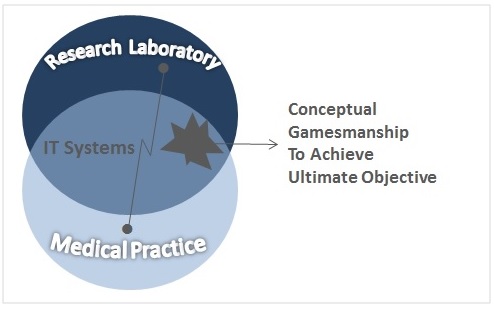
Basic research which is what the Human Genome Project was, is always followed by APPLIED BASIC RESEARCH. With the redesign of our health care system being implemented concurrently, they have set up the entire American population to be RESEARCH SUBJECTS in a system of integrated research and regular medical practice. I can’t be any clearer than that except to say that we have been set up to be the victims of crimes against humanity. And it isn’t the medical profession that did it. It’s the Public Health system which is a different animal. So from this point forward, when I write about health care reform, understand that the Human Genome Project is omnipresent in the background – driving the “reform”.
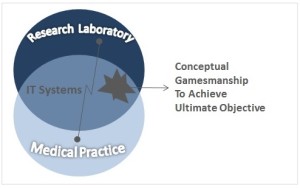
Funding Health Sciences Research
During World War II, basic research in the sciences made significant contributions to the success of the war effort. In 1945 Vannevar Bush, then head of the Office of Scientific Research and Development (OSRD), formulated a set of proposals intended to sustain the nation’s war-time research momentum and direct it toward civilian goals. His report to the President, entitled “Science, the Endless Frontier,” proposed a coordinated federal policy of investing in research and training new researchers.5 The policy was to be driven by scientific merit rather than by political or geographical interest. Subsequently, Bush and his colleagues in OSRD established a system by which grants and contracts were awarded to institutions based on scientific merit, and this approach became the cornerstone of the peer-reviewed, academically based system now in place for federally sponsored, competitive extramural research grant programs.
In the two decades following the war, several pieces of legislation changed the organization and conduct of scientific research in the United States. The federal government became the largest single sponsor of health research and about three fifths of these funds now come from programs in the Department of Health and Human Services (DHHS), namely those in the Public Health Service (PHS).2 Within the PHS the National Institutes of Health (NIH) and the Alcohol, Drug Abuse, and Mental Health Administration (ADAMHA) allocate the largest percentage of federal funds for health-related research (). Research funds in DHHS also are allocated to the Centers for Disease Control; the Health Care Financing Administration; the Health Resources and Services Administration; the Food and Drug Administration; the Office of Health Research, Statistics, and Technology; and the Office of the Assistant Secretary for Health in the PHS. Other federal departments and agencies have budgets for health sciences research as well—most notably, the Departments of Defense, Energy, and Veterans Affairs, and the National Science Foundation (NSF)
The Public Health system includes those freaks in the laboratories who design and develop new organisms for biological warfare. It’s the same system that is facilitating the importation of “refugees” which at this point are primarily Muslims from Muslim countries all of which puts an entirely different slant on legislation passed through the Congress in the early 1990s. Why? Because the Human Genome Project included scientists from all over the world.
Immigration Act of 1990
The Immigration Act of 1990 established the system of employment-based visas, investor visas and called for the Secretary of Labor to determine labor “shortages” in up to ten defined occupations and to develop a system of labor certification to allow employers to request visas even when there is a surplus of labor in a profession but claims there is a shortage for a particular job.
The significance of this legislation as a major step towards global systems, global “governance” and an invitation to terrorism cannot be under estimated. The devil is in the details of how the Secretary of Labor would go about fulfilling this legislative mandate. The place to begin with that is the initiation of the Secretary’s Commission on Achieving Necessary Skills (SCANS) in 1990 by the U.S. Labor Secretary which was billed for public consumption as education reform.
Continue reading here
Like this:
Like Loading...






 Cathy
Cathy chulai1968
 Truth Prevailing
 Publius Huldah
 radioroger2015
 revaustinmiles
 Steve
Steve