Tag Archives: False Teachers

Americans Unwittingly Elect Terrorists to Congress?


debt and politicians

I truly believe that Politicians and any other people responsible for placing America’s finances into such chaos as to make us vulnerable to strong arming by foreign Governments, and specifically Red China are Terrorists. America is deep in debt to China and that has empowered the Chinese to push us and test us. Internet attacks, conflicts in Trade, The current debacle in the S. China Seas - And there is nothing we can do to fight back as WE OWE them TRILLIONS of $.

The folks who put us in that position, all who are still living, need to be rounded up and convicted for their financial crimes against America - I suppose that’s just one mans opinion. But it’s my story, and I am sticking to it!

Out of the Mouths of Babes - America’s Holocaust!

I saw this video and admittedly cried through most of it. Knowing that a young and God loving child could be so right on made me bristle with shame for the nightmare we are leaving our future generations.

I cannot seem to convince anyone that it’s time to physically protest by establishing a massive revolt against government overreach, over taxation, taxation without representation etc. Why do we support financially a Government that is hell bent on our destruction?

This is so sad that a mere child is focused on the degeneracy of our once great nation, rather than living an innocent and happy childhood in a free and God fearing land.

Please - May God soon violently erase the Monsters responsible for this attack on our children and the raping of their minds and souls.

In my view - if you are doing nothing to alter the path of America in a downward smile, look closely in the mirror as it might be that you are the monster. Apathy is not a Godly value and the children of America are crying out for us to rescue them from the horror that we have allowed to take charge.

If this video doesn’t stir you to rise up - Then I pity your lost soul!


The Homosexual Fantasy?

On Homosexuality?
I say this… (It’s an Agenda 21 Population Control tool also)

The problem is that there is no such creature as a Homosexual or a “Gay” person. There is no science to support that hypothesis. There is no immutable distinction for homosexuality and no genetic or medically supported excuse for same sex behavior - It is a learned deviance that is masquerading as some imaginary 3rd gender. all of it designed to draw people into a false identity crisis. If there were such a thing, we would need to see genetic coding for all forms of deviant behaviors. Sexual or criminal behavior can’t be so easily defined as an uncontrollable compulsion. Unlike a proven immutable characteristic such as race or sex, homosexuality only exists in the theater of the mind. Perversion is simply perversion… Acceptable or unacceptable? I suppose moral relativists and moralists each have differing views. I am opposed on Moral grounds, ethical grounds and financial grounds as the medical costs and insurance costs for the collateral effect of sexual deviance is passed on the the larger whole. The data is compelling regarding life expectancy, life time medical costs, depression and suicide rates - on and on it goes. If there is a Gay gene… then so must there be a Bisexual, pedophile and a Prostitute gene as well… Maybe all criminals are genetically inclined also? Best to establish a Red Line of demarcation and hold the higher moral ground.


The False Teachers: Harry Emerson Fosdick

reposted from Tim Challies of challies.com

Harry Emerson Fosdick
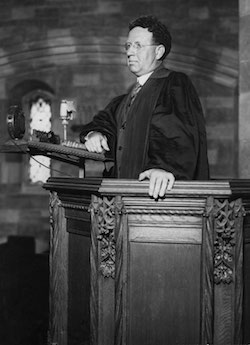
Fosdick

,Harry Emerson Fosdick was born in Buffalo, New York, on May 24, 1878. As a young boy he claimed to have been born again, but even as a teenager rebelled against the “born again” movement known as fundamentalism. He developed an early interest in theology and chose to pursue ministerial training at Colgate Divinity School where he was influenced by William Newton Clarke, an early advocate of the social gospel. Upon graduating from Colgate he continued to Union Theological Seminary. In 1904 he accepted his first pastorate at First Baptist Church in Montclair, New Jersey, and four years later also accepted a faculty position at Union where he was to teach until 1946. Fosdick quickly proved himself a skilled communicator and compelling speaker and it would not be long before he would be known as America’s foremost minister.

In 1919 Fosdick was asked to become associate pastor at First Presbyterian Church in New York City, though he was allowed to retain his baptistic convictions. He quickly gained a reputation as a leading Christian voice, and hundreds and then thousands descended on First Presbyterian to hear his sermons. It was here, on May 21, 1922, that he preached the sermon that came to define him: “Shall the Fundamentalists Win?” In this sermon he proclaimed that there was a great battle in the church between the fundamentalists and the modernists or liberals, and that he was going to stand firmly on the side of the liberals. Because of his desire to modernize the Christian faith, he soundly rejected belief in a series of traditional Christian doctrines including Christ’s virgin birth, the inerrancy of Scripture, and the literal return of Jesus Christ. He decried the fundamentalists as being intolerant for demanding adherence to doctrines that science, reason, and a modern world could no longer sustain. John D. Rockefeller enjoyed this sermon so much that he had 130,000 copies printed and mailed to every Protestant pastor in the nation.

“Shall the Fundamentalists Win?” set off what would soon be called the Fundamentalist-Modernist controversy. We need to be clear that we cannot import into this battle a twenty-first century understanding of fundamentalism. When Fosdick battled the fundamentalists of his day, he battled nothing less than traditional or conservative Christianity. Fundamentalists were those who insisted upon the key tenets of historic, orthodox Christianity—what they defined as the fundamental doctrines of the faith.

Fosdick was by no means the only liberal theologian of his day, but he was the one to gain the widest acclaim and the broadest platform. While many others were pressing theological liberalism in the seminaries and the halls of academia, Fosdick was on the radio waves and in the bookstores, taking his message to the common people. His voice extended through his radio program, The National Vespers Hour, which was broadcast in the Northern and Eastern United States, and through many bestselling books which eventually sold in the millions. On two separate occasions he was on the cover of TIME magazine.

By the mid 1920’s Fosdick had established himself as the leading voice of twentieth-century liberalism. His stand for liberalism put him at odds with many of the conservative voices in Presbyterianism, and this led him to leave First Presbyterian Church in 1925 and to go instead to Park Avenue Baptist Church.

I am a heretic if conventional orthodoxy is the standard. I should be ashamed to live in this generation and not be a heretic.

In the early 1920’s, J. Gresham Machen emerged as one of the foremost opponents of liberalism. His 1923 book Christianity and Liberalism was a strong, biblical response that drew comparisons between the Bible and liberal theology and showed that the two were in clear opposition. He rightly asked, “The question is not whether Mr. Fosdick is winning men, but whether the thing to which he is winning them is Christianity.” Others joined the battle as well. Fosdick remained firm in the face of such attacks, declaring “They call me a heretic. Well, ‘I am a heretic if conventional orthodoxy is the standard. I should be ashamed to live in this generation and not be a heretic.”

In 1929, Princeton, once a bastion of Reformed thinking and teaching, was reorganized under modernist influences. Almost immediately four Princeton professors who held to the Reformed faith (Robert Dick Wilson, J. Gresham Machen, Oswald T. Allis, and Cornelius Van Til) withdrew from Princeton and established Westminster Theological Seminary in Philadelphia in order to continue upholding the faith Princeton once defended. If the Fundamentalist-Modernist controversy was begun with Fosdick’s sermon in 1922, if was effectively cut off among conservative churches in 1929 with the departure of those professors.

Rockefeller money soon built a grand new building on the Hudson, and in 1930 Fosdick was installed as pastor at Riverside Church. He would pastor this congregation for sixteen years, and, after his retirement, attend it for a further twenty-eight. This church became his laboratory for liberalism and it was here that he practiced his liberal values to the full. (To be fair, and to give credit where credit is due, he was a strong advocate of racial reconciliation and was perhaps the most notable preacher to invite African-American preachers into his pulpit.)

Fosdick died in New York City on October 5, 1969, two weeks after being hospitalized for a heart attack. He was ninety-one years old.

False Teaching

Harry Emerson Fosdick was not an original thinker as much as a popularizer who took the theory of liberalism from the seminaries and brought it to a common level. He wanted to modernize the faith by making it attractive to, and compatible with, modern times and modern sensibilities. At heart, liberalism questioned the nature of the Bible and denied its inerrancy, infallibility, and authority. Liberalism denied that the Bible is the Word of God and insisted instead that it contains the Word of God. Once Scripture’s authority had been denied, a host of doctrines would necessarily fall in its wake.

Fosdick questioned the essential beliefs necessary to be a Christian and began to challenge long-held, orthodox Christian beliefs such as the virgin birth, and the return of Christ Jesus. Robert Moats Miller, one of Fosdick’s biographers, wrote, “Fosdick could not believe that Jesus was virgin born. He did not ridicule those who did, but he was adamant that such belief was not essential to acceptance of Christian faith. … Fosdick doubted whether Jesus ever thought of himself as the Messiah; perhaps he did, but more probably Jesus’ disciples may have read this into his thinking.” He also denied the wrath of God, suggesting that wrath was simply a metaphor for the natural consequences of doing wrong. With wrath removed, it was inevitable that the substitutionary atonement of Jesus Christ would also be denied. Before long Fosdick’s Christianity looked nothing like historic Christianity.

In a later sermon, “The Church Must Go Beyond Modernism,” Fosdick spoke of his methodology in modernizing the Christian faith, saying, “We have already largely won the battle we started out to win; we have adjusted the Christian faith to the best intelligence of our day and have won the strongest minds and the best abilities of the churches to our side. Fundamentalism is still with us but mostly in the backwaters. The future of the churches, if we will have it so, is in the hands of modernism.” Of course, he was too optimistic, and too blinded by his own success. Liberalism posed a major challenge to the faith, but like all other challengers, it would rise and then wane.

Followers and Modern Adherents

If Fosdick was the man who popularized and legitimized liberalism, we can rightly say that subsequent liberals, and especially those who operated at the popular level, followed in his footsteps. Men like Norman Vincent Peale, Robert Schuller and John Shelby Spong are among them. Martin Luther King Jr., a theological liberal in his own right, regarded Fosdick as the greatest preacher of the century and in 1958, inscribed a copy of Stride Toward Freedom for Fosdick with these words: “If I were called upon to select the foremost prophets of our generation, I would choose you to head the list.”

But Fosdick’s influence extends farther than that. Though the Fundamentalist-Modernist controversy began within Presbyterianism, it soon spread to other Protestant denominations, eventually leading to today’s division between “mainline” and “evangelical” Protestant churches. About half of today’s mainline Protestants consider themselves liberal, and they, too, whether they know it or not, are influenced by Fosdick.

What the Bible Says

Fosdick’s teaching was false in many areas, but the heart of it all was his denial of the inerrancy, infallibility and authority of the Bible. He elevated human reason above the plain words of Scripture; he made reason the final arbiter of truth. All the other doctrines he denied depended upon first undermining the Bible. Christians have long insisted, as the fundamentalists did in his day, that God’s Word, not science or human reason, is the measure of true knowledge. Proverbs 3:5-7 says, “Trust in the LORD with all your heart, and do not lean on your own understanding. In all your ways acknowledge him, and he will make straight your paths. Be not wise in your own eyes; fear the LORD, and turn away from evil.” Our understanding of ourselves and the world around us is flawed; we must depend upon God to reveal true knowledge.

If we remove the offense of the gospel, we have removed the power of the gospel.

In his second letter to Timothy, Paul warned, “For the time is coming when people will not endure sound teaching, but having itching ears they will accumulate for themselves teachers to suit their own passions, and will turn away from listening to the truth and wander off into myths” (2 Timothy 4:3-4). Fosdick wanted to make the Christian faith soothing to those itching ears and, in so doing, distorted it beyond all recognition. The reality is that the Christian faith is, and always will be, offensive. If we remove the offense of the gospel, we have removed the power of the gospel.

Where is the one who is wise? Where is the scribe? Where is the debater of this age? Has not God made foolish the wisdom of the world? For since, in the wisdom of God, the world did not know God through wisdom, it pleased God through the folly of what we preach to save those who believe. For Jews demand signs and Greeks seek wisdom, but we preach Christ crucified, a stumbling block to Jews and folly to Gentiles, but to those who are called, both Jews and Greeks, Christ the power of God and the wisdom of God. For the foolishness of God is wiser than men, and the weakness of God is stronger than men. (1 Corinthians 1:20-25)

The False Teachers: Charles Taze Russell

Reposted from Tim challies on challies.com

FalseTeachers-02

charles taze russell

Charles Taze Russell was born on February 16, 2026 in Allegheny, Pennsylvania, the second of five children born to Joseph and Ann Russell. Charles grew up in a devout home and his parents were respected members of the Presbyterian church. When he was young, his family moved to Pittsburgh, where his father came to own a number of haberdashery stores. In his early teens Charles became a partner in this business and soon owned several of the locations.

As a boy Charles had a great deal of religious enthusiasm, and while still only a teenager left his Presbyterian congregation to attend a Congregational church. As a form of evangelism he would often go to public locations and use chalk to write out Bible verses related to sin and damnation. But then, at the age of sixteen, he engaged in a debate with a friend that led him to question the reliability of the Bible and the validity of the Christian faith. He embarked on a period of religious searching and dabbled in many Eastern religions before determining that they, too, were empty and unsatisfying.

When Charles was eighteen he encountered Adventist preaching and began to regularly attend a Bible study. It was not long before he determined that he could not reconcile an eternal hell with a merciful God. Over the next two years he came to question many other historic Christian doctrines and became convicted that the historic creeds betrayed true Christianity. At the same time he adopted Adventist teachings: that the end times had begun in 1799, that Christ had returned invisibly in 1874 and been crowned King of Heaven four years later, that all Christians who had already died would be resurrected before the end of 1878, and that 1914 would mark the end of a harvest period and usher in Armageddon. He sold his five clothing stores, an act that generated a substantial amount of money (today’s equivalent of several million dollars), and committed his life to writing, publishing and funding the propagation of the message of Christ’s imminent return. He did this at first through a partnership with Nelson H. Barbour and his Adventist periodical Herald of the Morning.

When 1878 came and went without any of the predicted events, he was forced to re-examine his beliefs and to distance himself from some of his Adventist peers, including Barbour. He founded his own periodical which he titled Zion’s Watch Tower and Herald of Christ’s Presence. At this time he also married Maria Frances Ackley in an apparently celibate union that would last until 1897 before ending in an acrimonious divorce.

In 1881 Russell founded the Watch Tower Bible and Tract Society which grew to a substantial publishing venture, and there were soon some 16 million of his books and booklets in print. His ministry and his opportunities to preach grew exponentially and Pastor Russell, as he became known, soon had followers all over the Northern and Eastern states. He preached and wrote constantly, his sermons were printed in several thousand newspapers around the globe, and he became one of the most famous preachers in the world. He eventually moved the headquarters of the Watch Tower Society to Brooklyn, New York, where they remain today.

Russell died of cystitis on October 31, 1916, near Pampa, TX, as he attempted to return to his home in Brooklyn. By the time of his death, his writings had become among the most widely-distributed works in the world. Some estimate that when he died, only the Bible and the Chinese almanac were in greater circulation than his myriad books and pamphlets.

False Teaching

Unlike so many other false teachers before and after him, Russell did not rely upon visions or other extra-biblical revelation. Rather, he simply interpreted, and misinterpreted, the Bible. While claiming to be a Christian and, in fact, a Christian who was restoring the faith of the New Testament, he denied many key Christian doctrines including eternal punishment, the Trinity, the deity of Christ, and the existence of the Holy Spirit.

Russell, as with most Adventists, denied the existence of hell as a place where the wicked face God’s wrath. He also held that the soul simply ceases to exist after death.

As with Arius centuries before, he held that Jesus was a created being, and was actually Michael the Archangel in human form. While he taught that this Jesus died on behalf of humanity, he also taught that Jesus rose only spiritually rather than physically. While he denied the divinity of Jesus, he denied the existence of the Holy Spirit, teaching that the Spirit is not a person, but simply a name given to express a specific manifestation of God’s power. In denying the divinity of Jesus and the existence of the Holy Spirit, he necessarily denied the Trinity.

Followers and Modern Adherents

Those who followed Russell during his lifetime referred to themselves as Bible Students. In the years following his death, Joseph Franklin Rutherford succeeded him as president of the Watch Tower Society. Despite many people withdrawing from the Bible Study movement, and despite those who remained splitting many times over, Rutherford’s followers maintained control of the Watch Tower Society and officially renamed themselves Jehovah’s witnesses in July 1931.

The Watch Tower Society remains the official religious body of the Jehovah’s Witnesses. Though both their beliefs and their structure have evolved in the past century, they continue to state that there is one God in one person, that there is no Trinity, that Jesus was God’s first created being, that the Holy Spirit is an impersonal force, and that there is no hell. While Russell is honored among Jehovah’s Witnesses, they do not refer to him as their founder. Rather, they hold that Jesus is their founder while Russell was simply a man used by God to restore beliefs that had been lost.

Today there are some 8 million Jehovah’s Witnesses in the world.

What the Bible Says

The Bible teaches clearly, forcefully, and repeatedly that hell is real and that in hell God’s wrath is poured upon out upon the wicked in conscious, eternal punishment.

That the Holy Spirit is a person rather than an impersonal force or manifestation of the power of God is attested in many passages that refer to the Trinitarian formula of Father, Son and Holy Spirit. A host of verses speak to his personhood, including Romans 8:11, “If the Spirit of him who raised Jesus from the dead dwells in you, he who raised Christ Jesus from the dead will also give life to your mortal bodies through his Spirit who dwells in you.” The Spirit is a person who can teach, be grieved, be resisted, speak, help, and so much more besides.


The False Teachers: Pelagius

REPOSTED BY TIM CHALLIES FROM CHALLIES.COM

FalseTeachers-02

Pelagius

Historians believe that Pelagius was born in Britain around the year 354. We know little about his early years, but do know that at some point he became a monk and in that capacity journeyed to Rome. While in Rome, Pelagius began to write theological works, though, except for a few fragments, these have been lost and are known to us only through quotes in the writings of those who refuted him. He began to promote a rigorous asceticism, apparently out of concern for the moral laxity he saw among many Roman Christians. This austere lifestyle made him attractive to many Romans and he soon gained a considerable following. One person in particular, a lawyer named Celestius, became a devoted follower and promoter of Pelagius’ teachings.

It is said that at one time Pelagius heard a quote from Augustine’s Confessions—“Command what you will, and give what you command”—and blamed such teaching for the lack of morality in the church. He believed that Augustine was teaching doctrine contrary to a biblical understanding of both grace and free will and believed such teaching turned man into a mere automaton. Contrary to Augustine, “Pelagius taught that human beings have a natural capacity to reject evil and seek God, that Christ’s admonition, “Be ye perfect,” presupposes this capacity, and that grace is the natural ability given by God to seek and to serve God” (Theopedia).

When the Visigoths attacked Rome in 410, Pelagius and Celestius fled together to Carthage in North Africa. Pelagius’ influence began to spread there as well, causing concern for Augustine who responded by publishing several works that refuted and counteracted Pelagius. After a couple of years in Africa, Pelagius moved to Palestine and Augustine promptly warned Jerome that Pelagius was spreading a seditious heresy. Jerome, too, labored to prevent this false teaching from spreading in the East.

In 416 the church in North Africa held two separate synods to examine Pelagius’ teachings and both of them condemned him. Their results were sent to pope Innocent I for his decision, and upon receiving them he excommunicated Pelagius and Celestius. However, less than two months later, pope Innocent died and he was succeeded by Zosimus. Pelagius and Celestius asked Zosimus to reconsider the previous pope’s decision. When he did so there was alarm in North Africa and yet another synod was immediately convened to beg him not to repeal the prior pope’s sentence until it could be proven that the two men had clearly denounced their false beliefs.

Zosimus listened to these pleas and commanded that another council be convened to consider and decide the matter. In May of 418, the Council of Carthage once again branded Pelagianism as a heresy and Pelagius was expelled from Jerusalem. He settled in Egypt, and was never heard from again. In 431, at the Council of Ephesus, Pelagius and Celestius were officially declared heretics by the entire church.

False Teaching

Pelagius believed that man had not been entirely corrupted by Adam’s fall and that he could, by his own free will, do works that pleased God, and thus be saved. This led Pelagius to deny the doctrines of original sin and predestination, and to deny the need for special grace to be saved. Essentially, he believed that man is basically good and moral and that even pagans can enter heaven through their virtuous moral actions.

Monergism summarizes in this way: “Jesus Christ, was a good example. Salvation is a matter chiefly of following Christ instead of Adam, rather than being transferred from the condemnation and corruption of Adam’s race and placed ‘in Christ,’ clothed in his righteousness and made alive by his gracious gift. What men and women need is moral direction, not a new birth; therefore, Pelagius saw salvation in purely naturalistic terms—the progress of human nature from sinful behavior to holy behavior, by following the example of Christ.”

Followers and Modern Adherents

Though church councils condemned Pelagianism as heresy, this did not immediately crush the teaching. In the early church, Pelagianism was carried on by Julian, Bishop of Eclanum, one of eighteen Italian bishops who refused to sign the papal decree and who were consequently exiled. To advocate Pelagianism was to battle Augustine, and Julian did this until Augustine’s death, though he was never able to gain as great a following as Pelagius. Over the next century or so, Pelagianism broke out a handful of times, but the councils condemned it so consistently and strongly that by the sixth century it had been nearly eradicated.

Pure Pelagianism has not resurfaced in a major way during the past fifteen hundred years, but a modified form took root in the sixteenth century through the teachings of Jacob Arminius whose beliefs are often described as semi-Pelagian. Semi-Pelagianism teaches that while humanity is tainted by sin, we are not so tainted that we cannot cooperate with God’s free offer of grace. Calvinists tend to describe Arminianism as a form of semi-Pelagianism, though Arminians tend to consider the label unfair.

Perhaps the closest modern-day successor to Pelagius was Charles Finney. Like Pelagius, he denied original sin saying “Moral depravity is sin itself, and not the cause of sin.” He believed the whole notion of a sinful nature is “anti-scriptural and nonsensical dogma” and taught that we are all born in a state of moral neutrality, able to choose between good and evil—to choose between being good or being sinful.

What the Bible says

Today, Orthodox Christians confidently proclaim because of the disobedience of our first parents, Adam and Eve, all of creation is fallen; we are all born in sin and guilt, corrupt in our nature and unable to keep God’s law (New City Catechism, Answer 14).

<!-


->


The False Teachers: Pope Francis

REPOSTED FROM TIM CHALLIES AT CHALLIES.COM

FalseTeachers-02

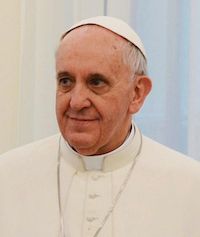
Pope Francis

Pope Francis

Jorge Mario Bergoglio was born in Buenos Aires, Argentina, on December 17, 1936, the first child of Italian immigrants Mario and Regina. He graduated from college as a chemical technician and pursued that career for a short time before entering seminary at the Diocesan Seminary of Villa Devoto. On March 11, 2026 he entered the novitiate of the Society of Jesus and over the next decade studied and taught in a variety of disciplines. He was ordained a priest in December 1969 and made his final profession with the Jesuits in April 1973.

In July of that year he was appointed Provincial of the Jesuits in Argentina and held that position for several years before resuming his work as a priest and a teacher and, later, as spiritual director and confessor to the Jesuits in Cordoba. As a priest he was loved and admired for his kindness and willingness to engage in patient dialog with his students and parishoners. However, he also walked into a political quagmire as the military sought to assert its dominance over the nation. He was accused of complicity with the military forces in the kidnapping of two Jesuit priests, though he has strenuously denied the charges which have not been satisfactorily proven.

In 1992 Pope John Paul II appointed Bergoglio titular Bishop of Auca and Auxiliary of Buenos Aires. He became the Archbishop of Buenos Aires in 1998, and was quickly elevated to Cardinal in 2001. After Pope John Paul II died in 2005, some reports indicated that Bergoglio received the second-most votes in that papal election, though Joseph Ratzinger (who became Pope Benedict XVI) was eventually elected to succeed John Paul. As a cardinal Bergoglio gained a reputation for his low-key lifestyle, his commitment to social justice, and his doctrinal conservatism, proving himself an ardent opponent of same-sex marriage and public efforts to introduce free contraception. One of his friends says, “He’s as uncompromising as Pope John Paul II, in terms of the principles of the Church - everything it has defended regarding euthanasia, the death penalty, abortion, the right to life, human rights, celibacy of priests.”

When Pope Benedict XVI voluntarily resigned as pope on February 28, 2013, the papal conclave elected the 76-year-old Bergoglio as his successor. He chose Francis as his papal name in honor of Saint Francis of Assisi and his lifestyle of simplicity. He is the first Jesuit to be pope, the first pope from the Americas and the southern hemisphere, and the first non-European pope in almost 1,300 years.

As pope, Francis immediately made his mark by maintaining his relatively austere lifestyle and eschewing much of the formality that has marked previous pontiffs. He chose not to live in the Apostolic Palace but instead to reside in the Domus Sanctae Marthae guesthouse. He wears simpler vestments than his predecessors and insists that he wants the Roman Catholic Church to be a church for the poor. He immediately began planning reforms to the Vatican’s expansive bureaucracy, emphasizing efficiency and transparency.

Francis has given hope to both conservatives and to progressives within the Roman Catholic Church, sometimes by apparently contradicting himself. While insisting that the Church’s view on sexuality will not be the subject of negotiation, he has also said “If a person is gay and seeks God and has good will, who am I to judge?” He has also hinted toward a kind of universalism saying, “You ask me if the God of the Christians forgives those who don’t believe and who don’t seek the faith. I start by saying—and this is the fundamental thing—that God’s mercy has no limits if you go to him with a sincere and contrite heart. The issue for those who do not believe in God is to obey their conscience. Sin, even for those who have no faith, exists when people disobey their conscience.”

In the year since he became pope, he has received wide acclaim both from within the Roman Catholic Church and from far outside it. In 2013 he was named Person of the Year by TIME magazine as well as LGBT-interest magazine The Advocate. Esquire noted his simpler dress and named him The Best Dressed Man of 2013. Fortune magazine ranked him at the top of their list of the top-50 leaders while Rolling Stone featured him on the cover of a recent issue.

False Teaching

For all we can commend about Pope Francis, the fact remains that he, as a son of the Roman Catholic Church and as the leader of the Roman Catholic Church, remains committed to a false gospel that insists upon good works as a necessary condition for justification. He is the head of a false church that is opposed to the true gospel of salvation by grace alone through faith alone in Christ alone. The core doctrinal issues that divided Protestantism from Catholicism at the time of the Reformation remain today. The core doctrinal issues that compelled Rome to issue her anathemas against Protestantism are unchanged. Rome remains fully committed to a gospel that cannot and will not save a single soul, and officially damns those who believe anything else: “If any one saith, that by faith alone the impious is justified; in such wise as to mean, that nothing else is required to cooperate in order to the obtaining [of] the grace of Justification, and that it is not in any way necessary, that he be prepared and disposed by the movement of his own will; let him be anathema.”

Roman Catholic doctrine states that justification is infused into a person through the sacrament of baptism. The Catholic Catechism explains: “Justification has been merited for us by the Passion of Christ. It is granted us through Baptism. It conforms us to the righteousness of God, who justifies us.” However, this justification is not a judicial declaration by God, but the beginning of a lifelong process of conformity. It is insufficient to save a person without the addition of good works. This infusion of righteousness enables a person to do the good works that complete justification. However, this justification can be diminished or even lost through sinful acts and in such cases it must be renewed and regained through confession, through the Eucharist, and through good works. Those who have been granted justification eventually merit heaven on the basis of the good works enabled by that justification. Again, according to the Catechism, “We can therefore hope in the glory of heaven promised by God to those who love him and do his will. In every circumstance, each one of us should hope, with the grace of God, to persevere ‘to the end’ and to obtain the joy of heaven, as God’s eternal reward for the good works accomplished with the grace of Christ.” This is another gospel, a false gospel, that adds human merit as a necessary addition to the work of Christ.

Francis also holds that Mary is mediatrix and co-redemptrix with her son Jesus, that Scripture is insufficient and must have the tradition of the church added to it, that even Christians who die may have to endure Purgatory, that Christ is sacrificed anew each time the Mass is celebrated, and so on. But no false teaching is more scandalous than his denial of justification by grace through faith alone.

Good deeds done to promote a false gospel are the most despicable deeds of all.

Those within the Roman Catholic Church who have experienced salvation (and I sincerely believe there are those who have) have done so despite the church’s official teaching, not through it. Even while Francis washes the feet of prisoners and kisses the faces of the deformed, he does so out of and toward this false gospel that leads not toward Christ, but directly away from him. Good deeds done to promote a false gospel are the most despicable deeds of all.

Followers and Modern Adherents

Pope Francis is the head of a church that spans the globe and may well be the most powerful organization in the world. Fully 17% of the global population—over 1.2 billion people—profess to be Roman Catholic and that number continues to increase. With his efforts to reach out to adherents of other faiths, Francis has a voice that extends to perhaps a third or a half of the world’s population. This makes him by far one of the most influential people in the world.

What the Bible Says

From the time of the Reformation Protestants have insisted that Roman Catholicism is a false church that promotes a false gospel. The Bible insists that we are justified by grace alone through faith alone in Christ alone and apart from all human effort. “For by grace you have been saved through faith. And this is not your own doing; it is the gift of God, not a result of works, so that no one may boast” (Ephesians 2:8-9). While we can agree with Rome on the necessity of good works, we must insist along with the New Testament writers that such works are the fruit of justification, and have no part in the root of our justification.

But when the goodness and loving kindness of God our Savior appeared, he saved us, not because of works done by us in righteousness, but according to his own mercy, by the washing of regeneration and renewal of the Holy Spirit, whom he poured out on us richly through Jesus Christ our Savior, so that being justified by his grace we might become heirs according to the hope of eternal life. The saying is trustworthy, and I want you to insist on these things, so that those who have believed in God may be careful to devote themselves to good works. These things are excellent and profitable for people. (Titus 3:4-8)

The False Teachers: Arius

False Teachers by Tim Challies from Challies.com

This morning I am setting out on a new series of articles that will scan the history of the church—from its earliest days all the way to the present time—and pause to examine some of Christianity’s most notorious false teachers. Along the way we will visit such figures as Pelgius, Servetus, Fosdick, and even a few you might find on television today. We will begin this morning with one of the very first, and certainly one of the most dangerous, false teachers: Arius.

Arius

Arius is said to have been Libyan by descent, and he was probably born around 256 AD. We know little about his early days except that he studied under Lucian, the presbyter of Antioch. He later returned to Alexandria and became a presbyter there where he quickly became both prestigious and popular.

Arius’ difficulties began in 318 when he clashed with Alexander, the bishop of Alexandria. Alexander believed in the co-eternality of the Word of God while Arius taught that the Word was created by God. Because Alexander understood this as a dangerous threat to the church, he publicly condemned Arius’ teaching and removed him from all church posts. However, Arius refused to accept Alexander’s judgments and appealed to the people of the city and to other eastern bishops. In this way the dispute spread and became a severe threat to church unity. Seeing this danger, and wishing to avert division within his empire, Constantine called the first Christian council: the Council of Nicaea.

At the council, Arius’ teaching was formally condemned. The debate lasted from May 20 until June 19, at which point the council produced an initial form of the Nicaean Creed which explicitly affirmed the “begotten” position and condemned Arianism. All but two of the attendees voted in its favor and those two, along with Arius, were excommunicated and banished to Illyria. All of Arius’ writings were ordered confiscated and burned.

After being in exile for a decade, Arius sought to be restored to the church, and appealed directly to the emperor. Constantine became convinced of Arius’ return to orthodoxy and soon ordered Alexander, the patriarch of Constantinople, to reinstate him. Alexander was wary of letting Arius back into the church and, according to a letter by Athanasius, prayed that God would somehow prevent it. Very soon after this prayer, before Arius could be reinstated, he died.

In ancient times, Arius’ teachings presented the foremost threat to orthodox Christianity.

Nathan Busenitz summarizes Arius’ impact in this way: “In ancient times, Arius’ teachings presented the foremost threat to orthodox Christianity—which is why historians like Alexander Mackay have labeled him ‘the greatest heretic of antiquity’.” His false teaching, coming as it did in the church’s infancy, truly did represent a grave threat.

His False teaching

Arius’ unorthodox position can be summed up very simply as “there was when he was not.” In other words, he held that God the Son is not co-eternal with God the Father. Instead, he believed that the Son was God’s first creation and that through him everything else was made (Colossians 1:15). This made the Son the only direct creation of the Father and thus unique among all creation as the first and greatest created being, but it also made the Father’s divinity greater than the Son’s. He argued that the opposing view, which would soon be officially established as the orthodox position, was incompatible with monotheism.

David F. Wright condenses Arius’ teaching on the nature of God to one short paragraph: “[T]he Father alone was really God; the Son was essentially different from his Father. He did not possess by nature or right any of the divine qualities of immortality, sovereignty, perfect wisdom, goodness and purity. He did not exist before he was begotten by the Father. The Father produced him as a creature. Yet as the creator of the rest of creation, the Son existed ‘apart from time before all things’. Nevertheless, he did not share in the being of God the Father and did not know him perfectly.”

Followers and Modern Adherents

While Arianism is a rare false teaching today, we do find it most prominently among the Jehovah’s Witnesses. Ryan Turner says, “Despite the best efforts of the Orthodox Church to stamp out Arianism, there are branches of the belief that continue to this present day. One of them is the Jehovah’s Witnesses. … Like the ancient Arians, these modern day Witnesses believe that Jesus is a created being who is therefore not eternal and not God.” To avoid the clear teaching of Scripture they modify their own translation of the Bible and argue that Jesus was Michael the Archangel.

What the Bible says

Today, Orthodox Christians confidently proclaim There are three persons in the one true and living God: the Father, the Son, and the Holy Spirit. They are the same in substance, equal in power and glory (New City Catechism, Answer 3).

T

The False Teachers: Brian McLaren

By Tim Challies of Challies.com

FalseTeachers-02

few weeks ago I set out on a series of articles through which I am scanning the history of the church—from its earliest days all the way to the present time—to examine some of Christianity’s most notable false teachers and to examine the false doctrine each of them represents. Along the way we have visited such figures as Joseph Smith (Mormonism), Ellen G. White (Adventism), Norman Vincent Peale (Positive Thinking) and Benny Hinn (Faith Healing). Today we turn to a man who helped lead the Emerging Church and who was once named by TIME as one of the 25 Most Influential Evangelicals in America.

Brian McLaren

McLaren

Brian McLaren (born in 1956) studied humanities at the University of Maryland and graduated with graduate and post-graduate degrees in English. Beginning in 1978, he taught college-level English, before founding Cedar Ridge Community Church in 1986. He served this church as its founding pastor until 2006, when he handed off the role so he could focus on writing and public speaking.

In 1986 Zondervan released McLaren’s first book, The Church on the Other Side: Doing Ministry in the Postmodern Matrix. This book established him as a leader and thinker in the church at a time when Christians were attempting to grapple with the dawning reality of postmodernism.

However, it was his 2001 work of fiction, a New Kind of Christian, that introduced him to the wider church and earned him Christianity Today’s Award of Merit in 2002. It was the first volume in a trilogy and quickly became one of the foremost texts for what was soon known as the Emerging Church movement. A New Kind of Christian tells the story of Dan Poole, a pastor who finds himself ready to give up on Christian ministry. Increasingly disillusioned, he has become less and less certain about what he believes. When he takes his daughter to a concert he meets Neil Oliver, a high school science teacher, and together they discuss a long list of core Christian doctrines. According to the publisher, “This stirring fable captures a new spirit of Christianity—where personal, daily interaction with God is more important than institutional church structures, where faith is more about a way of life than a system of belief, where being authentically good is more important than being doctrinally ‘right,’ and where one’s direction is more important than one’s present location.” McLaren became known as a Christian leader who was talking about life and faith in ways that seemed new and fresh.

McLaren followed this book with many more—nearly twenty to date. The most noteworthy of his books have probably been A Generous Orthodoxy which he calls “a personal confession and a manifesto of the emerging church conversation” and A New Kind of Christianity in which he offers responses to “ten questions that are central to the emergence of a postmodern, post-colonial Christian faith.”

In 2005 McLaren was named by TIME as one of the 25 Most Influential Evangelicals in America under the heading “Paradigm Shifter.” They pointed to his ambiguous statements about gay marriage and said that he represented a kinder and gentler form of Christianity. The following year he joined with Tony Campolo, Jim Wallis, Richard Rohr, and others to found Red Letter Christians, an organization dedicated to seeing Christianity liberated from both right-wing and left-wing politics in America. Where Christianity has been dominated for too long by discussions of abortion and homosexuality, this movement prefers to look to the words Jesus spoke and focus on issues related to social justice.

McLaren has traveled the world as a teacher, preacher, lecturer, and conference speaker, and has been granted honorary degrees from both Carey Theological Seminary and Virginia Theological Seminary. In September 2012 he made headlines for participating in a gay marriage ceremony for his son Trevor and his partner Owen Ryan. The wedding was officiated by a Universal Life minister, with McLaren leading a commitment ceremony built around Christian themes.

False Teaching

As McLaren’s theology has matured and taken shape over time and through his books, he has stepped forward as a leader in a new and revived form of theological liberalism. This displays itself most clearly in his view of Scripture.

In A New Kind of Christianity he insists that Christians have long been reading the Bible through the distorted lens of a Greco-Roman narrative. This narrative produced many false dualisms, an air of superiority, and a false distinction between those who were “in” and those who were “out.” These three marks of false narrative have so impacted our faith that we can hardly see past them. His book attempts to do that, and to reconstruct the Christian faith as it is meant to be.

Leading the way is his view of the Bible. He does not see the Bible as God’s inspired, inerrant, infallible, authoritative Word. He displays this, for example, in his interpretation of the account of Noah by saying, “a god who mandates an intentional supernatural disaster leading to unparalleled genocide is hardly worthy of belief, much less worship.”

He goes on to say, “I’m recommending we read the Bible as an inspired library. This inspired library preserves, presents, and inspires an ongoing vigorous conversation with and about God, a living and vital civil argument into which we are all invited and through which God is revealed.” After all, “revelation doesn’t simply happen in statements. It happens in conversations and arguments that take place within and among communities of people who share the same essential questions across generations. Revelation accumulates in the relationships, interactions, and interplay between statements.” He understands the Bible to be a slowly-evolving human understanding of God. “Scripture faithfully reveals the evolution of our ancestors’ best attempts to communicate their successive best understandings of God. As human capacity grows to conceive of a higher and wiser view of God, each new vision is faithfully preserved in Scripture like fossils in layers of sediment.”

This is nothing less than theological liberalism in twenty-first century, post-modern clothing (which is why Gresham Machen’s Christianity and Liberalism offers a rebuttal, though it was written 90 years earlier). Like Fosdick and other liberals before him, McLaren has assumed authority over the Bible instead of placing himself under its authority. His understanding of Scripture frees him to see Christian doctrine as evolving, and himself as an instrument of this evolution. In this way he revisits and reinterprets whatever does not accord with modern sensibilities. He has denied the literal nature of hell along with its eternality; he has denied the substitutionary atonement of Jesus Christ; he has denied Jesus Christ as the only way to the Father; he has affirmed homosexuality as good and pleasing to God. And he continues to think and to write, meaning that his theological development is not yet complete.

Followers and Adherents

McLaren has long been a leader in the Emerging Church, and almost all of those who “emerged” with him have known his influence. So too have many of his fellow progressive Christians. He continues to have a broad speaking platform and to write popular books.

What the Bible Says

Where McLaren casts doubt on the idea that we can ever really confidently know and understand the Bible, Christians have long held that God spoke and inspired his prophets and apostles to write because he actually intended to be heard as saying something, and that the message would be carried on and be understood forever after (see 2 Peter 1:16-21). This is why Jude calls it “the faith that was once for all delivered to the saints” (Jude 3), and why Paul is so emphatic with Timothy that he “guard the good deposit entrusted to [him]” (2 Timothy 1:14). Kevin DeYoung says it well in Taking God at His Word: “The Bible is an utterly reliable book, an unerring book, a holy book, a divine book. … There is no more authoritative declaration than what we find in the word of God, no firmer ground to stand on, no ‘more final’ argument that can be spoken after Scripture has spoken.”


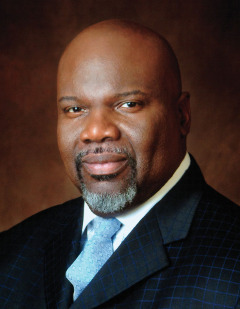
The False Teachers: T.D. Jakes

FalseTeachers-02

By Tim Challies from Challies.com

A few weeks ago I set out on a series of articles through which I am scanning the history of the church—from its earliest days all the way to the present time—to examine some of Christianity’s most notable false teachers and to examine the false doctrine each of them represents. Along the way we have visited such figures as Joseph Smith (Mormonism), Ellen G. White (Adventism), Norman Vincent Peale (Positive Thinking) and Benny Hinn (Faith Healing). Today we turn to a man who pastors a mega-church, whose sermons are a staple on TBN, and who has written a long list of bestselling books.

T.D. Jakes

TD Jakes

Thomas Dexter Jakes was born on June 9, 2026 in South Charleston, West Virginia and grew up in nearby Vandalia. As a teenager he was charged with supporting and caring for his invalid father and dedicated himself to that task. While still a young man he felt that the Lord was calling him to ministry so he enrolled at West Virginia State University and began to preach occasionally. Before long, though, he dropped out of school to work at Union Carbide, while continuing to preach on a part-time basis. In 1981, at the age of 24, he married Serita Ann Jamison.

Around this time Jakes, still eager to be a minister, founded Greater Emmanuel Temple of Faith, a small, independent, Pentecostal congregation in Montgomery, West Virginia. The church quickly began to grow from the ten founding members meeting in a small storefront to two hundred and then three hundred attendees. Jakes soon came into contact with Bishop Sherman Watkins who had founded the Higher Ground Always Abounding Assembly, which at that time was an association of more than two hundred Pentecostal churches. Watkins ordained Jakes and suggested that he plant a church in the Charleston Area.

In 1990 Jakes moved to Charleston and began to focus on the spiritual concerns of the women in his church, many of whom were in abusive or other otherwise difficult relationships. He called his class “Woman, Thou Art Loosed” and this later became the title of his bestselling book and the name of an annual conference. By 1993 he had moved his congregation to Cross Lanes, West Virginia, where the mixed-race congregation exploded to more than 1,100 people. The next year he established T.D. Jakes Ministries to produce televised sermons and conferences. In 1996 he moved to Dallas, Texas, where he founded the Potter’s House. Today some 17,000 people call it their home church. His television broadcast “The Potter’s House” appears on the Trinity Broadcasting Network and other networks around the world, making him one of the world’s most prominent and recognizable preachers. His annual MegaFest event draws up to 100,000 people each year. He has written more than 30 books, many of which have appeared on the lists of bestselling Christian books.

A gifted speaker and excellent communicator, Jakes has been widely praised for his teaching and his leadership. In September of 2001 he appeared on the cover of TIME magazine with the title, “Is this man the next Billy Graham?” He has also appeared on Oprah Winfrey’s network and has reciprocated the invitation, inviting her to appear at his MegaFest event. He has acted in or produced several movies including the currentHeaven Is For Real. Among his acquaintances he counts both President George W. Bush and President Barack Obama.

False Teaching: Modalism

T.D. Jakes is associated with several troublesome teachings including the prosperity gospel and positive thinking. For our purposes, though, we will look at his teaching on the Trinity. Jakes has long been associated with Oneness Pentecostalism which holds to an unorthodox position on the Trinity. This position is known as Modalism or, historically, as Sabellianism.

Modalism holds that Father, Son and Holy Spirit do not refer to distinct persons in the godhead, but to different modes of existence of a single person. It teaches that in ages past God manifested himself as the Father, during the incarnation of Christ he manifested himself as the Son, and subsequently he manifested himself as the Holy Spirit. As one of its key tenets it states that God cannot exist in more than one mode at a time. So while this teaching does hold to a form of trinitarian theology and while it does proclaim the divinity of Jesus Christ, it denies that there are three distinct persons who together make up the godhead. Hence the belief statement at the Potter’s House says, “There is one God, Creator of all things, infinitely perfect, and eternally existing in three manifestations: Father, Son and Holy Spirit.” (Formerly the statement was even clearer: “We believe in one God who is eternal in His existence, Triune in His manifestation, being both Father, Son and Holy Ghost AND that He is Sovereign and Absolute in His authority.”) The important word here is manifestations. Where historic Christianity affirms persons, modalism demands use of manifestations or modes.

Followers & Adherents

Jakes has wide influence in many circles. Some 17,000 people attend his church on a weekly basis and millions more encounter his teaching through his broadcasts, conferences, movies and books. He is one of a few Christian figures who has a voice that extends into the broader culture through association with Oprah Winfrey, American presidents, and other leaders.

What the Bible Says

These minor distinctions in trinitarian theology, a word here, a letter there, actually represent colossal differences and even eternal differences—the difference between heaven and hell. Modalism has long been labeled as a heresy meaning that if you believe it in place of the biblical understanding of the Trinity, you are not and cannot be a true Christian.

We can define the Trinity, as the church has historically understood it, through a series of seven simple statements: There is one God; The Father is God; The Son is God; The Holy Spirit is God; The Father is not the Son; The Son is not the Spirit; The Spirit is not the Father.

In all that is, in all that exists, there is only one God. No truth was more precious to the Israelites of old. In Isaiah’s prophecy God records:

There is no other god besides me
a righteous God and a Savior;
there is none besides me.
Turn to me and be saved,
all the ends of the earth!
For I am God, and there is no other. (Isaiah 45:21-22)

It could hardly be clearer. The New Testament is equally explicit. Paul writes, “There is one God, and there is one mediator between God and men, the man Christ Jesus” (1 Timothy 2:5). James agrees: “You believe that God is one; you do well. Even the demons believe—and shudder” (James 2:19).

There is one God. The other six statements affirm both unity and diversity within the godhead. There is one God who exists as Father, Son and Holy Spirit, yet each of these is distinct from the others. There is unity here, but there is also diversity. There is a real sense in which God is one, and there is a real sense in which God is three.

To summarize those seven statements, we might say, “God eternally exists as three persons, Father, Son, and Holy Spirit, and each person is fully God, and there is one God.” In all that we believe, in all that we affirm or deny, we must hold these seven statements together. If we take away one, the entire structure collapses. In fact, every time the Trinity comes under attack, or every time the Trinity is denied, it is because one of these statements has been taken away or tampered with.

Though he has recently denied being a Modalist, T.D. Jakes continues to use manifestations in place of persons and continues to affirm the faith of those who remain ardent Oneness Pentecostals. This is no minor quibble in theology because it contradicts and confuses the orthodox and accepted view of the Trinity. Until he clearly affirms the orthodox definition of the Trinity and denies the Modalist definition of the Trinity, we must regard him warily as a false teacher.


The False Teachers: Ellen G. White

FalseTeachers-02

By Tim Challies, Reposted from Challies.com

A few weeks ago I set out on a new series of articles through which I intend to scan the history of the church—from its earliest days all the way to the present time—to examine some of Christianity’s most notorious false teachers. Along the way we will visit such figures as Arius, Pelagius, Fosdick, and even a few you might find on television today. We continue this morning with a false teacher—the first woman in the series—who has around 18 million followers in the world today.

Ellen G. White

Ellen Gould Harmon was born on a small farm near the village of Gorham, Maine, on November 26, 1827. Only a few years after her birth, her parents Robert and Eunice Harmon gave up farming to move to the nearby town of Portland where her father became a hat maker. When Ellen was nine she was permanently disfigured when a fellow student maliciously hit her in the head with a rock. The rock put her into a coma that lasted several weeks and forced her to miss a long period of schooling.

When Ellen was twelve, she and her family attended a Methodist camp meeting in Buxton, Maine, and there she had a formative religious experience in which she professed faith in Jesus Christ. In 1840 and 1842 she and her family attended Adventist meetings and become devotees of William Miller. Miller had dedicated himself to the study of biblical prophecy and was convinced that Christ would return on October 22, 1844. When Christ did not return, a non-event that would become known as The Great Disappointment, most people abandoned Adventism. But in the resulting confusion, Ellen claimed to have received visions that were soon accepted as God-given revelation. The small Adventist movement that remained was split by many rifts and much infighting, but Ellen was believed to have a gift that could reunite and guide the movement. Her dreams and visions continued and she quickly became a leader among them.

In 1846, Ellen married a young Adventist preacher named James White and together they traveled extensively, spreading the Adventist faith to New England and beyond. Twelve months later she gave birth to a son, one of four children she would bear, but soon left the child with friends so she could carry on traveling, preaching, and writing.

In 1855 the Whites moved to Battle Creek, Michigan, and that became Adventism’s hub. Five years later, representatives from each Adventist congregation gathered there and determined that henceforth they would be known as Seventh-day Adventists. Soon after they formally organized as a denomination.

All through this time Ellen continued to receive prophetic dreams and visions—some 2,000 during her lifetime—and through them she guided and formed the church. Over her lifetime Testimonies for the Church expanded from a mere sixteen pages to nine full volumes. In 1863 she received a vision about human health and her followers soon adopted her health regulations as part of their practice, rejecting meat, coffee and medication in favor of natural remedies.

The Adventist movement continued to expand and the Whites were in high demand across America. They traveled constantly, addressing large congregations and meetings. After James died in 1881, Ellen traveled all the more, spending two years in England and almost nine years in Australia. She spent most of the final fifteen years of her life in Elmshaven, California, and was largely consumed with writing and organizing the growing denomination. She died on July 16, 1915, at the age of 87. During her lifetime she had preached countless times and had written some 5,000 articles and 40 books. By the time she died, Seventh-day Adventism had a worldwide membership of nearly 140,000.

False Teaching

In many respects Ellen G. White appeared to hold to the historic Christian faith. She believed in Christ’s imminent bodily return, she held to the inspiration and authority of the Bible, and she taught that we are saved by Christ’s righteousness rather than our own. But amid that truth were some dangerous false teachings. I will focus on only two.

The most obvious false teaching was the one that gave the Seventh-day Adventists their name: the view that the proper day of worship is Saturday rather than Sunday. Shortly after James and Ellen married, they studied a tract written by Joseph Bates titled Seventh-day Sabbath and became convinced that they were to keep Saturday as the sabbath. Six months later, Ellen had a vision in which she saw the law of God with a halo of light surrounding the fourth commandment. She and her husband took this as proof that their newfound understanding was correct. They elevated this to a doctrine of first importance.

Of far more concern was White’s aberrant view of death, hell and eternal punishment. Adventists adopted several key tenets including one stating that God does not eternally torment sinners, but that the dead enter into soul-sleep until the second coming and last judgment. At that time the punishment for sinners will be that they cease to exist.

White held that a God of eternal wrath must be incompatible with a God of love and kindness. In The Great Controversy she wrote, “How repugnant to every emotion of love and mercy, and even to our sense of justice, is the doctrine that the wicked dead are tormented with fire and brimstone in an eternally burning hell; that for the sins of a brief, earthly life they are to suffer torture as long as God shall live.”

She also believed that God would simply annihilate the souls of those who did not follow him. “But I saw that God would not shut them up in hell to endure endless misery, neither will He take them to heaven; for to bring them into the company of the pure and holy would make them exceedingly miserable. But He will destroy them utterly and cause them to be as if they had not been; then His justice will be satisfied. He formed man out of the dust of the earth, and the disobedient and unholy will be consumed by fire and return to dust again.”

Followers and Modern Adherents

Adventism nearly came to an end in the days following The Great Disappointment. But Ellen G. White gave the movement new life and a new voice. Through constant preaching, teaching and evangelism, she and her followers had grown the movement to nearly 140,000 by the time of her death in 1915. Today there are an estimated 18 million Seventh-day Adventists in the world. Their individual beliefs vary so widely that some Christians consider them a cult while others do not.

Seventh-day Adventism has continued to evolve. They continue to regard Ellen G. White as having a unique, God-given gift of prophecy. They continue to hold to the sabbath and to their emphasis on healthy eating and living. They continue to deny both the immortality of the soul and the reality of hell as eternal, conscious torment. Successors to Ellen G. White have also developed the distinctive and troubling doctrine of Investigative Judgment. (CARM helpfully lists their affirmations, denials and most troubling teachings and provides this counsel: “There are too many problems within Seventh-day Adventism to recommend it as a safe church. Though there are Seventh-day Adventist groups that are within orthodoxy, there are too many of them that are not.”)

What the Bible Says

The Bible counters much of what Ellen G. White taught and what her church teaches today.

In contrast to White’s teaching on the eternal destiny of those who do not know the Lord, the Bible teaches that hell is real, that it is eternal, and that in hell God’s wrath is poured out in conscious, everlasting punishment. John the Baptist spoke of Jesus, saying, “His winnowing fork is in his hand, and he will clear his threshing floor and gather his wheat into the barn, but the chaff he will burn with unquenchable fire” (Matthew 3:12). Jesus himself spoke of hell saying, “if your hand causes you to sin, cut it off. It is better for you to enter life crippled than with two hands to go to hell, to the unquenchable fire” and “these will go away into eternal punishment, but the righteous into eternal life” (Mark 9:43, Matthew 25:46). And in the epistles, Paul warned “They will suffer the punishment of eternal destruction, away from the presence of the Lord and from the glory of his might” (2 Thessalonians 1:9). Only by deliberately twisting the Scriptures can anyone deny the terrifying reality that hell is real and that those who do not know the Lord will be there to face his wrath forever.