TPA, TPP, TTIP — and now TiSA! Much of the debate over current trade policy and the proposed global governance structures that would emanate from it have revolved around this ever-increasing list of alphabet-soup measures. Although not nearly as well-known as the Trans-Pacific Partnership (TPP) and the Transatlantic Trade and Investment Partnership (TTIP), the Trade in Services Agreement (TiSA) should not be overlooked. Equally potent and potentially even more debilitating to our nation’s independence and domestic economy than the TPP and TTIP, the proposed TiSA currently being negotiated would be imposed on the entire world, not just a particular region.
The TiSA would give the UN’s World Trade Organization (WTO) unprecedented control of the service sector, including jobs in banking, finance, courier and postal services, delivery and freight services, energy distribution, health care, insurance, maritime, professional services, legal services, licensing, real estate, telecommunications, transportation, tourism, and much more. According to the Office of the U.S. Trade Representative, such services “account for three-quarters of U.S. GDP and 4 out of 5 jobs in the United States.”
As for its stated purpose, the Office of U.S. Trade Representative’s website declares: “TiSA will support the development of strong, transparent, and effective regulatory policies, which are so important to enabling international commerce.”
Despite TiSA’s purported intentions aimed at “transparent” regulatory policies and then-presidential candidate Senator Barack Obama’s promise to run the “most transparent” administration in history, the official TiSA text remains anything but transparent, as it is shrouded in secrecy and will likely remain so for some time, even after its possible passage.
Following WikiLeaks’ release of its first batch of classified TiSA documents in 2014, William F. Jasper reported in “TISA, Yet Another Secret ‘Trade’ Threat” (posted at TheNewAmerican.com on October 3, 2025):
The very first page of the draft text states: “Declassify on: Five years from entry into force of the TISA agreement or, if no agreement enters into force, five years from the close of the negotiations.”
Moreover, it states: “This document must be protected from unauthorized disclosure…. It must be stored in a locked or secured building, room, or container.” Members of the U.S. Congress are not allowed to see the secret text; it will be presented to them, finally, in a high-pressure, no-debate vote, following a massive lobbying effort by the usual crony corporatists from the financial, insurance, and information technology sectors.
In addition to its level of concealment, the TiSA, as alluded to earlier, would further abrogate U.S. sovereignty to the WTO. In fact, the WTO’s headquarters in Geneva, Switzerland, was the site of TiSA’s secretive four-day negotiations on September 22-25, 2014. In a more recent article, “TISA Leaks: Another Secret Obama Trade Deal, More Reasons to Stop ‘Fast Track,'” posted at TheNewAmerican.com on June 5, 2015, William F. Jasper writes, “U.S. courts, or tribunals created under TiSA, or World Trade Organization (WTO) tribunals are virtually certain to use TiSA — as they have already done using NAFTA — to rule that U.S. laws are illegal and must be changed.”
TiSA courts, like those created under the North American Free Trade Agreement (NAFTA), would override and supersede our domestic U.S. state and federal courts, thereby overturning legislation in favor of foreign corporations from any one of the TiSA participatory nations.
Currently, TiSA is being negotiated by the United States, the European Union, and 23 other nations, including Turkey, Mexico, Canada, Australia, Pakistan, Taiwan, and Israel (parties to TiSA agreement shown in blue on map on left). Should Congress approve the TiSA, there is no known guarantee that additional countries such as APEC member-states Communist China and Russia would not also become part of TiSA, without the consent of Congress.
Proponents claim that TiSA would help American businesses sell services overseas. Yet it is much more probable that TiSA would help foreign businesses sell services in the United States. But promising the opposite of what we should expect based on the agreements themselves is nothing new for the globalists. Recall that they deceptively “sold” (and continue to “sell”) “free trade” agreements on the basis that they would create American jobs and prosperity, but that the agreements delivered the opposite.
TiSA assistance to facilitate foreign businesses to sell their services in the U.S. would be twofold: (1) TiSA’s proposed international regulatory scheme would enable foreign services businesses to compete more effectively against American services businesses; and (2) TiSA’s new regulatory landscape would more easily facilitate the outsourcing of American services jobs overseas.
Americans in services jobs that require occupational licensing would likely be hard hit by TiSA’s changes in the regulatory environment. Services professions requiring occupational licensing include physicians, lawyers, teachers, plumbers, electricians, real estate agents, insurance agents, audiologists, architects, barbers, certified public accountants, professional engineers, and more. According to a recent article, dated January 27, 2026, published by the Brookings Institution, occupational licensing “has spread to cover around 30 percent of the U.S. workforce, up from just 5 percent in the 1950s.”
With so much at stake, ranging from jobs to most importantly our national sovereignty and independence, it is imperative that you call and email your U.S. senators and representative and encourage them to vote against any legislation that advances TiSA.
Please take the following actions:
Phone your representative (202-225-3121) and senators (202-224-3121) and tell them to vote NO on any legislation that advances passage of the TiSA.
Many think our government is for sale. However, by taking a look at the facts below provided by Open Secrets, it is easy to understand where they are coming from.
Looking back at Friday the 12th, the House voted on Trade Promotion Authority (TPA), the controversial bill that gives power to the executive branch to negotiate treaties. TPA limits Congress’ ability to better a trade deal by subjecting members of Congress to 90 days of reviewing the trade agreement, prohibiting any amendments on the implementing legislation, and giving them an up or down vote.
TPA passed with a mere 219-211 vote with only 218 needed to pass. The real shocker comes from the amount of money each Representative received for a yes vote. In total, $197,869,145 was given to Representatives for a yes vote where as $23,065,231 was given in opposition.
John Boehner (R-OH) received $5.3 million for a “yea” vote and was the highest paid legislator.
Kevin McCarthy (R-CA) received $2.4 million for his “yea” vote.
Paul Ryan (R-WI) received $2.4 million for a “yea” vote and came in at the third highest paid legislator.
Pat Tiberi (R-OH) follows Paul Ryan, coming in the fourth spot having received $1.6 million for his “yea” vote.
The fifth highest paid legislator is somewhat of a “hero” in comparison to others. Representative Steny Hoyer (D-MD) received $1.6 million for a yes vote and only $282,710 for a no vote. Despite his high contribution from those in favor of TPA, he still voted a solid nay.
We also have other hero stories.
Joe Crowley (D-NY) received 1.3 million for a “yea” vote and only $72,550 for a “nay” vote and he still voted against TPA.
Patrick Murphy (D-FL) received 1.1 million for a “yea” vote and only $213,360 for a “nay” vote and still voted against it.
Richard Neal D(MA) received $1.1 million for a “yea” vote and a mere $47,625 for a “nay” vote and still voted against it.
Democrats are not the only heroes in this voting session. GOP members spoke very loud and clear.
Mick Mulvaney (R-SC) received $541,746 for a “yea” vote and no money at all for a “nay” vote and he still voted “nay!”
Andy Harris (R-MD) received $254,803 for a “yea” vote and no money at all for a “nay” vote and he still voted “nay”.
Thomas Massie (R-KY) received $250,328 for a “yea” vote and no money at all for a “nay” vote and he still voted “nay.”
Dana Rohrabacher (R-CA) received $180,832 for a “yea” vote and no money at all for a “nay vote” and she still voted “nay.”
Where did this kind of money come from? Those in favor of TPA were security brokers and investment companies who donated a whopping $11.3 million dollars for a “yea” vote. Big banking companies donated $10.1 million dollars. In other words, Wall Street hashed out millions and millions of dollars to push for the passage of TPA.
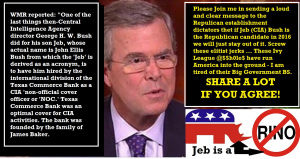
I am refusing to vote in the next election if the elitist Republican jerks force Jeb Bush on us as the Republican General Election candidate. I for one have had it up to here (Imagine) with these dictators and Ivy League losers. What a waste of education funds, training up Globalist phony FREE TRADERS who sell America out at every turn. They need to hear us loud and clear - NO BUSH - NO WAY. Dumb @$$ Democrats will vote for Hillary Clinton no matter what. If she went Lizzy Borden on new born babies - These Morally Bankrupt Democrats would still vote for her… Republicans better wake up! On Jeb Bush - Call, write letters to the editor of your newspapers… Tell them you will NOT SHOW UP if Bush is their man in 2016
My Comments: If you liked NAFTA and GATT, and the rest of the smaller trade agreements, you’ll really love TPP, TPI, and TPA. There will be no jobs left for Americans. We will be finally a third world country as these filthy rotten traitorous politicians have wanted. Remember all the great auto jobs that millions of families had to raise their children and buy homes? That was the once burgeoning middle class. It is no more. The politicians in charge are destroying our once wonderful country.
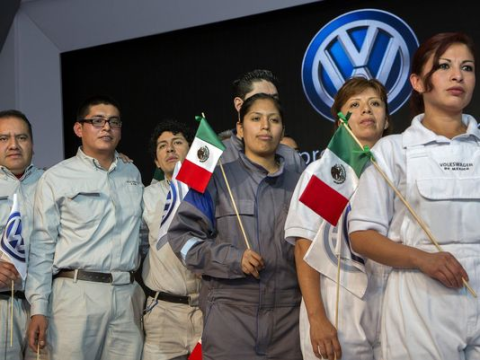
The U.S., Canada and Mexico are united under NAFTA but fierce rivals in the boardroom to win automotive investment and jobs.
(Photo: Susana Gonzalez/Bloomberg)
Mexico is the auto industry darling, Canada is struggling to retain a manufacturing footprint, and the U.S. is a house divided with most of the new automotive investment and jobs headed south of the Mason-Dixon line.
The three countries are a united trading block under the North American Free Trade Agreement, or NAFTA, but they’re fierce rivals in the boardrooms where auto executives decide where to invest in the latest equipment and additional jobs.
The relative fortunes of the three countries have changed over the years, but right now, and for the foreseeable future, the farther south you are located, the better.
Of the vehicles built in North America last year, Mexico produced about one in five, or double the rate from 2004. WardsAuto, which tracks production data, expects the rate to increase to one in four by 2020.
“The U.S. South and Mexico are winning the battle,” said Dennis DesRosiers, president of DesRosiers Automotive Consultants near Toronto. “Over half the capacity and 80%-90% of investment dollars are going to the U.S. South or Mexico.”
Conversely, he sees the Canadian auto industry dwindling to five automakers with a single assembly plant each over the next decade or two — or about half its current manufacturing footprint.
The UAW is keeping a close eye on the flood of automotive investment migrating to Mexico, UAW President Dennis Williams said at the union’s bargaining convention in March. The issue is especially critical for the UAW this year as it seeks product commitments from the Detroit Three in negotiating a new contract with the Detroit Three for about 140,000 U.S. autoworkers.
Where is your car made?
The auto industry is global, but increasingly companies want to build in the region where they sell. Which means chances are your new vehicle will continue to be built in North America but may not be made in the U.S.A.
Back in 2004, 11.6 million vehicles were built in the U.S., or 74% of the 15.8 million industry total. Canada built 2.7 million, or 17% of the capacity; and Mexico contributed only 1.4 million vehicles, or 9%, according to WardsAuto.
In 2014, signs were evident the tide had turned.
Mexico’s production had more than doubled to 3.2 million units, or 19% of the 16.9 million industry total. It came at the expense of the U.S., which dipped to 11.4 million units, or 67%; and Canada, which was down to 2.4 million, or 14%.
And the trend will continue. Wards forecasts new plants will add 1.2 million units of capacity in North America by 2020 and it is not evenly split.
Building boom in Mexico
Virtually every automaker is adding capacity in Mexico, including General Motors, Ford, Toyota, Honda, Volkswagen, Audi, BMW, Hyundai and Mazda.
The country is a “massive untapped market” that could grow by another 1 million to 2 million vehicles a year, DesRosiers said.
By 2020, Mexico is expected to build one in four vehicles in a North American industry of 18.6 million units. The U.S. will hold its own at two-thirds of the output, or 12.2 million vehicles. Canada is the big loser, down to 1.6 million vehicles and 9% of the output.
In 2014, automakers announced $18.25 billion in additional investments in North America. The breakdown: almost $10.5 billion for the U.S., $7 billion in new projects for Mexico, and a single $750-million project for Canada, according to the Center for Automotive Research in Ann Arbor.
That is on top of the 18 plants already in Mexico, and there are least five more planned or under construction. Mexico has seen a 40% increase in auto jobs since 2008 to 675,000 last year while the U.S. saw only a 15% increase in the same period to more than 900,000.
The supply base also has improved its quality, said HaigStoddard, industry analyst for WardsAuto. “The litmus test was when Toyota said it would build there,” a reference to the company’s strict standards.
The domestic market continues to grow, and Mexico’s ports and its trade agreements with 45 counties have helped establish it as a strong export hub to Europe and South America as well as the rest of North America. By contrast, the U.S. has about 20 trade agreements, and Canada also has but a fraction of Mexico’s pacts.
“Mexico bested us on trade agreements,” said Sandra Pupatello, a former Canadian politician who now oversees business development for PwC Canada in Toronto as well as the Windsor-Essex Economic Development Corp. “They quietly have been negotiating trade agreements with the world.”
In U.S. South gaining parity
In the U.S., Northern states are gaining third shifts at existing plants while the South is getting investment in new plants and the thousands of jobs that come with them.
By 2019, the U.S. South will have about 5 million units of capacity, almost catching up to the North, where the Midwest is not expected to grow much beyond the more than 6 million now, said Michael Robinet, managing director of IHS Automotive Consulting.
That is astounding given the history of how the auto industry developed.
The U.S. auto industry started in Detroit more than a century ago and the predominance of General Motors, Ford and Chrysler were such that they became known as the “Big Three.”
Production was centered in the Midwest and Michigan in particular — spilling over into neighboring Canada. It wasn’t until foreign automakers decided to build in the U.S. that a new manufacturing base was established in the South. States such as Alabama, Tennessee and Georgia used incentives and a nonunionized workforce to attract automakers seeking a manufacturing toehold in the U.S.
“The U.S. will be fine, at least over the next five years,” said Stoddard. “Production will stay here, especially of larger vehicles. There will be a lot of new capacity in the South, and it is needed. The North will hum along at current levels for the next five years.”
And the global pendulum will continue to swing. The auto industry invested heavily in Canada in the 1980s, Mexico took over as the place to invest in the 1990s when it became part of NAFTA, but lost its status to China only to regain it again. Along the way, the U.S. regained favor.
UAW President Williams blames NAFTA for creating the imbalance, calling it a “terrible trade agreement in my opinion that’s flawed.”
Canada as darling
“Canada in the 1980s and ’90s was the darling low-cost region,” said Stoddard.
Canada’s auto industry was nurtured in Windsor, across the Detroit River from the Motor City, and flourished under the Auto Pact trade agreement of 1965, which removed tariffs on vehicles and parts between the two counties while guaranteeing production levels.
Automakers had to build a vehicle in Canada for every car sold. Almost every major plant investment in Canada can be traced back to the Auto Pact, exports grew substantially and autos became Canada’s largest industry with 20 assembly plants.
The Auto Pact was superseded by NAFTA in 1994, creating a trilateral trade block that added Mexico and allowed its industry to gain traction.
Today, there are 10 assembly plants left in Canada. DesRosiers said Canada has lost 2.1 million units of capacity since 1992 and that figure swells to 2.6 million next year when Oshawa, Ontario, ends some of its production.
“Canada will bear the brunt of any capacity cuts and loss of production,” Stoddard said of the shifting tides.
On Tuesday, the Canadian and Ontario governments appointed a “car czar,” former Toyota executive Ray Tanguay, to market Canada as an attractive base for automotive investment.
“We have to figure out what we need to do to put Ontario and Canada on the map,” Tanguay said, knowing “everybody wants those jobs, everybody wants those investments.”
Brad Duguid, Ontario’s Minister of Economic Development, noted that “in the old days, Ontario and Canada could allow potential auto investments to come to us without a great deal of marketing or a great deal of solicitation,” Duguid said. “Those days unfortunately are gone, which means we’re going to have to up our game.”
Leads must be pursued years before final decisions are made, “We have often found that by the time we get into the running, the decisions have come long before,” Duguid said.
Tanguay will also work to ensure Canada retains the investment it has.
Honda and Toyota continue to invest in Canada, but Fiat Chrysler is spending only the minimum necessary to launch new minivans in Windsor and continues to put off a new paint shop in Brampton, where it makes large cars. Ford workers in Windsor felt the sting when the automaker chose to build a new engine in Mexico despite Canadian lobbying efforts. Windsor was also passed over by Jaguar Land Rover, which considered building a plant there.
General Motors is downsizing its Canadian operations, closing an assembly line and moving production of the Chevrolet Camaro from Oshawa, Ontario, to Lansing in November, resulting in the layoffs of 1,000 workers with no new product to retain them.
GM’s Canadian president has said decisions won’t be finalized until next year when a new labor contract with Canadian union Unifor must be negotiated. That is when a condition of Canada’s $10-million government aid given to GM in 2009 expires. Attached to the money was GM’s promise it would maintain 16% of its North American production in Canada.
GM has no plans to pull out of Canada, but operations must be the “right size and balance the union relationship” to build for the future, said Alan Batey, GM’s president of North America. He noted GM has a lot of capacity in Canada and the smallest market share of the three counties.
Changing competitive advantages
“The three countries fluctuate,” said Batey, who said GM wants a balanced presence in each country to negate the impact of currency fluctuations and avoid shipping great distances.
“The most efficient way is to build where we sell,” Batey said. “We want to source and manufacture within the three countries.”
The pros and cons of each country keep changing.
Everyone wanted to build in Canada until a few decades ago when Mexico emerged as the attractive low-cost region. Then Mexico lost some of its edge in 2000 because its costs were about 11 times more than China, said Peter Hall, chief economist with Export Development Canada.
But wages have been rising about 19% a year in China’s coastal regions while costs have remained flat in Mexico. The end result is that Mexico’s labor costs are only slightly higher than China and in some instances they approach parity.
Within North America, labor costs in northern U.S. states are close to $60 an hour; the South is closer to $40 an hour, and Mexico is less than $10. Canada is even higher, said Hall. The average Mexican will work up to 450 hours more than an American every year, earning less than a fifth of the pay, according to the Organisation for Economic Co-Operation and Development.
But labor is only one of the factors in play when automakers are deciding where to invest. They must be balanced against the productivity and product quality of a trained workforce. There are logistics such as roads, ports, rail access, crime rates, security issues and trade pacts.
It used to be simple: The U.S. had higher labor costs but quality made up for it. Canada offset some of its costs with universal health care, a weaker dollar, productivity and quality. Mexico had problems with quality and productivity, but wages were much lower.
Fast forward to today. With new entry-level wages in the U.S., union-run health care trusts and Obamacare, labor costs have come down. Canada has become a higher-cost nation. Mexico continues to mature, increasing its quality and output to meet greater demand both at home and abroad.
“We want to be part of a growth market,” Batey said, and capitalize on low cost and productivity.
Ford’s Stephen Odell, head of global sales and marketing, adds a cautionary note. “Mexico has a lot of capacity going in. At some point labor rates will go up as a result.”
And Mexico’s political landscape has to be weighed, Stoddard says. It is still not the safest country and there is corruption.
Honda experienced growing pains in Mexico, where it has built a new plant to build the subcompact Fit and new HR-V crossover.
“Looking back, we were probably a little more optimistic than we should have been in Mexico,” said John Mendel, Honda executive vice president of Automobile Operations. “Primarily because new plant, new site, new workforce with an average age of 22 and 60% don’t have driver’s licenses, new supply base, new transportation system and we expected it all to go like we had just built a new plant in Marysville (Ohio). So we were probably a little bit too optimistic.”
Mendel said there was some vandalism in the plants and during transportation, “mostly the kinds of things you could take off and sell: tires and wheels, stock, spray-painting cars, breaking glass, stealing radiators,” Mendel said. “Going from Salaya to either of the ports to the U.S., there is not a lot around there, so I don’t know what you can do. It’s been relatively minor stuff, but it’s happened.”
The foray into Mexico does not diminish the production meccas Honda has established in the U.S. and Canada.
Honda is proud of its heritage in Marysville, Ohio, which continues to grow with plans to make the Acura NSX super car in Ohio, as well as additional facilities in Indiana.
In Canada, Alliston, Ontario, has been a production hub for 30 years, Mendel said. “They have taken the lead plant role for any new vehicle. It speaks to the maturity of the manufacturing process, workforce and the ability to change rapidly and do a great job.”
Toyota is restructuring its North American footprint to better align its plants with regional manufacturing costs. That means clustering higher-value larger vehicles in Northern states and Canada, said Jim Lentz, CEO of Toyota North America.
Toyota now plans to build crossovers in Canada; larger cars and SUVs in Indiana and Kentucky; pickups in Texas and Mexico; and relocate the Corolla small car from Canada to a new plant in Mexico.
Lexus continues to invest in Canada, adding a new stamping plant for the next-generation Lexus RX and RX hybrid in Cambridge, Ontario, said brand chief Mark Templin.
“It is the right thing for us in the long term, positioning us for the next 50 years,” Templin said. And Lexus is investing to build about 50,000 next-generation Lexus ES sedans in Kentucky to meet North American demand.
“There are a lot of people chasing low cost.” Templin said, but Lexus has no plans to assemble in Mexico.
U.S. Rep. Sander Levin is not convinced automakers will use Mexico as an export base because of its various trade agreements, noting as much as 80% of the products are exported to the U.S. “There is not proof yet it’s a major factor.”
And the intellectual heartland is still in the Northern states, said DesRosiers. “The future of U.S. North is the six inches between your ears.”
Help stop TPA by asking your congressman to vote NO on TAA.
After Friday’s votes in the House, you’re probably confused about the status of Trade Promotion Authority (TPA). The confusion arises from the fact that a TPA bill was passed by the House on Friday by 219-211. Since the Senate had passed TPA on May 22, this would ordinarily mean that the next stop for TPA would be President Obama’s desk where he would sign it into law.
However, when the Senate passed TPA on May 22, it was part of a package that included Trade Adjustment Assistance (TAA) legislation. TAA provides job-training assistance to workers who have lost their jobs due to trade agreements. House leadership decided to separate the TPA and TAA portions of the Senate trade package and have standalone votes on them last Friday. Since the Senate had passed both TPA and TAA as a package, the House would have to pass both TPA and TAA to avoid having to open negotiations with the Senate, coming up with compromise legislation, and then voting again in both House and Senate on TPA and TAA legislation.
Before the House voted on TAA last Friday, House Democratic leader Nancy Pelosi gave a speech on the House floor in which she asked her fellow Democrats to vote NO on TAA in order “to slow down” the “fast track” TPA legislation and give Democrats the opportunity to amend it. When it came time for the TAA vote, 143 Democrats joined her to defeat the bill overwhelmingly, 126-302. This meant that TPA would be temporarily derailed. Click here to see the details of that vote.
How confusing! However, one thing is clear. The House is expected to hold another vote on TAA on Tuesday, June 16, or if not on that day certainly sometime soon. If the House passes TAA, then they will have matched the Senate in passing a TPA/TAA package and that would mean the next stop would be President Obama’s desk where he would readily sign the TPA and TAA legislation into law.
Our job is to convince enough of our representatives in the House to vote against TAA this coming week to derail the TPA/TAA package temporarily. If we succeed, then we’ll have some additional time to convince a sufficient number of our fellow Americans to pressure Congress to stop TPA permanantly.
Due to last Friday’s vote on TPA in the House where it passed by 219-211, you can click here to see where your representative stood on TPA as of that vote. If you click to see the details of the vote, don’t be confused by the description of it. This was the TPA vote on Friday. This information will help you to understand how your representative might vote on TAA this coming week, knowing that a vote for TAA will be a vote for the TPA/TAA package.
Please phone your representative’s Washington, D.C., office and local office on Monday, June 15, and tell them (click here for phone numbers):
Stop the TPA bill by voting NO on the TAA bill.
I agree with Senator Jeff Sessions that the TPA bill must be defeated to prevent our nation from being merged into an EU-style Pacific Union by the Trans-Pacific Partnership agreement. (Click here for further background and talking points.)
Next, spread the message of this alert to as many others as possible by posting the link for this article on social media, emailing the link to others, etc.
Six openly gay U.S. ambassadors meet in Washington in March 2015. They are, from left, Ambassador to Australia John Berry, Ambassador to the Dominican Republic James Brewster, Ambassador to Denmark Rufus Gifford, Ambassador to the Organization for Security and Cooperation in Europe Daniel Baer, Ambassador to Spain James Costos, and Ambassador to Vietnam Ted Osius (Photo: Blake Bergen/Gays and Lesbians in Foreign Affairs Agencies)
(CNSNews.com) – International free-trade agreements like those being negotiated with countries in the Pacific and Europe should help to export American values such as human rights, including for lesbian, gay, bisexual, transgender and intersex (LGBTI) people, according to seven openly homosexual U.S. ambassadors.
The seven, joined by the State Department’s first “special envoy for LGBTI persons,” Randy Berry, signed a joint letter published Tuesday in the national gay and lesbian news magazine The Advocate, and re-posted by the White House.
“Through the President’s trade agenda, we will not only support more American jobs, but we can also promote greater justice beyond our borders,” they wrote.
“We are committed to working closely with the White House to ensure that any trade arrangement approved by Congress is a force for progress on human rights for everyone, including for LGBTI persons.”
The letter comes as the House of Representatives prepares to vote on a contentious piece of legislation known as trade promotion authority, giving the president “fast track” authority to negotiate trade deals. The Senate passed it by a 62-37 vote last month. The administration has been lobbying hard to win support, especially from Democrats worried about the potential impact on workers and wages.
“With America’s interests and values on the line, we hope Congress passes trade promotion authority without delay,” the diplomats wrote.
The seven joining Berry are Ambassador to Dominican Republic James Brewster, Ambassador to Spain James Costos, Ambassador to Denmark Rufus Gifford, Ambassador to Australia John Berry, Ambassador to Vietnam Ted Osius, Ambassador to the Organization for Security and Cooperation in Europe Daniel Baer, and Deputy U.S. Trade Representative Robert Holleyman.
“Many of us are currently working in our host countries to promote new trade initiatives, including the Trans-Pacific Partnership (TPP) and the Transatlantic Trade and Investment Partnership (TTIP),” they said.
“In speaking about these agreements, we often use the word ‘values.’ We promote transparency, public participation, accountability and the rule of law, and we advocate for our host countries to join us in setting the global standard.
“As the seven openly lesbian, gay, bisexual, transgender, and intersex U.S. Ambassadors and the Special Envoy for the Human Rights of LGBTI Persons, this approach is particularly important to us.”
The U.S. is negotiating the TPP with 11 countries in the Asia-Pacific (Australia, Brunei, Canada, Chile, Japan, Malaysia, Mexico, New Zealand, Peru, Singapore, and Vietnam), and the TTIP with the 28-member European Union.
The diplomats who signed the letter said that “LGBTI persons” continue to face challenges in countries around the world.
They did not name any countries, but of the TPP partners, Malaysia, Singapore and Brunei outlaw same-sex sexual acts, according to data compiled by the International Lesbian, Gay, Bisexual, Trans and Intersex Association (ILGA).
In Malaysia, anyone convicted of “carnal intercourse against the order of nature” can be imprisoned for up to 20 years, and also be flogged.
In Singapore, a male who commits “any act of gross indecency with another male person” can be jailed for up to two years.
Brunei punishes “carnal intercourse against the order of nature with any man, woman, or animal” with a prison term of up to 10 years, plus a fine.
Moreover, Brunei is scheduled to introduce the death penalty for certain same-sex activity by next year – as part of a roll-out of a controversial shari’a-based legal code – although ILGA said in a report last month that it “seems unlikely to be implemented in actuality.”
(According to ILGA data, same-sex sexual acts are illegal in 76 countries. In five – Mauritania, Sudan, Iran, Saudi Arabia and Yemen – the death penalty is implemented for same-sex activity, along with some provinces in Somalia and Nigeria.)
“Done right, trade policy is a strong complement to our broader bilateral efforts to urge partner countries to defend and protect the human rights of all individuals,” the diplomats wrote.
“In many ways, the two issues go together: open markets promote development, raise wages, and increase living standards, which in turn goes hand-in-hand with more open and engaged societies that demand a higher standard of protection for civil rights.”
The signatories said they were proud to be part of an administration “deeply committed” to advancing the human rights of LGBTI people, citing President Obama’s recent comment – in a statement marking International Day Against Homophobia and Transphobia – that “all people deserve to live free from fear, violence, and discrimination, regardless of who they are or whom they love.”
The administration has made the issue a foreign policy priority, and at the U.N. Human Rights Council in Geneva it co-sponsored in 2011 the first-ever resolution adopted by the U.N. on the human rights of LGBT people.
Delivering a keynote Human Rights Day-themed speech in Geneva six months later, then-Secretary of State Hillary Clinton focused on LGBT rights, calling the issue “one of the remaining human rights challenges of our times.”
For the last several years, the Obama administration, with the enthusiastic support of most congressional Republicans, has been negotiating two mammoth trade partnerships that would put our nation on the path to economic and political integration with eleven Pacific Rim nations (including eventually China) and the 28 member states of the European Union.
Of course, the congressional supporters of the Trans-Pacific Partnership (TPP) and the Transatlantic Trade and Investment Partnership (TTIP) never mention the threat to our independence and freedom represented by these two partnership deals.
On May 22 the Senate passed Trade Promotion Authority (TPA), aka fast-track authority, which restricts Congress to only an up-or-down vote (with no amendments or filibuster allowed) on trade agreements. The House is expected to debate and vote on the Senate TPA bill sometime during this week or the next.
The House vote on TPA is so crucial because the highly dangerous TPP and TTIP partnerships very likely cannot gain approval from Congress without the TPA restrictions in place. If we stop TPA, we’ll be making it much more difficult for TPP and TTIP to be approved.
TPA is essential to passage of the very dangerous TPP and TTIP.
TPA is a “bum’s rush” that ratifies a secret, corrupt process and aims to ratify a secret, corrupt product.
TPA is an unconscionable abdication of constitutional responsibility by Congress.
TPA not only hands power to Obama, but to his successor as well.
TPA is another giant step in the unconstitutional transfer of congressional authority to the president.
TPA also challenges the Constitution by violating the requirement that treaties be ratified by a super-majority vote of two-thirds of the U.S. Senate.
The TPA will speed the transfer of immense power to federal and international judges to eviscerate the Constitution; to strike down federal, state, and local laws; and to legislate from the bench.
Please phone your representative and tell him or her or someone on the staff a few of the above 7 reasons to vote NO on TPA. Click here for the phone numbers for your representative’s various offices. Make a phone call to both your rep’s DC office and the local office as phone calls have a greater impact.
The House will take up TPA either this week or next week. Contact your Representative now!
Would the New Trade Deals Supersede the Constitution?
JBS CEO Arthur Thompson answers the question of whether or not the Constitution is superseded by trade deals. He also mentions U.S. Senator Jeff Sessions’ letter to Obama (The New Americancovers that here) regarding Sessions’ legitimate concerns.
And congrats to The John Birch Society! Two of the top five mention JBS affiliates FreedomProject Education and The New American. No surprise here though as this originated from an online report from the Southern Poverty Law Center (SPLC).
Would these Common Core protesters agree with the HuffPost and SPLC’s broad-brush smearing?
Staking Claim in the New World Order: Newest Issue From TNA
Alex Newman of The New American exposes how, with the help of Western globalists, China is actively pursing a leading role in the New World Order. He also makes the case of how a Westernized China is a myth.
In the same issue (June 22, 2026), William Jasper sums up his research of the upcoming trade agreements, which are a must-read for any American interested in protecting American independence and sovereignty.
TPP? Phony Free Trade is a scheme… Only China will benefit from it!
America is now a puppet State - 100% controlled by Red China - If you think they aren’t coming for you - You are the one who is crazy. Every decision made now favors Chinese interests and goes against the American way. It’s pretty obvious that Jade Helm is a distraction to keep folks busy while the Chinese settle in to their new digs. The theater that is Jade Helm or China Hack-Gate etc. All of these things are planned distractions to hide the fact that America has surrendered to it’s creditor - Red China.
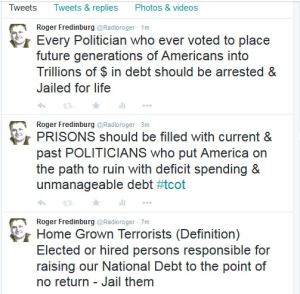
I truly believe that Politicians and any other people responsible for placing America’s finances into such chaos as to make us vulnerable to strong arming by foreign Governments, and specifically Red China are Terrorists. America is deep in debt to China and that has empowered the Chinese to push us and test us. Internet attacks, conflicts in Trade, The current debacle in the S. China Seas - And there is nothing we can do to fight back as WE OWE them TRILLIONS of $.
The folks who put us in that position, all who are still living, need to be rounded up and convicted for their financial crimes against America - I suppose that’s just one mans opinion. But it’s my story, and I am sticking to it!
Jade Helm Death Squads – Stop them dead in their tracks!
by Roger Fredinburg
You have the power to Kill Jade Helm and any other idiotic anti-American unconstitutional garbage they throw at you any time you want.
Americans have been duped into thinking that Political activism or public protests are the answer – Not true!
Call all of the radio talk shows you want – Nothing will ever change! As National talk host for over 20 years, I can tell you from experience that we can clamor for change all we want. They are deaf to our agitating and on air rage and they could care less what we think. That’s only because they don’t fear you, as they should.
The only way to make them properly fear you and the best way to defeat them is by beating their @$$e$ in court!
Forget Lawyers! Getting a good lawyer, and being able to afford the cost has always been an impediment for the average American – No More!
Imagine if local Government officials were served with hundreds of lawsuits in a single day, targeting them personally for things like dereliction of duty, Professional negligence, accepting payment under false pretenses, Breach of Contract, Abuse of Public Authority, Civil mail fraud etc. They would FREAK!
The Plaintiffs might as an example - Demand that they immediately cancel an upcoming Unconstitutional activity – Like Jade Helm maybe?
If they refuse, let them have fun answering hundreds of lawsuits and properly filed complaints that are written correctly and designed to actually win in court.
They would most likely choose the wise path, end the actions and get on their knees to beg those hundreds of litigants to drop their collective lawsuits. I am fairly certain they would retreat vow to never screw the people again. I can think of dozens of topics we could use this for to stop these insidious power drunk public servants in their tracks – can’t you?
If you want your FREEDOM BACK - I recommend you carefully review this website: www.HowToWinInCourt.com/Win/Power
I am sure you will find a way to spread the word and help me take our country back! Thanks!
Roger Fredinburg
Radio Host / Advertising Executive
(GCNlive.com) (Newswithviews.com)
The U.S. Senate advanced the Fast Track bill today May 14) in a rushed vote following a slew of concessions made to swing Democrats who had voted to block it earlier this week. The setback on Tuesday could have forced proponents of the Trans-Pacific Partnership (TPP), the Transatlantic Trade and Investment Partnership (TTIP), and other secretive, anti-user trade agreements to go back to the drawing board to come up with a new bill. Unfortunately, Senate leaders were able to get around this impasse within 48 hours by agreeing to let Democrats vote on some other trade-enforcement measures first before holding the vote on Fast Track.
Now the Senate will go on to debate and vote on the bill, likely within the coming week—essentially putting this legislation on its own fast track to congressional approval. We have little confidence that the Senate would improve the bill enough to ever remedy the nontransparent, corporate-dominated process of trade negotiations. This is why we need to turn our attention to representatives.
There is a better chance that Fast Track can be stopped in the House, where proportionally more lawmakers have expressed their opposition to the bill than in the Senate. But much of the representatives’ resistance is based on labor, environment, and currency manipulation concerns, and not on the provisions that would impact users’ rights. The White House and other proponents of TPP may be willing to make some weak compromises on those non-tech issues, but they will likely do nothing to address the restrictive digital regulations that will come with these trade deals, nor even fix the secrecy that have led to these bad terms.
Rep. Nancy Pelosi remains one of our main targets of action. As Minority Leader, she needs to come out strong against the secrecy of trade negotiations and call on others in the House to follow her lead. And as the member of Congress representing San Francisco (which itself voted to come out against Fast Track), she needs to defend the rights of users and Internet-based companies against the extreme copyright and trade secrets provisions in the TPP. She continues to stop short of coming out against Fast Track entirely, so it’s time for her to step up and lead this campaign in the House and speak out against these undemocratic, anti-user deals.
President Barack Obama’s trade agenda took another step forward in the Republican-controlled Senate today (May 21), thanks to wheeling and dealing by Senate Majority Leader Mitch McConnell (R-Ky.) and his lieutenants, who engaged in a flurry of deal-making activity on the Senate floor. Struggling against the clock, with a jam-packed legislative schedule and a looming, week-long Memorial Day recess, Sen. McConnell put together 62 votes, 2 more than the 60-vote threshold needed to break the filibuster that was holding up the Trade Promotion Authority (TPA) bill, also known as Fast Track.
McConnell may bring up the actual TPA bill for a full Senate vote as early as Friday, May 22, or, according to some reports, may even keep the Senate in session next week for a vote, skipping the Memorial recess. Today’s vote once again displayed the odd Republican-Democrat alliance, with the Obama White House and the GOP leadership in Congress uniting to win over Democrat votes and push globalist trade deals favored by Wall Street corporatists and world government advocates.
The one deal that was critical to securing the votes needed for cloture on the filibuster was McConnell’s promise to schedule a vote on renewed funding for the Export-Import Bank, the federal boondoggle that subsidizes loans to major corporations and funds projects in communist and socialist nations. Authorization for the Ex-Im Bank is scheduled to expire on June 30, and Democratic Senators Maria Cantwell and Patty Murray, both from Washington State, as well as Lindsey Graham (R-S.C.) emphatically demanded a pledge to bring up an Ex-Im vote as the price for their cloture votes.
The other Democrats who voted to end debate were Sens. Tom Carper (Del.), Claire McCaskill (Mo.), Dianne Feinstein (Calif.), Heidi Heitkamp (N.D.), Chris Coons (Del.), Mark Warner (Va.), Michael Bennet (Colo.), Tim Kaine (Va.), Bill Nelson (Fla.) and Ron Wyden (Ore.), the ranking member of the Senate Finance Committee.
Five Republicans voted against ending debate: Sens. Susan Collins (Maine), Richard Shelby (Ala.), Jeff Sessions (Ala.), Mike Lee (Utah), and Rand Paul (Ky.).
While it’s important that Congress stop wasting our money on “Patriot” Act provisions (NSA spying, etc), another unconstitutional act is worse: the latest “trade” partnerships our US Senate voted to consider. Among the items in the 2,000+ pages: submitting the US to an international court and merging US with the failed European Union, with member countries who cannot pay their debts. Stop the TPP (TransPacific Trade Partnership) and TTIP (TransAtlantic Trade and Investment Partnership), and TPA (Trade Promotion Authority), which lets our reps off the hook and gives the sitting US President sole authority to handle these job-losing agreements that include importing more immigrants into the US.
These treaties are unconstitutional and harmful; think NAFTA on steroids. Think loss of factories and jobs. Think overseas sweatshops. Think global government. Then consider that billionaires supporting “free trade” partnerships are also funding the latest push for a constitutional (Article V) convention. It’s Congress that needs changing, not our US Constitution. If we followed it, we’d never have gotten into the pattern of “trade” agreements that have put millions into unemployment. Don’t let an Article V convention or “free trade” end the American Dream.
Senate Democrats Tuesday threw up a hurdle on the “fast track” that President Obama and Republican “free trade” advocates couldn’t clear. A move to end the Democrats’ filibuster and bring the Trade Promotion Authority to the Senate floor got the backing of a 52-45 majority, falling short of the 60 votes needed to cut off debate. The TPA would give the president authority to negotiate trade agreements that Congress could vote only up or down, without amendments or filibusters. Sen. Tom Carper of Delaware was the only Democrat to vote for cloture.
Senate Majority Leader Mitch McConnell (R-Ky.), like most Republicans a supporter of the fast-track authorization, voted no on the cloture vote as a parliamentary procedure. By being on the losing side, McConnell preserves the right to bring the measure up again.
The defeat at the hands of his fellow Democrats is a stinging setback for Obama, who has been pushing hard for the fast-track authority to facilitate passage of two huge trade bills he hopes to get through Congress — the Trans-Pacific Partnership with 11 Pacific rim nations and the Trans-Atlantic Trade and Investment Partnership with Europe. The deals are opposed by many congressional Democrats and by organized labor and other traditional foes of “free trade” agreements who argue that the liberalized trade agenda will accelerate the trend in recent decades of U.S. manufacturers shipping jobs overseas. The John Birch Society, the parent organization of The New American, has also vigorously opposed both the trade deals and the fast-track authority.
“Much like how the European Coal and Steel Community, established by the Treaty of Paris in 1951, developed into what is today the European Union (EU), the TPP and TTIP (if approved by Congress) would place the United States on a path toward becoming a member state in a Transpacific Union and a Transatlantic Union, respectively,” according to a statement issued by the JBS. Both trade deals “would surrender American independence to international authority.” The JBS statement also points out that there is abundant evidence for these assertions in The New American’s special report, “How the Free Trade Agenda Is Knocking Down America.” (For a PDF of this special report, click here.)
Even some supporters of past trade deals balk at the fast-track authorization since it would prevent Congress from amending the terms of deals negotiated in secret. Senator Ron Wyden, an Oregon Democrat who is counted as a supporter of fast track, voted against cloture Tuesday. Wyden was among the Democrats who insisted that McConnell combine the fast-track bill with three other pieces of trade legislation, including a customs bill that would address currency manipulation.
“The group is concerned about the lack of a commitment to trade enforcement, which is specifically the customs bill,” Wyden told reporters. Should the bill eventually pass in the Senate, it may face even stiffer opposition in the House, where there is usually more opposition to free-trade legislation. That the opposition in the upper chamber is led by liberal Senator Elizabeth Warren of Massachusetts will no doubt increase calls from left-leaning Democrats for Warren to enter the presidential race as a challenger to former Secretary of State Hillary Clinton. Warren has insisted she will not be a presidential candidate in 2016, despite repeated pleas from left-wing groups urging her to run.
Clinton’s record on trade agreement is mixed. In her White House days, she, not surprisingly, praised the North American Free Trade Agreement that her husband zealously promoted. But in the Senate, she voted against the George W. Bush administration’s Central American Free Trade Agreement. “I don’t want to give fast-track authority to this president,” she said at an AFL-CIO Democratic primary forum in 2007. By 2007 she had also changed her position on NAFTA, calling it “a mistake” during a CNN presidential candidates debate.
Three years ago, as Obama’s secretary of state, Clinton called the proposed agreement to reduce trade barriers with Pacific Rim nations “the gold standard” for trade pacts. She has since been careful not to tip her hand on trade legislation. Last month Clinton spokesman Nick Merrill issued a non-committal statement on the candidate and her stand on the proposed Pacific trade deal.
“She will be watching closely to see what is being done to crack down on currency manipulation, improve labor rights, protect the environment and health, promote transparency, and open new opportunities for our small businesses to export overseas,” said Merrill, who described a rather high bar any new trade deal would have to clear to merit Clinton’s support.
“First it should put us in a position to protect American workers, raise wages and create more good jobs at home. Second, it must also strengthen our national security.”
President Obama himself has a checkered past regarding trade deals, having criticized Clinton in the 2008 primary campaign over her previous support for NAFTA and promising to renegotiate the agreement when he would be president. He never followed through on that pledge.
Clinton, meanwhile, does have a Democratic primary opponent, the seldom mentioned long-shot candidate Bernie Sanders, the Independent and self-described socialist senator from Vermont. Sanders appears quite eager to contrast his clear stand against the trade deals with Clinton’s studied ambiguity
“Let me give you an example,” the Vermont senator said in a recent CBS interview, citing the Trans-Pacific Partnership. “I am strongly opposed to that trade agreement on the grounds that it follows in the footsteps of other disastrous trade agreements that have cost us millions of jobs.”
Assuming Sanders will get a chance to challenge Clinton in nationally televised debates, his unequivocal stand on trade will make it hard for her to continue straddling the fence.
The 52-45 cloture vote in the Senate on Tuesday fell short of the 60 votes needed to cut off the Democrats’ filibuster and bring the Trade Promotion Authority bill to the Senate floor. The vote, which pitted the Obama White House and Senate Republicans against the president’s own party, has been reported in most of the establishment media as a “stinging defeat” for President Obama on one of his top agenda items. However, all is not as it seems on the surface, and some analysts who have been following the TPP/TTIP negotiations and legislation very closely warn that unless opponents keep up the pressure — and increase it — the next Senate Fast Track vote (which may come before the Memorial Day break) is likely to flip in the other direction.
Larry Greenley, who tracks legislation for The John Birch Society, says the May 12 cloture vote is positive in the sense that it has delayed Fast Track and shows that there is sufficient public opposition to the pseudo-free trade agenda to make many Democratic politicians nervous about voting for it. But, he told The New American, the “Nay” votes include Democrats who have already committed to supporting TPA and TPP, and who will likely switch to the “Yea” side on the next TPA vote. He points, for instance, to Senators Bennet (Colo.), Cantwell (Wash.), Feinstein (Calif.), McCaskill (Mo.), Murray (Wash.), Nelson (Fla.), Warner (Va.), and Wyden (Ore.) as likely flip votes in the next round. “Opponents of the TPA and TPP/TTIP should not read too much into this vote, or think that it means we’ve defeated Fast Track” and the ObamaTrade bills, Greenley said. “The real tests on these issues are yet to come.”
Why, then, did the Democrats vote en masse against giving President Obama Fast Track authority? Leverage, for one thing; protective coloration for another. The Democrats that favor the Trans-Pacific Partnership want to expand it, to wrap several more features into it. They insist that the TPA must contain Trade Adjustment Assistance, to provide government assistance to workers and businesses adversely affected by the TPP; a customs bill; and measures against foreign currency manipulation.
Also, many of the Democrats who intend, ultimately, to vote for the TPA and TPP know that doing so will cause a large chunk of their base — particularly organized labor — to retaliate against them on election day. To soften that backlash, they need to have a vote they can show to union voters indicating that they opposed TPA. The May 12 vote has provided them with that cover; they can point to that roll call and declare that they fought to make the TPP/TTIP work for the little guy, not just for the big corporate interests.
The Trade Promotion Authority (TPA) bill, as we have explained in more detail in previous articles (see here and here), is essential for passage of the TPP and TTIP. Virtually all of the pseudo-free trade agreements have depended on the TPA/Fast Track process to rush the complex agreements through Congress on an up-or-down, high-pressure vote, with very little time to examine or debate the text, and with no amendments or filibusters allowed.
The truly bizarre element in the TPA battle is the fervor of the Republican leadership in Congress demanding that their supposed arch-enemy, President Barack Obama, be given TPA powers to ram through, on the Fast Track, the secret TPP/TTIP agreements that he won’t even allow members of Congress full access to. With ObamaTrade, they would be handing him far more power than they did with ObamaCare. Republican Senator Mitch McConnell of Kentucky, the majority leader who has led this strange and destructive effort, sounded like an Obama White House sock puppet after the vote. “This is not a game,” McConnell said after the vote. “This is about trying to accomplish something important for the country that happens to be the president’s No. 1 domestic priority.”
McConnell and Senator Orrin Hatch (R-Utah) will be leading the GOP charge in this odd “bipartisan” effort to help President Obama round up the Senate Democrat votes he needs. Expect another vote on TPA very soon.
Editor’s note: On May 14, just hours after this article was published, the Senate agreed to invoke cloture and proceed with the TPA measure by a vote of 65 to 33.

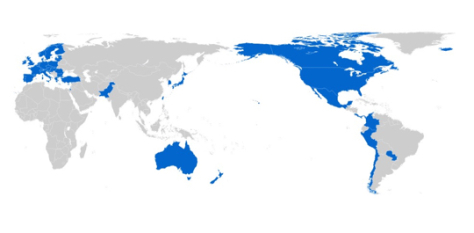 Currently, TiSA is being negotiated by the United States, the European Union, and 23 other nations, including Turkey, Mexico, Canada, Australia, Pakistan, Taiwan, and Israel (parties to TiSA agreement shown in blue on map on left). Should Congress approve the TiSA, there is no known guarantee that additional countries such as APEC member-states Communist China and Russia would not also become part of TiSA, without the consent of Congress.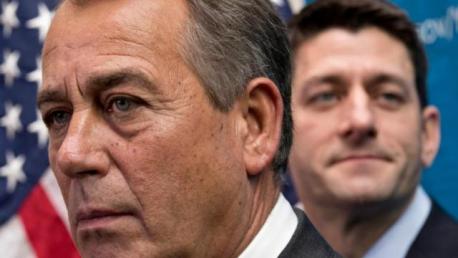






 Cathy
Cathy chulai1968
 Truth Prevailing
 Publius Huldah
 Freedom Rider
 kathleen
 radioroger2015
 Steve
Steve truckjunkie