Tag Archives: Cornelius Van Til

The False Teachers: Harry Emerson Fosdick

reposted from Tim Challies of challies.com

Harry Emerson Fosdick
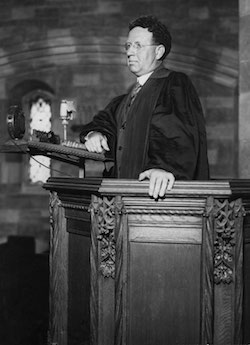
Fosdick

,Harry Emerson Fosdick was born in Buffalo, New York, on May 24, 1878. As a young boy he claimed to have been born again, but even as a teenager rebelled against the “born again” movement known as fundamentalism. He developed an early interest in theology and chose to pursue ministerial training at Colgate Divinity School where he was influenced by William Newton Clarke, an early advocate of the social gospel. Upon graduating from Colgate he continued to Union Theological Seminary. In 1904 he accepted his first pastorate at First Baptist Church in Montclair, New Jersey, and four years later also accepted a faculty position at Union where he was to teach until 1946. Fosdick quickly proved himself a skilled communicator and compelling speaker and it would not be long before he would be known as America’s foremost minister.

In 1919 Fosdick was asked to become associate pastor at First Presbyterian Church in New York City, though he was allowed to retain his baptistic convictions. He quickly gained a reputation as a leading Christian voice, and hundreds and then thousands descended on First Presbyterian to hear his sermons. It was here, on May 21, 1922, that he preached the sermon that came to define him: “Shall the Fundamentalists Win?” In this sermon he proclaimed that there was a great battle in the church between the fundamentalists and the modernists or liberals, and that he was going to stand firmly on the side of the liberals. Because of his desire to modernize the Christian faith, he soundly rejected belief in a series of traditional Christian doctrines including Christ’s virgin birth, the inerrancy of Scripture, and the literal return of Jesus Christ. He decried the fundamentalists as being intolerant for demanding adherence to doctrines that science, reason, and a modern world could no longer sustain. John D. Rockefeller enjoyed this sermon so much that he had 130,000 copies printed and mailed to every Protestant pastor in the nation.

“Shall the Fundamentalists Win?” set off what would soon be called the Fundamentalist-Modernist controversy. We need to be clear that we cannot import into this battle a twenty-first century understanding of fundamentalism. When Fosdick battled the fundamentalists of his day, he battled nothing less than traditional or conservative Christianity. Fundamentalists were those who insisted upon the key tenets of historic, orthodox Christianity—what they defined as the fundamental doctrines of the faith.

Fosdick was by no means the only liberal theologian of his day, but he was the one to gain the widest acclaim and the broadest platform. While many others were pressing theological liberalism in the seminaries and the halls of academia, Fosdick was on the radio waves and in the bookstores, taking his message to the common people. His voice extended through his radio program, The National Vespers Hour, which was broadcast in the Northern and Eastern United States, and through many bestselling books which eventually sold in the millions. On two separate occasions he was on the cover of TIME magazine.

By the mid 1920’s Fosdick had established himself as the leading voice of twentieth-century liberalism. His stand for liberalism put him at odds with many of the conservative voices in Presbyterianism, and this led him to leave First Presbyterian Church in 1925 and to go instead to Park Avenue Baptist Church.

I am a heretic if conventional orthodoxy is the standard. I should be ashamed to live in this generation and not be a heretic.

In the early 1920’s, J. Gresham Machen emerged as one of the foremost opponents of liberalism. His 1923 book Christianity and Liberalism was a strong, biblical response that drew comparisons between the Bible and liberal theology and showed that the two were in clear opposition. He rightly asked, “The question is not whether Mr. Fosdick is winning men, but whether the thing to which he is winning them is Christianity.” Others joined the battle as well. Fosdick remained firm in the face of such attacks, declaring “They call me a heretic. Well, ‘I am a heretic if conventional orthodoxy is the standard. I should be ashamed to live in this generation and not be a heretic.”

In 1929, Princeton, once a bastion of Reformed thinking and teaching, was reorganized under modernist influences. Almost immediately four Princeton professors who held to the Reformed faith (Robert Dick Wilson, J. Gresham Machen, Oswald T. Allis, and Cornelius Van Til) withdrew from Princeton and established Westminster Theological Seminary in Philadelphia in order to continue upholding the faith Princeton once defended. If the Fundamentalist-Modernist controversy was begun with Fosdick’s sermon in 1922, if was effectively cut off among conservative churches in 1929 with the departure of those professors.

Rockefeller money soon built a grand new building on the Hudson, and in 1930 Fosdick was installed as pastor at Riverside Church. He would pastor this congregation for sixteen years, and, after his retirement, attend it for a further twenty-eight. This church became his laboratory for liberalism and it was here that he practiced his liberal values to the full. (To be fair, and to give credit where credit is due, he was a strong advocate of racial reconciliation and was perhaps the most notable preacher to invite African-American preachers into his pulpit.)

Fosdick died in New York City on October 5, 1969, two weeks after being hospitalized for a heart attack. He was ninety-one years old.

False Teaching

Harry Emerson Fosdick was not an original thinker as much as a popularizer who took the theory of liberalism from the seminaries and brought it to a common level. He wanted to modernize the faith by making it attractive to, and compatible with, modern times and modern sensibilities. At heart, liberalism questioned the nature of the Bible and denied its inerrancy, infallibility, and authority. Liberalism denied that the Bible is the Word of God and insisted instead that it contains the Word of God. Once Scripture’s authority had been denied, a host of doctrines would necessarily fall in its wake.

Fosdick questioned the essential beliefs necessary to be a Christian and began to challenge long-held, orthodox Christian beliefs such as the virgin birth, and the return of Christ Jesus. Robert Moats Miller, one of Fosdick’s biographers, wrote, “Fosdick could not believe that Jesus was virgin born. He did not ridicule those who did, but he was adamant that such belief was not essential to acceptance of Christian faith. … Fosdick doubted whether Jesus ever thought of himself as the Messiah; perhaps he did, but more probably Jesus’ disciples may have read this into his thinking.” He also denied the wrath of God, suggesting that wrath was simply a metaphor for the natural consequences of doing wrong. With wrath removed, it was inevitable that the substitutionary atonement of Jesus Christ would also be denied. Before long Fosdick’s Christianity looked nothing like historic Christianity.

In a later sermon, “The Church Must Go Beyond Modernism,” Fosdick spoke of his methodology in modernizing the Christian faith, saying, “We have already largely won the battle we started out to win; we have adjusted the Christian faith to the best intelligence of our day and have won the strongest minds and the best abilities of the churches to our side. Fundamentalism is still with us but mostly in the backwaters. The future of the churches, if we will have it so, is in the hands of modernism.” Of course, he was too optimistic, and too blinded by his own success. Liberalism posed a major challenge to the faith, but like all other challengers, it would rise and then wane.

Followers and Modern Adherents

If Fosdick was the man who popularized and legitimized liberalism, we can rightly say that subsequent liberals, and especially those who operated at the popular level, followed in his footsteps. Men like Norman Vincent Peale, Robert Schuller and John Shelby Spong are among them. Martin Luther King Jr., a theological liberal in his own right, regarded Fosdick as the greatest preacher of the century and in 1958, inscribed a copy of Stride Toward Freedom for Fosdick with these words: “If I were called upon to select the foremost prophets of our generation, I would choose you to head the list.”

But Fosdick’s influence extends farther than that. Though the Fundamentalist-Modernist controversy began within Presbyterianism, it soon spread to other Protestant denominations, eventually leading to today’s division between “mainline” and “evangelical” Protestant churches. About half of today’s mainline Protestants consider themselves liberal, and they, too, whether they know it or not, are influenced by Fosdick.

What the Bible Says

Fosdick’s teaching was false in many areas, but the heart of it all was his denial of the inerrancy, infallibility and authority of the Bible. He elevated human reason above the plain words of Scripture; he made reason the final arbiter of truth. All the other doctrines he denied depended upon first undermining the Bible. Christians have long insisted, as the fundamentalists did in his day, that God’s Word, not science or human reason, is the measure of true knowledge. Proverbs 3:5-7 says, “Trust in the LORD with all your heart, and do not lean on your own understanding. In all your ways acknowledge him, and he will make straight your paths. Be not wise in your own eyes; fear the LORD, and turn away from evil.” Our understanding of ourselves and the world around us is flawed; we must depend upon God to reveal true knowledge.

If we remove the offense of the gospel, we have removed the power of the gospel.

In his second letter to Timothy, Paul warned, “For the time is coming when people will not endure sound teaching, but having itching ears they will accumulate for themselves teachers to suit their own passions, and will turn away from listening to the truth and wander off into myths” (2 Timothy 4:3-4). Fosdick wanted to make the Christian faith soothing to those itching ears and, in so doing, distorted it beyond all recognition. The reality is that the Christian faith is, and always will be, offensive. If we remove the offense of the gospel, we have removed the power of the gospel.

Where is the one who is wise? Where is the scribe? Where is the debater of this age? Has not God made foolish the wisdom of the world? For since, in the wisdom of God, the world did not know God through wisdom, it pleased God through the folly of what we preach to save those who believe. For Jews demand signs and Greeks seek wisdom, but we preach Christ crucified, a stumbling block to Jews and folly to Gentiles, but to those who are called, both Jews and Greeks, Christ the power of God and the wisdom of God. For the foolishness of God is wiser than men, and the weakness of God is stronger than men. (1 Corinthians 1:20-25)
Enemies on the Left, False Friends on the Right - Part 20

“Conspiracy theorizing about the Christian Right’s supposedly “secret” agenda involves highlighting the hate-mongering and bizarre ideas of a handful of Christian Right players while neglecting the broad popularity of dominion theology.” — Sara Diamond, “Dominion Theology: The Truth About the Christian Right’s Bid for Power”

Gary Kilgore North, PhD

Dr. Gary North

Does the name Gary North ring a bell with anyone? For decades North has made a living predicting modern society will end in panic and ruin. In 1980, he forecast rationing of housing and a nuclear war with the Soviet Union. He warned his followers to buy “gold, silver, grain, a safe place outside the major cities.” Then AIDS became the threat, “In North’s 1987 essay, The Plague Has Come at Last, he predicted millions of deaths by AIDS, and stated, “In 1992, we will run out of available hospital beds…. The world will eventually panic.”

He was also the apocalyptic herald of the destruction which would result from Y2K with the computer changeover to the year 2000. Here is an archived page from his website on January 25, 1999, expounding on the tragedies which would result from the crash of our entire system. He was nicknamed “Scary Gary” in tech circles due to his fear-mongering. In a 1997 email, North made this statement, “Of course I want to see Y2K bring down the system. I have hoped for this all of my adult life.”

Gary North was selling fear, and he made a lot of money doing just that. [Link] He wants a crash of our system. Why? Because out of this wreckage, North and many other Christian Reconstructionist men hope to build a harsh biblical order where sinners, such as adulterers and homosexuals, disobedient children, etc., can be severely punished, even executed, preferably by stoning.

Gary Kilgore North, (born February 1942) is a Christian
Dominionist/Reconstructionist (D/R) theorist and economic historian, and a charter member of the secretive Council for National Policy (CNP). He is also a libertarian theocrat. North has authored or coauthored over fifty books on topics including Christian theology, economics, and history. He is an Associated Scholar of the libertarian Ludwig von Mises Institute (the U.S. center for Austrian economics), recipient of its 2004 Rothbard Medal (Murray Rothbard was one of the founders), and contributor of hundreds of articles for LewRockwell.com, the newsletter of the Institute’s founder and chairman.

North is the son-in-law of the late Rousas John Rushdoony (also a charter member of the Council for National Policy). R.J. Rushdoony was the founder of Christian Reconstructionism. The most prominent example of Dominion Theology and Theonomy is the Christian Reconstructionist movement. Theonomy is from theos (god) and nomos (law) and is the idea, espoused by Christian Reconstructionists, that Mosaic law should be observed by modern societies, that we are to live under the Old Testament laws. Some components of (D/R) are very similar to Islam. They want a theocracy, and a theonomy which includes stoning sinners in the streets.

Rousas John Rushdoony

rushRousas John Rushdoony

Born in 1916 and heavily influenced by the writings of Reconstructionist, Cornelius Van Til, Rushdoony founded the Chalcedon Foundation in California in 1965. His 1973 book, The Institutes of Biblical Law, remains the handbook of Christian Reconstructionism, laying out all its principles and goals.

A core of anti-Semitism exists in Rushdoony’s Reconstructionism. He has been accused of Holocaust Denial and racism. In The Institutes of Biblical Law, he uses the 1967 work Judaism and the Vatican by Léon de Poncins as a source for Paul Rassinier‘s figure of 1.2 million Jewish deaths during the Holocaust, and the claim that Paul Hilberg calculated the number at 896,292, and further asserts that very many of these died of epidemics. He calls the charge of 6 million Jewish deaths “false witness” against Germany. He never retracted this statement.

Just as his father-in-law did, North has endorsed Holocaust denial. When old issues of Reason Magazine were unearthed by journalist Mark Ames, he found that North had contributed a supportive article to an issue dedicated to denial of the Holocaust. This was the same year North was Ron Paul’s congressional aide. North’s article in Reason mocked the Holocaust as “the Establishment’s favorite horror story” and questioned “the supposed execution of 6 million Jews by Hitler.” North also painted other rabidly anti-Semitic Holocaust deniers in a positive light, praising the works of David Hoggan, author of “The Myth of the Six Million,” French neo-fascist Paul Rassinier, and American historian Harry Elmer Barnes, considered the godfather of American Holocaust denial literature. [Link] North states, “There is only one Bride; God is not a bigamist. He took no gentile wife under the Old Covenant, and He will not accept a pale imitation of Old Covenant Israel - modern Judaism - as His wife in the future.”

God doesn’t change, and the relationship between the Lord and the children of Israel is confirmed many times in scripture. In Jeremiah 3:14, we read the words, “Turn, O backsliding children, saith the Lord; for I am married unto you.”

And the prophet Isaiah, in a chapter about the wife of Jehovah, plainly states, “For thy Maker is thine HUSBAND; the LORD of hosts is his name; and thy Redeemer the Holy One of Israel” (Isaiah 54:5). The entire book of Hosea is about the Lord God and his Wife, Israel.

Having studied the Holocaust and anti-Semitism in the church for over 30 years, I fully believe there were far more than six million Jews, and six million Christians, Gypsies, and Homosexuals who were murdered by the Nazis.

Rushdoony was also an early advocate of home schooling, peppered with his religious doctrine. (North is now is the leader of Ron Paul’s home school curriculum.) Rushdooney was also a board member of the Rutherford Institute headed by John Whitehead (also a CNP member).

Originally an activist in libertarian and anti-communist groups, North came under the influence of R. J. Rushdoony and married his daughter. Beginning in 1963, Rushdoony helped North secure a series of jobs working for the Volker Fund and the Foundation for Economic Education. So by the time North went to work for Rushdoony’s Chalcedon Foundation in 1973, he was a bona fide veteran of the libertarian movement.

The two had a falling out over an obscure bit of doctrine and stopped speaking. North moved to Tyler, Texas, and founded the Institute for Christian Economics where he focuses on economic aspects of Christian Reconstructionism. He is the primary publisher of Reconstructionist material today.

Let’s take a look at the origins and tenets of Dr. North’s Reconstructionist doctrine.

Dominion Theology

The earliest expression of Dominionism is in the writings of Francis Schaeffer whose book, A Christian Manifesto, was long an important text for the whole Christian Right. Schaeffer argued that America was founded as a Christian Nation, that humanists had replaced God with their “concern with human progress,” and that Christians must reestablish control of all human institutions. They desire a theocracy, which is a country ruled by their form of religious leaders.

The Biblical, and most important, basis for their belief in Dominion Theology is Genesis 1:26, “And God said, Let us make man in our image, after our likeness: and let them have dominion over the fish of the sea, and over the fowl of the air, and over the cattle, and over all the earth, and over every creeping thing that creepeth upon the earth..” For most Christians, this simply means that humans have dominion over the natural world; for Dominionists, this means that Christians have, and must take, dominion over everything, including other people. Mix in Rushdoony’s Reconstructionism, and you have a blend that is quite different from orthodox Christianity.

Basic Beliefs of Christian Reconstructionism

Christian Reconstructionism is an explicitly hyper-Calvinist movement. Christian Reconstructionists look to 17th century Geneva under John Calvin for inspiration. In Geneva, he rejected Papal authority, and established a new scheme of civic and ecclesiastical governance. He is famous for his teachings and writings and infamous for his role in the execution of Michael Servetus. Reconstructionists accept that there should be separate spheres under governmental and church control, but that the government must submit to biblical precepts as defined and interpreted by the church (their doctrine, of course). There is little practical distinction between this and a Christian theocracy. So from the very beginning, according to Dominionism, God has commanded the creation of a totalitarian government.

Reconstructionists agree on the following principles

• God’s sovereignty over all humanity and the world.
• Postmillenialism.
• A Christian theonomy (the idea, espoused by Reconstructionists, that all 613 Mosaic laws should be observed by modern societies, eliminating only a few.)
• A Christian theocracy - Most evangelicals are pre-millennialists, believing that Christ will return before establishing a utopian 1,000 year reign of believers. However, Reconstructionists believe that this 1,000 year reign must come first, and only after this will Christ return. Jesus is literally waiting for Christians to establish a Christian theocracy. Christian Reconstructionism is thus more optimistic than evangelicalism and fundamentalism because it teaches that a perfect Christian society is possible.

Since 1963, when I was a Goldwater girl, I have watched society crumble, the culture decay, the total corruption of all political realms, and the failure of the churches to speak the truth and lead their congregations to the truth of the Bible, and to work to save our God given rights in this Republic. Highly unlikely we’re headed for a “perfect” Christian society.

For Reconstructionists, the Christian Church is the New Israel. Christians, not Jews, are God’s chosen people and are those whom God has a special covenant. If Christians keep the covenant, they will be rewarded. If they don’t, they will be punished, as will the whole nation. The basis of this belief is called “replacement theology” and leads to anti-Semitism. More on this in part 21.

Well-known Christian Reconstructionists include Jay Grimstead, Greg Bahnsen, David Chilton, Gary DeMar, D. James Kennedy, Kenneth L. Gentry, Jr., Rev. P. Andrew Sandlin, Randall Terry, George Grant, David Barton, Howard Phillips, Chuck Colson, Earl Paulk, Rick Joyner, Tommy Tenny, Fred Price, Francis Frangipane, Kenneth Hagin, C. Peter Wagner, Gen. Jerry Boykin, Don Wildmon, and many others who are/were leaders in the Christian right and/or members of the Council for National Policy. [Link]

Who Practices Dominionist /Reconstructionist Theology

D/R is prevalent in the Pentecostal community as “Kingdom Now,” “Dominion Theology,” and/or “Restoration Theology.” The Pentecostal charismatic churches are where some of the earliest strains of dominionism showed up, and dominionism is actually an integral part of the theology of some of these groups. However, this theology has wormed it’s way into the more mainstream churches as well. D. James Kennedy’s Presbyterian Church in Coral Ridge, Florida is a good example, but there are countless other mainstream denominations who have, knowingly or unknowingly, adopted all, or parts of D/R.

Restoration theology has been an integral part of the majority of ‘shepherding’ (discipling) fellowships and house churches, and is now a guiding force behind the heretical and apostate New Apostolic Reformation, the Transformations Movement (one world religion, all denominations together), the P.E.A.C.E. Plan and Purpose-Driven materials of Rick Warren, and the Word-Faith movement. However, there are problems with these doctrines which make them unorthodox theology. The fact of its popularity is no proof of its authenticity. The truth is not always popular, and truly biblical Christianity has always been a minority religion. (I marvel that ye are so soon removed from him that called you into the grace of Christ unto another gospel. Galatians 1:6)

Reconstructionism offers an appealing solution to all of society’s ills. They believe human laws cannot govern human institutions. Therefore, they must return dominion over human institutions to God. Submission to the moral principles of the Bible guarantees that everything will turn out well because God and the Bible are perfect. Unfortunately, D/R’s don’t take into account that man is not perfect, and this is why God gave us grace.

“For by grace are ye saved through faith; and that not of yourselves: it is the gift of God: Not of works, lest any man should boast. For we are his workmanship, created in Christ Jesus unto good works, which God hath before ordained that we should walk in them.” Ephesians 2:8-10

D/R denies repentance, mercy, and grace. Was not St. Paul a persecutor and blasphemer? Yet, he was changed by grace, by the knowledge of his Saviour. Had he lived in a D/R world he would have been stoned, just as he stoned those he called transgressors.

In the next article we’ll look at direct quotes from Gary North, an overview of replacement theology, and at North’s involvement since the 70s with Ron Paul, and his leadership in Ron Paul’s Home School Curriculum.