
Tag Archives: Kerry

Kerry bombshell: U.N. in ‘secret deal’ with Iran

By Leo Hohmann for WND
GERMANY/

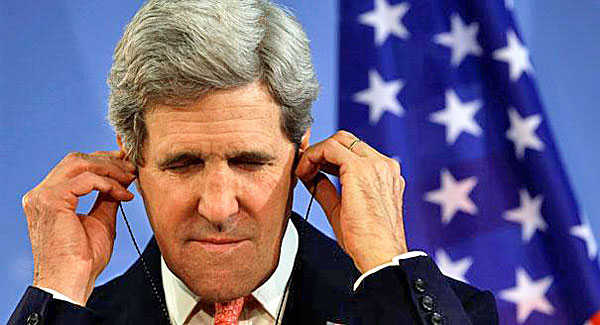
Secretary of State John Kerry testified on Capitol Hill Wednesday that the U.S. government will not be revealing to the American people the contents of “secret side deals” made with Iran on its nuclear enrichment program.

The International Atomic Energy Agency, a unit of the United Nations, has negotiated two side deals with Iran involving critical data collection processes.

Astonishingly, Kerry himself said Wednesday that he has not read the agreements but has been “briefed” on their contents.

Sen. Tom Cotton, R-Ark., wanted to know why these deals can’t be made public.

“Why can’t we confirm or deny the content of these agreements in public?” Cotton asked in a Senate hearing. “Why is this classified? It’s not a sensitive U.S. government document. The Ayatollahs know what they agreed to.”

“Because we respect the process of the IAEA and we don’t have their authorization to reveal what is a confidential agreement between them and another country,” said Kerry.

Cotton said, “So the ayatollahs will know what they agreed to but not the American people?”

Watch the testy exchange between Sen. Cotton and Secretary of State Kerry:

Kerry said members of Congress would be able to learn about it in a classified briefing.

Kerry said he believes one staffer in his department may have read the agreement “at their facility” but didn’t possess a copy of it. “The IAEA is an independent entity under the United Nations, Senator, which I know you know.”

“I have received several classified briefings on the deal, and look forward to another one, but what Congress would like is the text of the deal,” Cotton said.

Cotton said reports by media, including the latest by the Associated Press, indicate that Iran will be allowed to collect its own samples and submit those samples to the IAEA, “much like an NFL player taking his own urine sample and sending it to Roger Goodell for a drug test. Can you confirm or deny that that is the content of those side deals?”
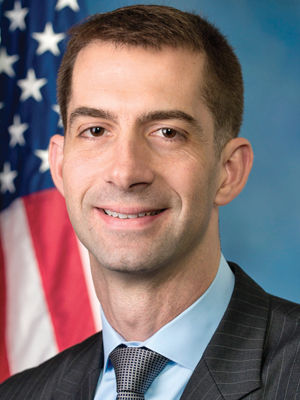
Sen. Tom Cotton

“I can’t here in this session,” Kerry responded.

Secretary of Energy Ernest Moniz also said he was not aware if anyone in his agency has read the secret side agreements.

“I’m not sure. I don’t know. I’m not sure. I can ask. In terms of the technical team, maybe somebody saw something,” Moniz said.

What’s next? Find out in “Showdown with Nuclear Iran.”

Today’s testy exchanges in the Senate hearing come a day after similarly heated exchanges between Kerry and Rep. Scott Perry in the House.

Perry gave Kerry a public dress-down on the Iran deal, suggesting the secretary of state could have forged a better deal if he had only kept America’s interests as the top priority.

Perry said: “There is a history for … getting a better deal and if the ayatollah doesn’t like it and doesn’t want to negotiate it, oh boo hoo, we’re here for America, we stand for America. You represent America,” according to news video of the Capitol Hill committee meeting.

Kerry replied a bit tersely: “Congressman, I don’t need any lessons from you about who I represent. I represent and fought for our country since I was out of college.”

Perry cut in to say, “and God bless you for your service,” but Kerry’s temper was irked.

“So I don’t need any lessons from you about that, OK,” Kerry said. “Let me just make it crystal clear to you, this is America’s interest because America is the principle guarantor of security in the region. And particularly with respect to some of our closest friends. Now, we believe that Iran was marching toward a weapon or the capacity to have a weapon, and we’ve rolled that back. That’s indisputable.”

Perry cut in to disagree: “That’s your opinion, Mr. Secretary.”

“No,” Kerry said, “that’s a fact. That’s a fact.”

The Iranian deal forged largely at the pressing of America has been criticized as giving away too many U.S. interests. Specifically, the deal allows Iran to hold up inspections for a period of 24 days, something opponents of the pact say will give Tehran the ability to construct a nuclear weapon eventually.


Analysis of Iran deal and the LIES

Dr. Raymond Stock,
Shillman Ginsburg Writing Fellow
Middle East Forum

July 25, 2026

During four and a half hours of testimony before the Senate Foreign Relations Committee on July 23 (along with Secretary of Energy Ernest Moniz and Secretary of the Treasury Jack Lew) about the recently concluded nuclear deal with Iran, Secretary of State John Kerry was not only deeply condescending to the body in which he spent decades as a member—dismissing them as “535 Secretaries of State”-he also told a number of outright untruths.

For example, he said that “no one” had ever talked about “dismantling Iran’s nuclear program,” when in reality he himself had said, at the outset of the negotiations, that dismantlement was the goal.

In addition, he said that when the negotiations began, Iran had its current level of 19,000 centrifuges to enrich uranium, blaming this on the Bush administration-noting that Iran had only 100 or so in 2003. In fact Iran has acquired 75% of its centrifuges on Obama’s watch (as noted by the great James Rosen of Fox News).

Kerry (and Moniz) also denied that the deal requires us to protect Iran’s nuclear program from sabotage or attack, even from an ally like Israel, when, as Senator Marco Rubio pointed out, a plain reading of the text proves that is not true. (Moreover, the agreement mandates that we train Iran how to protect its nuclear program from hostile acts, presumably those of Israel, other powers or even actions we might carry out ourselves if we find Iran has broken the deal.)

At the same, Kerry sought to reassure Rubio that “we” (presumably the U.S., not necessarily all the other signatories) would always act in full consultation with Israel in this regard (even though Israel was not a party to the deal, the terms of which it has vigorously rejected, and was not even briefed in the final weeks of the talks).

Kerry was also wrong when he insisted that the language in Monday’s Security Council resolution lifting the sanctions on Iran was in effect the same as in a previous resolution (1929) and in the agreement itself regarding the prohibition on Iran from conducting work on its ballistic missiles program. In fact, rather than “shall not,” as in 1929, the new resolution substitutes the much weaker “calls upon”-which is not binding, of course. Given that the new resolution supersedes all previous resolutions and even the text of the agreement itself, Kerry clearly misled the Senate committee on this point.

Kerry further claimed that Iran had lived up to the Interim Agreement signed in Geneva in November 2013, and that its enriched uranium stockpile had gone down since then. In fact, Iran Watch reported in April 2015 that its stockpile had actually increased since that time.

Moniz descended into farce when he told the committee Iran would be required to tell the International Atomic Energy Agency (IAEA) when it chose to build any new nuclear facility, even at the planning stage.

But you can see how well that worked out in their secret facility at Fordow, which the negotiators know was hidden and operated secretly for years, even under the formerly rigorous sanctions regime.

When Senator Robert Menendez pressed Kerry on the question of who is responsible for collecting the material samples for testing at sites such as Parchin, where Iran had previously tested nuclear explosives detonators, he said that was confidential between the IAEA and Iran (being part of one of the two separate, secret agreements negotiated between the agency and the Islamic Republic), and that it is classified.

In other words, he could not deny reports that Iran would be allowed to collect its own samples for testing at sites where illegal activity is suspected. As Senator James Risch had pointed out earlier in the hearing, not even the NFL would allow its players to provide their own urine samples to test for banned substances-or as Menendez put it, that’s like “the fox guarding the chicken coop.”

Shockingly, when Sen. Ron Johnson mentioned the threat of Electro-Magnetic Pulse (EMP) against our electrical grid by Iran-and noted Iran had tested the use of missiles to launch such an attack from ships-Energy Secretary Moniz was not aware of this fact. Moniz was also unaware of the 15 recommendations by the Critical National Infrastructures Commission to prevent EMP attacks issued in 2008.

How could this man negotiate with Iran, especially resulting in a deal that will let it continue to develop ballistic missiles, without even knowing that Iran has already practiced using them in order to destroy our entire electrical infrastructure, perhaps irretrievably?

Sen. Barbara Boxer made the point that all fifteen members of the Security Council had approved the deal by their vote last Monday-and they are not stupid, as both she and Kerry stated. But neither of them noted that the representatives of those countries had less than a week to study it before their vote—while the Congress is prudently taking sixty days before casting its own.

Indeed, as Corker and Risch also pointed out, taking the agreement to the Security Council before the U.S. Congress has reached its decision dramatically reversed Iran’s role—the international “pariah” before the deal was signed—and that of Congress, which is would now be the rogue if it rejects it in the end. This means that the world’s largest state sponsor of terrorism is now legitimized, while our own legislative branch—even the U.S. itself—would be outside the pale of international law if it backed out of the deal, regardless of the reason why.

But the most telling moment comes at the end of the hearing, when Menendez reminds Kerry he had said that sanctions were not stopping Iran from getting close to nuclear breakout before the deal was signed-and yet the agreement relies on the “snap-back” of sanctions to ensure Iran doesn’t break the agreement and go for the bomb anyway. At the same time, because the U.N. has approved the deal, the credible threat of military action is now effectively off the table (probably) forever, thus we now have only the threat of sanctions left-to which Kerry replied that they would be an adequate deterrent (even though they weren’t before).

That is, by taking this deal to the U.N. before it was debated in Congress, he deliberately created a situation in which we have to trust Iran-which has never kept any of its nuclear agreements to date-to abide by this one, because we have no reliable means left to make them comply: This, despite Kerry’s statements ad nauseam that the deal “is not based on trust.”

Image

New Iranian Doll for Easter?

boom boom doll