Author Archives: Freedom Rider

What You Can Expect - Life Under The Islamic Caliphate

My comment: This will mean that if you are not tortured and murdered immediately (and almost certainly) you will be compelled to deny Jesus Christ and be forever blotted out from the Lamb’s Book of Life… This is a long read but worth your time as a Christian Soldier. Very hard times such as have never been seen are coming as a roaring lion upon this world and we as followers of Jesus will be given very special ‘attention’!

http://apnews.myway.com/article/20150619/ml-inside_the_caliphate-nation_of_fear-bef304e4b4.html

State of fear: Survivors tell of life under IS rule
Jun 19, 7:57 AM (ET)

ZEINA KARAM, VIVIAN SALAMA, BRAM JANSSEN, and LEE KEATH
ESKI MOSUL, Iraq (AP) — Inside the Islamic State’s realm, the paper testifying that you have “repented” from your heretical past must be carried at all times. Many people laminate it just to be safe. It can mean the difference between life and death….

Bilal Abdullah learned that not long after the extremists took over his Iraqi village, Eski Mosul, a year ago. As he walked down the street, an Islamic State fighter in a pickup truck asked directions to a local mosque. When Abdullah didn’t recognize the mosque’s name, the fighter became suspicious.

“He told me my faith is weak and asked, ‘Do you pray?'” Abdullah recalled. Then the fighter asked to see his “repentance card.” Abdullah had been a policeman until the IS takeover, and policemen and soldiers are required to have one. So are many other former government loyalists or employees — even former English teachers, since they once taught a “forbidden” language and tailors of women’s clothes because they once designed styles deemed un-Islamic.

Abdullah had left his card at home. Terrified, he sent his son running to get it.

“They are brutal people,” he told The Associated Press. “They can consider you an infidel for the simplest thing.”

The Islamic State’s “caliphate,” declared a year ago, stretches across northern Syria through much of northern and western Iraq. Untold numbers have been killed because they were deemed dangerous to the IS, or insufficiently pious; 5-8 million endure a regime that has swiftly turned their world upside down, extending its control into every corner of life to enforce its own radical interpretation of Islamic law, or Shariah.

The Islamic State’s domain is a place where men douse themselves with cologne to hide the odor of forbidden cigarettes; where taxi drivers or motorists usually play the IS radio station, since music can get a driver 10 lashes; where women must be entirely covered, in black, and in flat-soled shoes; where people are thrown to their deaths off buildings on suspicion of homosexuality; where shops must close during Muslim prayers, and everyone found outdoors must attend.

There is no safe way out. People vanish— their disappearance explained by a video of their beheading, an uninformative death certificate, or nothing at all.

“People hate them, but they’ve despaired, and they don’t see anyone supporting them if they rise up,” said a 28-year-old Syrian who asked to be identified only by the nickname he uses in political activism, Adnan, in order to protect his family still living under IS rule. “People feel that nobody is with them.”

The AP interviewed more than 20 Iraqis and Syrians who survived life under the group’s rule. One AP team travelled to several towns in northern Iraq, including Eski Mosul, north of Mosul, where residents are just emerging from nearly seven months under IS rule. Another AP team travelled to Turkish cities along the border, where Syrians who have fled IS territory have taken refuge.

What follows is based on their accounts, many of which were verified by multiple people, as well as on IS social media and broadcast operations and documents obtained by the AP, including copies of repentance cards, weapons inventories, leaflets detailing rules of women’s dress and permission forms to travel outside IS territory — all emblazoned with the IS black banner and logo, “Caliphate in the path of the prophet.”

The picture they paint suggests the Islamic State’s territory, now an area roughly the size of Switzerland, has evolved into an entrenched pseudo-state, one based on a bureaucracy of terror.

—

THE TAKEOVER

In January 2014, when the Islamic State group took over the Syrian city of Raqqa, Adnan fled, fearing his work as a political activist would make him a target. But after a few months of missing his family, he returned to see whether he could endure life under the extremists.

Adnan found Raqqa transformed from a once-colorful cosmopolitan city into the Islamic State’s de facto capital. Women covered head to toe in black scurried quickly to markets before rushing home, young men avoided the cafes they once frequented. IS fighters turned the city soccer stadium into a prison and interrogation center, known as “Point 11.” One of the city’s central plazas was now referred to by residents as “Jaheem” Square — Hell Square.

He soon learned why. He heard celebratory gunshots one day and saw the bodies of three men dangling from poles in Hell Square. The corpses were left there for three days, he told AP as he chain-smoked in a cafe in Gaziantep, a town on the Turkish border filled with Syrians living in exile.

The reign of terror he had fled had gotten only worse, he said.

Each time the Islamic State group overruns a community, the pattern has been roughly similar, AP found — as methodical as it is bloody.

First comes an initial wave of killings of police and troops. Then the fighters often seek to garner support by quickly repairing electricity and water lines. They call on bureaucrats to return to work. Government employees and any former troops or policemen sign their “repentance” papers and must hand over their weapons or pay fines sometimes amounting to several thousand dollars.

In loudspeaker announcements, mosque sermons and leaflets, new regulations are laid out: No smoking, no alcohol, and no women working except as nurses or in women’s clothing shops, where even mannequins in store windows are covered. Residents said they were required to build walls outside their homes so women would never be seen.

In each district, an “emir” — often a local militant — is appointed to govern. Schools close, then reopen with IS-written curricula. Taxes are imposed on businesses. Pharmacies are given Shariah courses and banned from selling contraceptives. In most locations, tribes or families declare loyalty to the group and gain positions or perks, several interviewees told AP.

Adnan stayed in Raqqa for almost a year, watching the extremists pervade nearly every aspect of life. IS authorities came to his family’s car parts store and demanded taxes — the equivalent of $5,000. The group was clearly flush with money from taxing businesses, confiscating lands from those who fled and sales from oil fields captured further east in Syria, Adnan said.

The group encourages commerce across the “caliphate,” he said — for example, cement supplies and vegetables moved from Turkey, through Raqqa to Mosul, Iraq’s second-largest city

Then Adnan’s one-time activism in support of Syrian rebels caught up with him. In January, a patrol raided his family home, confiscated his laptop and arrested him for publishing online articles they said encouraged secularism. “Such a pretty house,” a patrol member said before smashing two glass water pipes. “This pollutes the environment,” he told Adnan.

For the next 55 days, Adnan was held in Point 11, the soccer stadium.

He was interrogated three times in the initial days, beaten with a green plastic pipe. Then he was moved out of isolation into wards with other prisoners.

Soon after came another gruesome moment. One of the top Islamic State judges in the area, a local man known by the pseudonym Abu Ali al-Sharei, dropped by in early February to teach another lesson in Islamic law to the prisoners. He made small talk with a roomful of them. Then he grinned and said, “Listen, I haven’t told you yet, but today we made al-Kaseasbeh crispy.”

He took a flash drive out of his pocket, Adnan said, and, to the prisoners’ horror, played them footage of captured Jordanian Air Force pilot Muath al-Kaseasbeh being burned alive in a cage by his IS captors.

Adnan’s account is just one example of how IS uses the execution videos that it broadcasts to the world online to also intimidate people under its rule.

In Raqqa’s prison, Adnan’s job of distributing food to other inmates gave him a broad view of operations.

He saw two Kurdish prisoners and overheard wardens saying the pair would likely be used in Kurdish-language propaganda videos before being released. Adnan said he also saw several foreign Islamic State fighters being held — three Turks, an Uzbek, a Russian and a Yemeni — apparently on suspicion of spying. Two other IS fighters were brought in for stealing booty looted from the Syrian Kurdish town of Kobani rather than sharing it with other fighters. Kobani was the scene of the biggest defeat of IS in Syria, when Kurdish forces backed by U.S. airstrikes drove off the militants after months of heavy fighting.

“We gave up 2,200 martyrs in Kobani, and you go and steal?” Adnan said he heard the interrogator shouting at the two detained militants.

Adnan met Palestinian prisoner Mohammed Musallam, whom IS accused of being a spy for Israel. Musallam told Adnan his captors were repeatedly filming him in his own execution video. Each time, he said, they would video a child shooting him in the head — but each time the gun would be empty.

“Then one day, they executed him for real,” Adnan said.

In March, the Islamic State group released a video showing Musallam’s death. Kneeling in a field, he is shot in the head by a young boy wearing military camouflage.

Adnan said he believes that is why many victims in the execution videos appear so calm. “They repeat the thing with them like 20 times. So when the real one comes, the prisoner will think it’s just another mock execution,” he said.

—

SURVIVING THE CALIPHATE — OR NOT

In Eski Mosul, a village on a bend in Iraq’s Tigris River, Sheikh Abdullah Ibrahim lives in one of the larger houses, behind high walls with a garden. He looked exhausted as he showed AP journalists one IS vestige he’s keeping: the death certificate for his wife, the group’s black logo on top.

It’s all he has left of her.

IS swept into the village of some 3,000 families in June last year, established its reign over a grim seven-month period, then fled in January when Kurdish fighters ran them out. IS forces remain dug in only a few miles away, so close that smoke can be seen from fighting on the front lines.

Ibrahim’s wife, Buthaina, had been an outspoken human rights advocate and had run for the provincial council in Mosul. So when IS took over, fighters demanded she apply for a repentance card. “She said she’d never stoop so low,” her husband said.

He knew the danger. He had seen the bodies of a dozen policemen in the street, shot in the head. He’d seen others thrown off buildings. He had heard talk of the dreaded “Khasfa,” a deep natural sinkhole in the desert south of Mosul where the extremists boast of throwing bodies — or sometimes living victims.

Ibrahim sent his wife away to safety for a few days, but she soon returned, missing their three daughters and two sons, he said. Her youngest was 2.

A few nights later, in early October, the militants came for her, he said.

Ibrahim and his wife were asleep, but their daughters were watching TV. “Wake up, dad, Daesh is in the front yard,” they called out, using the group’s Arabic acronym. Ibrahim saw the house was surrounded.

They demanded to see Buthaina. Ibrahim tried to protect her, he said, but she came out and confronted the IS extremists, demanding an explanation. An argument ensued, and one militant handcuffed the sheikh and knocked him across the head with a pistol. The men pushed Buthaina into their car, and took Ibrahim’s as well.

A member of the powerful al-Jabour tribe, Ibrahim hoped his connections — and money — could win Buthaina’s freedom.

He and fellow tribesmen went to the nearby town of Tal Afar, an IS stronghold from which many of the fighters who took Eski Mosul had come. There, he said, he met in a mosque with Abu Alaa al-Afari, a local IS commander who some Iraqi officials now believe has risen to become the No. 2 figure in the “caliphate.”

Ibrahim begged for his wife’s release, pointing out that she was still breastfeeding their youngest son, Arkam.

“It doesn’t matter. Your children will become orphans,” al-Afari replied, according to Ibrahim.

Another Eski Mosul resident, 31-year-old Fadi Mohammed, wishes that all he had gotten from IS was his brother’s death certificate.

He and his brother, Mohammed Mohammed, were both former policemen who had given up their weapons and signed repentance papers. But his brother was arrested after informants claimed he was part of an elite intelligence unit. Mohammed Mohammed was sent to Mosul. In January, 13 days before the Kurds took back Eski Mosul, Mohammed said IS militants “brought us discs that showed his beheading.”

Now, he said, “I want to blow myself up among Daesh. Even that won’t satisfy me. If I chop them up, drink their blood and eat their hearts, it won’t take away my pain.”

Laying low was often key to survival in the “caliphate,” several of those interviewed said. Best to stay home as much as possible, avoiding checkpoints of IS fighters and the “Hisba” committees, the dreaded enforcers of IS’ innumerable regulations.

Armed members of the Hisba patrol the streets, cruising in SUVs with blackened windows and wearing Afghan-style baggy pants, long shirts and face masks, looking for behavior deemed unacceptable.

Punishments for smoking, for wearing Western clothes or for playing the wrong radio station can vary from a fine to imprisonment for a few hours or days — often depending on the Hisba’s mood. For more serious or repeat offenses, the fighters might bind the perpetrator to a pole in a town square for several days with his crime written on a sign around his neck.

Women try not to go out at all, most of those interviewed by AP said. If they do go to market, they sometimes avoid taking their husbands, sons or brothers with them: If they’re harassed by the Hisba, their male relative might defend them and bring the Hisba’s wrath.

It’s not an unreasonable fear. Abu Zein, a 31-year-old who recently fled the eastern Syrian town of Muhassan, recounted how a Hisba member one day berated a woman for being improperly covered as she swept her porch. Her brother came out and argued, the fight escalated, the militant shot the brother, and the brother’s relatives promptly killed the militant. Soon after, a larger contingent of Islamic State fighters descended on the house and killed eight members of the family, Abu Zein said.

Abu Zein said he was detained multiple times for various minor offenses, including visiting his uncle’s grave.

During Islamic holidays late last year, he said, militants announced in mosques that it was forbidden to visit the graves of relatives, a holiday tradition that IS sees as encouraging polytheism. Abu Zein’s uncle had died of cancer the year before, so he, his cousin and another relative decided to defy the ban.

As they approached the graveyard, IS fighters opened fire over their heads, shouting “Grave worshippers!” and “This is forbidden!” Abu Zein said he and his friends tried to reason with them. “You cannot stop me from visiting my father,” cried Abu Zein’s 20-year-old cousin — prompting one militant to slap him across the face. The three were arrested and detained for several hours before being released with a warning.

Sheikh Abdullah Ibrahim’s wife, Buthaina, never reappeared after being taken by the militants.

Shortly after her husband appealed for her release, he received the death certificate. A simple sheet of paper from an “Islamic court” with a judge’s signature, it said only that Buthaina’s death was verified, nothing more.

It is a horrifying document, but he’s keeping it, he said, “because it has her name on it.”

—

ESCAPING THE CALIPHATE

Escape is not easy. Residents are banned from leaving their cities without first applying for permission, filling out a long form with all their personal details and setting property as a guarantee that IS will seize if they don’t return. Women must apply to the Hisba to travel and are often refused permission, out of concern that they will not follow IS dress codes once they are out.

When Adnan’s aunt needed cancer treatment, she applied to leave IS territory to get care. The IS refused but sent her to Mosul, paying for transport and some of the medical costs, though not her chemotherapy.

In March, after Adnan had spent 55 days in prison, a top IS leader in Raqqa freed about 40 inmates — including the young Syrian activist.

Adnan decided it was time for him to go. He paid a smuggler to drive him along dirt roads about 25 kilometers to the Tal Abyad border crossing, which at the time was in IS hands and was shut from the Turkish side, then paid another smuggler to get him into Turkey. “It was an adventure,” he said, smiling.

Escape was much more harrowing for Ali, a 63-year-old appliance store owner from the Iraqi town of al-Zaab, near Mosul, who asked that his full name not be used to protect relatives still under IS rule. He told AP that when he decided to flee, he managed to convince local authorities he was only going on a three-day work trip. They gave him a permission slip without a guarantee of property, so he set out in his car with his wife, son and daughter-in-law.

Between them and freedom were three different checkpoints. At the first, fighters wrote down the model and license number of his car. At the second, they searched his car, then ordered him to return to the first checkpoint. There, the fighters told him his car registration was improper and he had no property guarantee.

“Your fate will be execution,” he said they told him.

But in a show of how capricious life can be under the Islamic State, a commander at the checkpoint made a phone call and got approval to let Ali and his family pass. “God give him long life,” Ali said of the commander. He said he’d rather have been killed right there at the checkpoint than be forced to drive back into IS-held al-Zaab.

In Eski Mosul, delivery from IS came to residents at the hands of Kurdish fighters. Amid the joy over liberation — and perhaps worry over being accused of having IS loyalties — many residents promptly discarded documents from the Islamic State.

Not Salim Ahmed. For nearly seven months, the 23-year-old former soldier had clung to his repentance card, always having it ready at checkpoints. He hated the card. He had refused to laminate it, unwilling to give it a sense of permanence.

Now IS is gone, but the fear instilled in him is not. He still carries his card.

“We live very close to their front line,” he said. “One day, they might come back and ask me for my repentance card again.”

—_

Salama and Janssen reported from Eski Mosul, Karam from Gaziantep, Turkey, and Keath from Cairo. AP journalists Mohammed Rasool and Hussein Malla in Beirut and Salar Salim in Irbil, Iraq, contributed to this report.
WNAT TERRIFIES OUR GLOBAL OVERLORDS?

The Elite Have A Great Fear Of Death

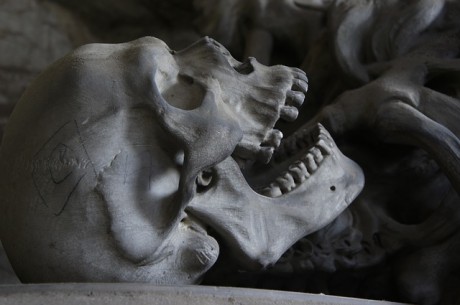
Death Skull - Public Domain

If there is one thing that the elite of the world fear more than anything else, it is death. They spend an extraordinary amount of time and energy attempting to shield themselves from potential threats, to separate themselves from the general population and to do whatever they can to extend their lifespans. They travel with multiple bodyguards, they install “safe rooms” in their homes, they buy private islands on the other side of the world and they invest huge amounts of money into life extension technologies and research. They do all of these things in a desperate attempt to battle an enemy that they have never been able to defeat – death. And in this day and age, the elite are becoming more paranoid than ever. They know that as the gap between the wealthy and the poor has exploded that they have become bigger targets than ever. So firms that provide private security, “safe rooms” and high tech “security bunkers” for the elite are doing a booming business these days. Many of the elite live in constant fear and absolutely crave security, and they are willing to pay big bucks to get it.

On Monday, the New York Times ran an article entitled “Still Secret and Secure, Safe Rooms Now Hide in Plain Sight” which discussed how “safe rooms” are becoming much more common among the elite living in New York City…

For centuries, the best way for the wealthy to feel protected, or at least give the impression, was from behind a moat, a gate or an army. Such options are impractical in Manhattan, even for those who can afford them, yet a number of these property owners are finding ways to feel safe even in the event of a home invasion. When an alarm or a doorman is not enough, advances in designs and materials have made it possible to enjoy the safety of Fort Knox amid the comfort of a Four Seasons suite.

“The world is a very scary place right now, especially for people of means; they feel cornered and threatened,” said Tom Gaffney, the president of Gaffco Ballistics, which has installed a number of safe rooms around New York City. “When you have so much to lose, and you can afford to, you put a premium on your safety.”

Most Americans tend to view the elite as people that have it all together. But that is not really the case. Most of them spend much of their time living in fear. Sometimes the threats are real, and sometimes the threats are imagined.

And as anger toward “the one percent” has surged in recent years, so has the fear of the ultra-wealthy. In fact, many of them have gone so far as to purchase “survival properties” and “bug out locations” on the other side of the planet. If you do not believe this, just consider what the president of the Institute of New Economic Thinking, Robert Johnson, told a packed audience in Davos, Switzerland…

With growing inequality and the civil unrest from Ferguson and the Occupy protests fresh in people’s mind, the world’s super rich are already preparing for the consequences. At a packed session in Davos, former hedge fund director Robert Johnson revealed that worried hedge fund managers were already planning their escapes. “I know hedge fund managers all over the world who are buying airstrips and farms in places like New Zealand because they think they need a getaway,” he said.

But even if the elite are able to shield themselves from the rest of us for their entire lives, they know that eventually the aging process is going to catch up with them and they are going to die. Despite all of their wealth and influence, death is something that they cannot escape.

That is why the elite have always been obsessed with the latest medical technologies. Anything that can extend their time in this world is greatly desired by them.

And now, thanks to the massive technological explosion that we have seen in recent years, many of them hope that new radical life extension technologies will enable them to live far longer than humans have been able to live before. The elite are pouring hundreds of millions of dollars into these kinds of technologies, and many of them seem quite promising. The following is an excerpt from an article about these new technologies that appeared in the Week…

The entrepreneurs are driven by a certitude that rebuilding, regenerating, and reprogramming patients’ organs, limbs, cells, and DNA will enable people to live longer and better. The work they are funding includes hunting for the secrets of living organisms with insanely long lives; engineering microscopic nanobots that can fix your body from the inside out; figuring out how to reprogram the DNA you were born with; and exploring ways to digitize your brain based on the theory that your mind could live long after your body expires.

That sounds like stuff you would find in a science fiction movie.

But it doesn’t stop there. Many among the elite believe that the “transhumanism” movement will eventually allow them to completely merge with technology and essentially become part-human/part-machine cyborgs which will have indefinite lifespans. This may sound quite bizarre to you, but there are lots and lots of scientists that take this stuff extremely seriously. For example, the following is an excerpt from an article that appeared just this week in the Telegraph…

Wealthy humans are likely to become cyborgs within 200 years as they gradually merge with technology like computers and smart phones, a historian has claimed.

Yuval Noah Harari, a professor at the Hebrew University of Jerusalem, said the amalgamation of man and machine will be the ‘biggest evolution in biology’ since the emergence of life four billion years ago.

Prof Harari, who has written a landmark book charting the history of humanity, said mankind would evolve to become like gods with the power over death, and be as different from humans of today as we are from chimpanzees.

He argued that humans as a race were driven by dissatisfaction and that we would not be able to resist the temptation to ‘upgrade’ ourselves, whether by genetic engineering or technology.

Wow.

So these “transhumans” will become as different from us as we are from chimpanzees?

And this technology will only be for the wealthy?

When I first read that, it reminded me of this quote from Charles Darwin: “At some future period, not very distant as measured by centuries, the civilised races of man will almost certainly exterminate and replace throughout the world the savage races. At the same time the anthropomorphous apes, as Professor Schaaffhausen has remarked, will no doubt be exterminated. The break will then be rendered wider, for it will intervene between man in a more civilised state as we may hope, than the Caucasian and some ape as low as a baboon, instead of as at present between the negro or Australian and the gorilla.”

This is how the elite of the world have always approached things. They see themselves as the very top of the pyramid. In fact, once technology has advanced far enough they believe that they won’t even need any “god” anymore because they will be “gods” that can live indefinitely. Just consider the words of Professor Harari…

“But what we see in the last few centuries is humans becoming more powerful and they no longer need the crutches of the Gods. Now we are saying we do not need God just technology.”

Others in the transhumanist movement hold similar views. The following is a quote from a prominent transhumanist named Mark Pesce that I included in a previous article…

“Men die, planets die, even stars die. We know all this. Because we know it, we seek something more—a transcendence of transience, translation to incorruptible form. An escape if you will, a stop to the wheel. We seek, therefore, to bless ourselves with perfect knowledge and perfect will; To become as gods, take the universe in hand, and transform it in our image—for our own delight. As it is on Earth, so it shall be in the heavens. The inevitable result of incredible improbability, the arrow of evolution is lipping us into the transhuman – an apotheosis to reason, salvation – attained by good works.”

So what about the rest of us?

Well, the truth is that the elite certainly do not intend for all of us to live indefinitely. In fact, most of them are absolutely convinced that there are far too many people living on the planet already. This is something that I covered in my previous article entitled “46 Population Control Quotes That Show How Badly The Elite Want To Wipe Us All Out“. If everyone was allowed to radically extend their lifespans, that would make our “overpopulation” problem far worse according to them. So no, the amazing new technologies talked about in this article won’t be for the rest of us. It will only be for those among the elite with lots and lots of money.

The global elite look forward to a glorious new age in which the population of the planet will be stabilized around 500 million people (which represents a more than 90 percent reduction from today). They believe that new technologies will usher in a time when poverty, disease and sickness will be eradicated and when people will be able to live indefinitely. It will be a world shaped and molded by them, and there will be no more war or conflict. Instead, everyone will share the same common values and the same common goals. They believe that it will literally be “heaven on earth” and the elite will not need any “gods” because they will be gods.

So will the elite ever achieve their version of utopia?

Did the journal Science publish a fabricated study on gay unions?

http://natmonitor.com/2015/05/26/did-the-journal-science-publish-a-fabricated-study-on-gay-unions/

Did the journal Science publish a fabricated study on gay unions?

Criticis are blasting the journal Science over supposedly lax standards after a graduate student’s recently published paper was slammed by scientists.

The scientific community has been shaken to its core after one of the biggest science journals on the planet, Science, had to retract a study that found that gay canvassers were very persuasive with people who had voted against same-sex marriage.

Michael LaCour, a political science researcher at the University of California, Los Angeles wanted to examine whether canvassers with a personal stake in the issue of gay marriage sway voters opinions on the issue, and reached out to Donald P. Green, a professor at Columbia University who was highly respected when it comes to field experiments, according to a New York Times report.

Green signed on to help LaCour with his study in 2013, although he had reservations that it might be too ambitious of an idea of a graduate student. Now, two years later and just a few months after being published in Science, the study is under fire due to accusations the LaCour had misrepresented his methods and lacked evidence for his findings.

Green asked the journal to retract the study because of a lack of original data from LaCour, who said he stands by his study.

WHAT THE NSA REALLY WANTS

The NSA’s Technotyranny: One Nation Under Surveillance

https://www.lewrockwell.com/2015/05/john-w-whitehead/what-the-nsa-really-wants/

WHO’S REALLY BEHIND THE RISE OF ISIS - NO SURPRISES HERE

2012 Defense Intelligence Agency document: West will facilitate rise of Islamic State “in order to isolate the Syrian regime”

On Monday, May 18, the conservative government watchdog group Judicial Watch published a selection of formerly classified documents obtained from the U.S. Department of Defense and State Department through a federal lawsuit.

While initial mainstream media reporting is focused on the White House’s handling of the Benghazi consulate attack, a much “bigger picture” admission and confirmation is contained in one of the Defense Intelligence Agency documents circulated in 2012: that an ‘Islamic State’ is desired in Eastern Syria to effect the West’s policies in the region.

Astoundingly, the newly declassified report states that for “THE WEST, GULF COUNTRIES, AND TURKEY [WHO] SUPPORT THE [SYRIAN] OPPOSITION… THERE IS THE POSSIBILITY OF ESTABLISHING A DECLARED OR UNDECLARED SALAFIST PRINCIPALITY IN EASTERN SYRIA (HASAKA AND DER ZOR), AND THIS IS EXACTLY WHAT THE SUPPORTING POWERS TO THE OPPOSITION WANT, IN ORDER TO ISOLATE THE SYRIAN REGIME…”.

The DIA report, formerly classified “SECRET//NOFORN” and dated August 12, 2012, was circulated widely among various government agencies, including CENTCOM, the CIA, FBI, DHS, NGA, State Dept., and many others.

The document shows that as early as 2012, U.S. intelligence predicted the rise of the Islamic State in Iraq and the Levant (ISIL or ISIS), but instead of clearly delineating the group as an enemy, the report envisions the terror group as a U.S. strategic asset.

While a number of analysts and journalists have documented long ago the role of western intelligence agencies in the formation and training of the armed opposition in Syria, this is the highest level internal U.S. intelligence confirmation of the theory that western governments fundamentally see ISIS as their own tool for regime change in Syria. The document matter-of-factly states just that scenario.

Forensic evidence, video evidence, as well as recent admissions of high-level officials involved (see former Ambassador to Syria Robert Ford’s admissions here and here), have since proven the State Department and CIA’s material support of ISIS terrorists on the Syrian battlefield going back to at least 2012 and 2013 (for a clear example of “forensic evidence”: see UK-based Conflict Armament Research’s report which traced the origins of Croatian anti-tank rockets recovered from ISIS fighters back to a Saudi/CIA joint program via identifiable serial numbers).

The newly released DIA report makes the following summary points concerning “ISI” (in 2012 “Islamic State in Iraq,”) and the soon to emerge ISIS:

  • Al-Qaeda drives the opposition in Syria
  • The West identifies with the opposition
  • The establishment of a nascent Islamic State became a reality only with the rise of the Syrian insurgency (there is no mention of U.S. troop withdrawal from Iraq as a catalyst for Islamic State’s rise, which is the contention of innumerable politicians and pundits; see section 4.D. below)
  • The establishment of a “Salafist Principality” in Eastern Syria is “exactly” what the external powers supporting the opposition want (identified as “the West, Gulf Countries, and Turkey”) in order to weaken the Assad government
  • “Safe havens” are suggested in areas conquered by Islamic insurgents along the lines of the Libyan model (which translates to so-called no-fly zones as a first act of ‘humanitarian war’; see 7.B.)
  • Iraq is identified with “Shia expansion” (8.C)
  • A Sunni “Islamic State” could be devastating to “unifying Iraq” and could lead to “the renewing facilitation of terrorist elements from all over the Arab world entering into Iraqi Arena.” (see last non-redacted line in full PDF view.)

_____________________________________________

The following is excerpted from the seven page DIA declassified report (bold-facing is my own):

ARE NEW “IMPROVEMENTS” FOR YOUR SMART PHONES COMING SOON?

Apple and Google Just Attended a Confidential Spy Summit in a Remote English Mansion

Featured photo - Apple and Google Just Attended a Confidential Spy Summit in a Remote English MansionBarclay/Bloomberg/Getty Images

https://firstlook.org/theintercept/2015/05/22/apple-google-spy-summit-cia-gchq-ditchley-surveillance/

At an 18th-century mansion in England’s countryside last week, current and former spy chiefs from seven countries faced off with representatives from tech giants Apple and Google to discuss government surveillance in the aftermath of Edward Snowden’s leaks.

The three-day conference, which took place behind closed doors and under strict rules about confidentiality, was aimed at debating the line between privacy and security.

Among an extraordinary list of attendees were a host of current or former heads from spy agencies such as the CIA and British electronic surveillance agency Government Communications Headquarters, or GCHQ. Other current or former top spooks from Australia, Canada, France, Germany and Sweden were also in attendance. Google, Apple, and telecommunications company Vodafone sent some of their senior policy and legal staff to the discussions. And a handful of academics and journalists were also present.

According to an event program obtained by The Intercept, questions on the agenda included: “Are we being misled by the term ‘mass surveillance’?” “Is spying on allies/friends/potential adversaries inevitable if there is a perceived national security interest?” “Who should authorize intrusive intelligence operations such as interception?” “What should be the nature of the security relationship between intelligence agencies and private sector providers, especially when they may in any case be cooperating against cyber threats in general?” And, “How much should the press disclose about intelligence activity?”

The list of participants included:

From companies:

Richard Salgado, Google’s legal director for law enforcement and information security; Verity Harding, Google’s U.K. public policy manager and head of security and privacy policy; Jane Horvath, Apple’s senior director of global privacy; Erik Neuenschwander, Apple’s product security and privacy manager; Matthew Kirk, Vodafone Group’s external affairs director; and Phillipa McCrostie, global vice chair of transaction advisory services, Ernst & Young.

From the U.S.:

John McLaughlin, the CIA’s former acting director and deputy director; Jami Miscik, the CIA’s former director of intelligence; Mona Sutphen, member of President Obama’s Intelligence Advisory Board and former White House deputy chief of staff; Rachel Brand, member of the Privacy and Civil Liberties Oversight Board; George Newcombe, board of visitors, Columbia Law School; David Ignatius, Washington Post columnist and associate editor; and Sue Halpern, New York Review of Books contributor.

From the U.K.:

Robert Hannigan, current chief of British surveillance agency GCHQ; Sir David Omand, former GCHQ chief; Sir Malcolm Rifkind, former head of the British parliament’s Intelligence and Security Committee; Lord Butler of Brockwell, member of the Intelligence and Security Committee; Dr. Jamie Saunders, director of the National Cybercrime Unit at the National Crime Agency; Sir Mark Waller, Intelligence Services Commissioner; Peter Clarke, former head of Counter Terrorism Command at London’s Metropolitan Police; Baroness Neville-Jones, House of Lords special representative to business on cyber security and member of the joint parliamentary committee on national security strategy; John Spellar, member of parliament; Duncan Campbell, investigative journalist; Gordon Corera, BBC security correspondent; and Professor Timothy Garton Ash, historian and author.

From Europe:

Ernst Uhrlau, former head of the German federal intelligence service, the BND; Christophe Bigot, director of strategy for French surveillance agency Directorate General for External Security; Ingvar Akesson, former director general of Sweden’s surveillance agency, the FRA; Gilles de Kerchove, the European Union’s counterterrorism coordinator; Isabelle Falque-Pierrotin, chair of the EU’s Article 29 Working Party, which deals with data protection issues; Dr Giuseppe Busia, secretary general of the Italian data protection authority; and Jacob Kohnstamm, chairman of the Dutch data protection authority.

From Australia and Canada:

David Irvine, former chief of the Australian Security Intelligence Organisation; Richard Fadden, Canadian government national security adviser and deputy minister at the Department of National Defense, former director of the Canadian Security Intelligence Service; Kent Roach, professor of law at the University of Toronto; and Jacques Fremont, president, Quebec Human Rights and Youth Rights Commission.

The event was chaired by the former British MI6 spy chief Sir John Scarlett and organized by the Ditchley Foundation, which holds several behind-closed-doors conferences every year at its mansion in Oxfordshire (pictured above) in an effort to address “complex issues of international concern.” The discussions are held under what is called the Chatham House Rule, meaning what is said by each attendee during the meetings cannot be publicly revealed, a setup intended to encourage open and frank discussion. The program outlining the conference on surveillance told participants they could “draw afterwards on the substance of what has been said” but warned them “not under any circumstances to reveal to any person not present at the conference” details exposing what particular named individuals talked about.

Investigative reporter Duncan Campbell, who attended the event, told The Intercept that it was a “remarkable” gathering that “would have been inconceivable without Snowden,” the National Security Agency whistleblower.

“Away from the fetid heat of political posturing and populist headlines, I heard some unexpected and surprising comments from senior intelligence voices, including that ‘cold winds of transparency’ had arrived and were here to stay,” said Campbell, who has been reporting on British spy agencies over a career spanning four decades.

He added: “Perhaps to many participants’ surprise, there was general agreement across broad divides of opinion that Snowden – love him or hate him – had changed the landscape; and that change towards transparency, or at least ‘translucency’ and providing more information about intelligence activities affecting privacy, was both overdue and necessary.”

One particularly notable attendee was GCHQ chief Hannigan, who stayed only for the first day of the discussions. Hannigan recently took over the top British eavesdropping job, and one of the first things he did in the post was to publicly accuse U.S. tech companies of being “command-and-control networks of choice for terrorists and criminals,” which is not likely to have gone down well with the likes of Google and Apple. (Neither Google nor Apple had responded to requests for comment on this story at time of publication.)

Hannigan may have viewed the event as an opportunity to rein in his rhetoric and attempt to gain the trust of the tech giants. The British spy chief has said U.S. tech companies should provide “greater support” to surveillance agencies and that he wants to see “better arrangements for facilitating lawful investigation by security and law enforcement agencies than we have now.” In the U.S., similar pressure has been exerted on the companies, with federal agencies pushing for greater cooperation on surveillance amid an increased adoption of encryption technology that protects the privacy of communications.

In the aftermath of Snowden revelations showing extensive Internet surveillance perpetrated by British and American spies and their allies, Google and other companies have reportedly become more resistant to government data requests. Google engineers were outraged by some of the disclosures and openly sent a “fuck you” to the surveillance agencies while hardening Google’s security. Meanwhile, Apple has expanded the range of data that’s encrypted by default on iPhones, iPads, and Mac computers, and CEO Tim Cook has vowed never to give the government access to Apple servers, stating “we all have a right to privacy.” But the Ditchley event is a sign that, behind the scenes at least, a dialogue is beginning to open up between the tech giants and the spy agencies post-Snowden, and relations may be thawing.

Monsanto’s Next Poster Puppet

Hillary Clinton: Monsanto’s Next Poster Puppet

This isn’t how to get votes

Conservative, liberal or independent – it makes no difference – when one of the nationally recognized presidential candidates for 2016 supports Monsanto, you know that democracy has failed in the United States. I’m talking about Hillary Clinton.

Hillary Clinton is Monsanto’s next poster puppet. Why? She represents a demographic that wants GMOs labeled. She represents ‘women’ who are, in large part, the people who buy groceries, take them home, and feed their families. She represents ‘democratsl ostensibly educated, liberal, and young – but she doesn’t represent me. That’s because she supports GMOs.

Hillary Rodham Clinton doesn’t represent the American people, either. Recently, she stated her desire to get industry representatives around a table to have an “intensive discussion” about “how the federal government could help biotechs with insurance against [financial] risk.”

That’s right – when the news comes out, and it will (WHO recently declared chemicals like glyphosate ‘probably carcinogenic’) – she wants to make sure the pubic has no recourse against these eco-terrorism companies.

Clinton has also said:

“[GMO] seeds and products that have a proven track record.”

Perhaps she hasn’t read about farmer suicides in India, super weeds in the American Midwest, or Monsanto’s GM corn leading to organ failure.

Clinton is so transparently, obviously the next spokesperson for Monsanto and Big Biotech that it is almost painful to watch her speak. She ignores facts about killing our pollinating insects, ruining our soil, air, and water, and instead props up biotech companies with swill like this:

“I don’t want to see biotech companies or pharma companies moving out of our country simply because of some perceived tax disadvantage and potential tax advantage somewhere else.”

Oh Hillary, you’ve been paid well by biotech and pharma companies to do the dirty work of promoting their abhorrent agendas.? Maybe if you convince them to use different semantics, people will somehow decide to hate Monsanto and GM foods less?

She might as well recite, “I pledge allegiance to Monsanto and their dejected crew, under this republic, for which I cannot stand, etc.” After all, Hillary worked in the 1980’s at Rose Law Firm, which represented both Monsanto and Tyson Foods.


DEA HARASSES INNOCENT AMTRAK RIDERS

The DEA harasses a shocking number of innocent Amtrak riders

RTR6S4KREUTERS/Tim Shaffer

Two recent articles about the Drug Enforcement Administration harassing Amtrak passengers have elicited like responses from a number of Atlantic readers. “Hey,” they’ve more or less written, “I’ve been harassed aboard Amtrak, too!”

The DEA is mentioned again in what follows, though other stories concern different law-enforcement organizations. The common theme is the harassment of innocent people without probable cause to think that they are doing anything illegal. As Brian Doherty noted at Reason, the gendarme bothering innocent travelers on trains was a stock trope of movies and books about malign European regimes. And now it is a regular feature of train travel in the United States of America.

An incident of harassment weighed on one reader for many years:

I am still very disturbed by an event much like yours that happened more than 2 decades ago. I still feel so violated, and was approached exactly the same way as others in your story. I had a sleeper car as I was going from Austin to Los Angeles. Mine happened in Arizona (don’t remember exactly where), but I was finally told (when I tried to repeatedly ask why I was being harassed) that I “matched a description” of a drug dealer. I was then a 30-something female, traveling alone, with luggage I had in my room because I had a room (duh). I was told that if I didn’t cooperate and let them search me, they would arrest me and take me off the train. I am still disgusted at myself that I let them.

Another reader had cash taken:

I quit using Amtrak due to a 4 a.m. search and robbery of $300 in cash (thank god for travelers checks) by cops in Buffalo. Good luck with your story. It is nice to see the rest of the country finally getting it. There has been a police state, a profit-driven one, rising in this country due to drugs prohibition.

This next reader was told that he raised suspicion as the result of a characteristic I share:

While traveling on Amtrak from Chicago to Toronto the train was boarded by U.S. Customs agents who proceeded to take me and my luggage off of the train to a small shed where everything was searched. The train waited during this time. I was the only one taken off the train. I had been riding with the rest of the economy passengers and not in a sleeper car. After a 15 minute search, I was told to go back on the train. I then stated that I thought it was unfair that I had been singled out.

The agents told me it was because I was from California!

Another reader was questioned in Nevada:

I just read your article about the DEA harassing people on Amtrak. Here is my story: I took the California Zephyr from Chicago to San Francisco in April 2014. Shortly after departing Reno a man with a badge identified himself as with the DEA. He asked to see my ticket, where I was headed and why. He asked where my bags were and I told him I had one with me and two more on the lower level (I was in an upper level coach seat). He asked to search my backpack and I consented.

He did not care at all about my other bags.

For most of the 52 hour train ride those bags were unattended and out of sight, but largely available to all the passengers. Even if he searched and found a moderate amount of drugs in my bags, how does he prove they’re mine? This may be why he was unconcerned. I did not see him ask questions of anyone else in my car. I was a young (30) white male traveling alone.

This next Amtrak passenger was bothered by conductors:

I use Amtrak as often as I can. When I read your article I was shocked because I went through a series of incidents. My job used to be as a paid political operative. Basically, I beat Republicans for a living. I would always try to go by Sleeper Car because your meals are included and the bathroom facilities are much better. Plus the quiet calmed my nerves.

When I moved home to Arkansas from West Virginia in 2000 and again in 2005 from Milwaukee, Wisconsin to Little Rock, Arkansas, I had similar interrogation scenes. Why was I travelling with so many bags unchecked, etc. Well, I am moving home … hello. When you are a staffer it’s more than clothes. You live on site. Because of fundraising, campaigns sometimes don’t pay you till a month in. When you win you are often paid in cash. I had snooping conductors wanting to know what was in my boxes and bags. I showed them because honestly I had nothing to hide, but I felt intimidated.

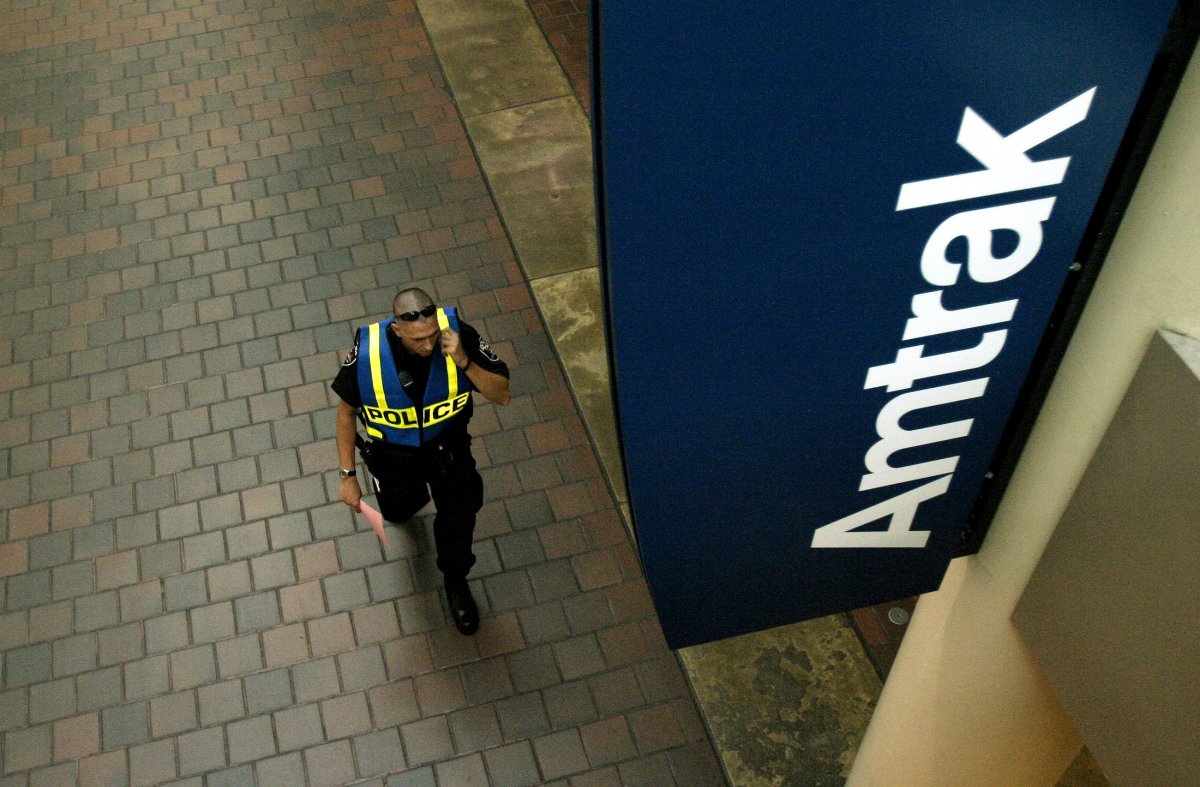
RTRGTJZREUTERS/Shaun Heasley An Amtrak police officer patrols inside Union Station in Washington July 7, 2005. The U.S. raised its terrorism alert level from “elevated” to “high” for buses, subways and trains on Thursday amid concerns of copycat attacks following deadly bombings in London.

This last reader was once inconvenienced for an hour while the DEA searched her Amtrak train. And then, on a separate occasion, she witnessed the border patrol disturbing the sleep on Amtrak customers on a train that stayed within the United States:

Travelling westbound on Lake Shore Limited in 2012, I recall beingwoken up by either Border Patrol or a State Trooper and asked for ID in Syracuse, N.Y. around 1 AM. (The Lake Shore Limited does not crossinternational borders.) The story was this—the law enforcement agent(who was very polite) woke everyone up gently, one at a time, andasked if they were U.S. citizens. Almost everyone said yes, and thosewho said yes were left alone. I said no (I am not a U.S. citizen) and
then was asked for ID. As it happened, I did not actually have any IDon me, except for a local government employee ID issued by a New York State authority. (Since I was not crossing international boundaries, I did not carry my passport nor my USCIS Permanent Resident Card—and do not routinely carry my driver’s licence unless I am driving.)

I think, technically, I was supposed to carry some form of governmentissued ID while travelling onboard Amtrak but my government-issuedemployee ID had served as an acceptable form of ID for that purpose.After a little dialogue, I think the agent decided I was not suspicious and simply moved along. I can’t honestly say I felt intimidated but I also recognize that it could have gone down very differently for someone who is not used to dealing with such situations, or someone having a different profile—or indeed someone who legitimately forgot their ID at home.

Although I have far more readers on the Acela corridor than anywhere else on the Amtrak system, and although that corridor serves the most passengers by a wide margin, I have yet to receive a story of anyone being harassed by the DEA on that route. Maybe that’s a coincidence. Maybe there just aren’t many drugs flowing in and out of Boston, New York City, and Washington, D.C. Or maybe the DEA knows that if it tried such tactics on the power elites of those cities it’d be reined in.

Many Military, Police And Businessmen Are Made Members of Outlaw Motorcycle Gangs!

Most folks have only a vague concept of the hard core biker world. I have been a biker for over 50 years as you might gather from my profile image when you mouse over my icon… Though I am much older and a lot slower, (and wiser) now I have known many 1%er bikers through the years .

I have participated in runs and partied with them at their rallies and clubhouses back in my “Bad Old Days”. I have been offered probate status on more than one occasion.

I have long been aware of their infiltration into the upper echelons of business, military and every facet of the “legitimate” world. I am aware that many are at CEO levels and positions of power in the Military/Industrial Complex.

A 1%er owes allegiance only to his club. He swears a death oath to that effect before he gets his bottom rocker. (Full membership status.) However the information in this article still surprises me.

Enough said. Just be sure to click on the PDF file at the bottom of this post. You might what to save it for future reference.

FREEDOM RIDER

———————————————————————————-

Exclusive: Leaked Report Profiles Military, Police Members of Outlaw Motorcycle Gangs

Featured photo - Exclusive: Leaked Report Profiles Military, Police Members of Outlaw Motorcycle Gangs

A P

Nuclear power plant technicians, senior military officers, FBI contractors and an employee of “a highly-secretive Department of Defense agency” with a Top Secret clearance. Those are just a few of the more than 100 people with sensitive military and government connections that law enforcement is tracking because they are linked to “outlaw motorcycle gangs.”

A year before the deadly Texas shootout that killed nine people on May 17, a lengthy report by the Bureau of Alcohol, Tobacco, Firearms and Explosives detailed the involvement of U.S. military personnel and government employees in outlaw motorcycle gangs, or OMGs. A copy of the report was obtained by The Intercept.

The report lays out, in almost obsessive detail, the extent to which OMG members are represented in nearly every part of the military, and in federal and local government, from police and fire departments to state utility agencies. Specific examples from the report include dozens of Defense Department contractors with Secret or Top Secret clearances; multiple FBI contractors; radiological technicians with security clearances; U.S. Department of Homeland Security employees; Army, Navy and Air Force active-duty personnel, including from the special operations force community; and police officers.

A photo from the ATF report on Outlaw Motorcycle Gangs.

“The OMG community continues to spread its tentacles throughout all facets of government,” the report says.

The relationship between OMGs and law enforcement has come under scrutiny after it became known that law enforcement were on site in Waco bracing for conflict.

The 40-page report, “OMGs and the Military 2014,” issued by ATF’s Office of Strategic Intelligence and Information in July of last year, warned of the escalating violence of these gangs. “Their insatiable appetite for dominance has led to shootings, assaults and malicious attacks across the globe. OMGs continue to maim and murder over territory,” the report said. “As tensions escalate, brazen shootings are occurring in broad daylight.”

The ATF report is based on intelligence gathered by dozens of law enforcement and military intelligence agencies, and identifies about 100 alleged associates of the country’s most violent outlaw motorcycle gangs and support clubs who have worked in sensitive government or military positions.

Those gangs “continue to court active-duty military personnel and government workers, both civilians and contractors, for their knowledge, reliable income, tactical skills and dedication to a cause,” according to the report. “Through our extensive analysis, it has been revealed that a large number of support clubs are utilizing active-duty military personnel and U.S. Department of Defense (DOD) contractors and employees to spread their tentacles across the United States.”

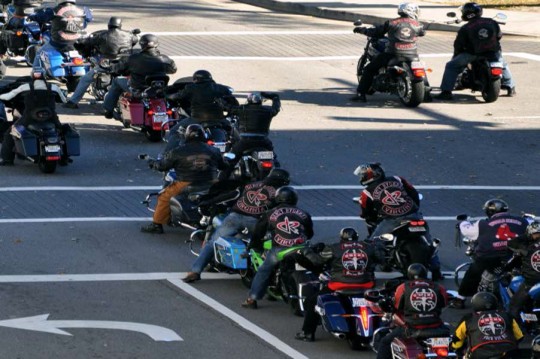
The report predicted that six dominant OMGs — Mongols, Hells Angels, Outlaws, Pagans, Bandidos and Vagos — would continue to expand, with escalating violence. The groups are known as “one-percenter” clubs, a moniker they proudly use to denote their outlaw status. The report identifies the most violent as Bandidos and Hell’s Angels support clubs — the same groups involved in a deadly shootout in Waco, Texas on Sunday.

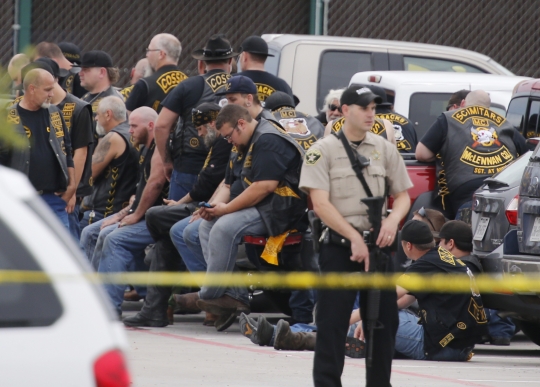
The deadly confrontation involved the Bandidos and a rival club, the Cossacks MC, who are backed by Bandidos’ arch rivals, the Hell’s Angels. The shootout was part of a ongoing turf battle: Without permission from the Bandidos, Cossacks members have begun wearing a patch on their vests that claims Texas as the club’s territory — a figurative thumb in the eye of the Bandidos, long the state’s dominant motorcycle club. Nine people were killed and more than 170 bikers were arrested in the noontime showdown.

On Wednesday, law enforcement in Texas confirmed to several media outlets that one of the bikers arrested in the massive post-shootout sweep was a former San Antonio police detective, who joined the Bandidos after retiring from the department after 32 years.

The ATF report identifies the Bandidos as the dominant and most violent of the motorcycle gangs in Texas, Louisiana and Mississippi, and identifies a staff sergeant instructor in the United States Air Force, currently stationed at Keesler Air Force Base, as the president of the local Pistoleros chapter, a Bandidos support club. According to the report, he routinely hosts parties for active duty military personnel.

In response to questions about the report, an ATF spokesperson said, “This was supposed to be solely a law enforcement tool to help fight violent crime. It was not supposed to be out there in the ether for general consumption.” The Intercept, after consulting with ATF, has redacted some portions of the report.

In an interview, Edward Winterhalder, a former high-ranking member of the Bandidos who left the club in 2003, said that while military veterans have long been involved in motorcycle clubs — many of the current outlaw clubs were formed in the wake of World War II — current-duty military or law enforcement members are not generally involved in the most violent gangs.

According to Winterhalder, biker clubs not associated with the violent one-percenters have many government employees — current military, law enforcement and firefighters — as members. Indeed, some clubs have emerged that pointedly disavow any connections to violence or lawlessness, or that specifically bill themselves as a LEMC — law enforcement motorcycle club.

Among those are the Iron Circle LEMC, a Texas club formed in 2006; the Arizona-founded Roughnecks Country MC — for the “99 percent … that gives a shit about society and the laws that govern the world we live in”; the Iron Order MC, a fiercely independent club that strongly rejects the ethos of the one-percenters; and the Protectors LEMC, which requires a criminal background check for prospective members.

Nonetheless, the report documents extensive involvement of current-duty military and government personnel in the outlaw groups, and does not mention LEMCs.

The report is a testament to how seriously law enforcement takes the issue of outlaw motorcycle gangs, detailing extensive surveillance; the document below includes copies of military or government identification photos, some gained from traffic stops, and information from what appears to be close monitoring of military and government officials who attend the groups’ gatherings and activities across the country.

CLICK ON THE PDF FILE BELOW!!!

Democrats call for ‘flood’ of Muslims to U.S.

By Leo Hohmann http://www.wnd.com/2015/05/democrats-call-for-flood-of-muslims-to-u-s/

A group of 14 Democrat senators has written a letter to President Obama urging him to “dramatically increase” the number of Syrian refugees being resettled into American cities and towns.

They say the U.S. needs to take in at least 65,000 Syrians as permanent refugees over the next year-and-a-half.

“While the United States is the largest donor of humanitarian assistance to Syrian refugees, we must also dramatically increase the number of Syrian refugees that we accept for resettlement,” says the four-page letter to Obama, copied to Secretary of State John Kerry and Homeland Security Secretary Jeh Johnson.

More than 3.5 million Syrians are registered with the United Nations as refugees, and the U.N. wants to assign about 350,000 of them to so-called “third-party countries.”

The 14 senators, led by Richard Durbin, D-Ill., Amy Klobuchar, D-Minn., and Diane Feinstein, D-Calif., cite the research of the Refugee Council USA to make their case for 65,000 Syrian refugees by the end of 2016. RCUSA is the main lobbying arm of the nine agencies that contract with the federal government to resettle refugees in cities and towns across America.

The more refugees brought into the country, the more government grants doled out to the nine resettlement agencies. Among them are the U.S. Conference of Catholic Bishops, Lutheran Immigration and Refugee Service, Hebrew Immigrant Aid Society, Church World Service, International Rescue Committee and the National Association of Evangelicals’ World Relief.

More than 90 percent of Syrian refugees will be Muslim

Of the 843 Syrians resettled in the U.S. since the start of the Syrian civil war, 92 percent have been Muslim and about 7 percent Christian. Syria’s overall population is 90 percent Muslim and close to 10 percent Christian.

“The vast majority of these refugees are women and children, including two million children,” the letter states, using language similar to what Democrats used to justify the entry of some 60,000 unaccompanied alien children from Central America last year. “An entire generation of Syrian children is at risk.

“More than ten thousand Syrian children have been killed, and half of Syrian refugee children are not attending school, more than one-hundred thousand are working to support their families, and thousands are unaccompanied or separated from their parents.

“[W]e urge your Administration to work to accept at least 50 percent of Syrian refugees whom UNCHR [United Nations High Commissioner for Refugees] is seeking to resettle, consistent with our nation’s traditional practice under both Republican and Democratic Presidents.”

The letter also addresses the security concerns about accepting Syrians who may have ties to the various Islamic extremist factions fighting to overthrow and replace Syrian dictator Bashar Assad. Among them are ISIS, Jabat al-Nusra and the Free Syrian Army.

“We fully support your Administration’s efforts to ensure that any potential security concerns are addressed by strengthening security checks for refugees with the latest technology and information,” the letter states.

“Refugees are the most carefully vetted of all travelers to the U.S., with extensive biometric, biographic, intelligence, and law enforcement checks involving numerous agencies,” the letter says, parroting the U.S. State Department talking points about the quality of the screening process for refugees.

The problem with that argument, however, is that it has been debunked by FBI counter-terrorism experts who have openly admitted it is virtually impossible to screen Syrian refugees, precisely because U.S. agents don’t have access to reliable biometric and law enforcement data. As WND previously reported, Michael Steinbach, deputy assistant director of the FBI counter-terrorism unit, admitted at a hearing before the House Homeland Security committee on Feb. 11 that reliable records are not available in a “failed state” like Syria.

The House Homeland Security Committee was schedule to hold another hearing this week on the national security risks associated with the Syrian refugees, but that hearing was postponed Thursday until further notice.

The letter being sent to Obama makes the upcoming House hearing even more pivotal as the battle over this issue heats up on both sides of the aisle, with Democrats pushing for more Syrians and Republicans pushing for less.

‘A serious mistake’

Rep. Michael McCaul, R-Texas, chair of the House Homeland Security Committee, says resettling Syrian refugees in the U.S. is a “serious mistake” and should be stopped until safeguards are in place.

“We have no way … to know who these people are, and so I think bringing them in is a serious mistake,” said McCaul during a press conference Thursday.

McCaul said the U.S. has “no intelligence footprint or capability” inside Syria to ensure refugees mean no harm.

“We don’t have databases on these individuals so we can’t properly vet them,” he added, “to know where they came from, to know what threat they pose, because we don’t have the data to cross-reference them with.”

McCaul, who has visited Syrian refugee camps overseas, said that while there are “a lot of mothers and kids, there are [also] a lot of males of the age that could conduct terrorist operations.”

“That concerns me,” he added.

Former Congresswoman Michele Bachmann, R-Minn., is equally concerned.

“It is virtually impossible for the United States government to ‘vet’ Syrian refugees prior to resettlement in the U.S.,” Bachmann told WND. “Bringing Syrians into the U.S. is more than a terrible idea, it could be deadly for innocent American citizens.”

‘Give me your tired…’

The U.S. takes in more refugees than any other country by far. In the current fiscal year it has committed to accept 70,000 and some years it has been as high as 200,000. Almost all of the refugees coming to the U.S. are selected by United Nations High Commissioner for Refugees Antonio Guterres.

Also playing against the Democratic senators argument is the recent string of arrests of Somali refugees and children of Somali refugees. Just last month six Somali young men were arrested and charged with trying to leave the country to fight for ISIS. Two of them used their college student loan money to pay for plane tickets to Turkey.

Dozens of others have gone to fight with al-Shabab in Somalia and still others have been arrested, charged and convicted of providing money or other material support to overseas terrorist organizations.

Somalia, like Syria, is a failed state where the U.S. has no military presence and no access to reliable law enforcement data, said Steven Camarota, director of research at the Center for Immigration Studies.

“This issue has obviously come up before. We’ve had a bunch of people who have come in as refugees and committed terrorist acts, or tried to commit terrorist acts,” said Camarota. “But I think the underlying question is, one, the ability to vet people from a war-torn country that had poor record keeping to begin with is virtually nonexistent now. There’s simply no way to know what people have done in the past from a country like Syria.

“All we know about Syria is that powerful and well-organized terrorist groups operate throughout the country,” he said.

Lessons learned or mistakes repeated?

Even if they could be adequately screened, experience proves that the children of Muslim immigrants are sometimes in more danger of being radicalized than their parents, Camarota said.

He points to numerous recent cases like that of Hoda Muthana, the 20-year-old daughter of Muslim parents who emigrated from Yemen more than 20 years ago and settled in Birmingham, Alabama. She left to fight for ISIS in November after being recruited over the Internet. Her parents have been “traumatized” by losing their oldest daughter, according to an article by AL.com.

The fact that some arrive as “children” is also no guarantee against radicalization. Some are radicalized online or in American mosques after they become teens and young adults.

That’s what happened to the Tsarnaev brothers, who carried out the Boston Marathon bombing. They came as asylum seekers as young boys with their parents from war-torn Chechnya.

“Unfortunately, a number of people who have come as refuges became radicalized after they arrived in the United States, including the Tsarnaev brothers. The younger brother, who just got convicted, was a young boy when he arrived with his family,” Camarota said.

“We’ve had a number from Somalia who have gone to fight for ISIS or al-Shabab who came to America at young ages,” he added. “Unfortunately, we’ve also seen a number of cases where people have been radicalized after they got here from Somalia.”

There is an alternative that low-immigration advocates such as Camarota say could be more effective in helping the plight of true refugees.

“We can help countries in the region resettle these folks, provide resources to countries like Jordan, and countries like Saudi Arabia, which is a rich country with lots of space,” he said. “And because they would be close to their home countries they could return once the war is over.”

Resettling refugees costs the American taxpayer $1.5 billion a year, and that does not include the cost of social welfare benefits. Unlike other immigrants, refugees immediately qualify for government benefits such as food stamps, temporary assistance for needy families, or TANF, subsidized housing and Medicaid health care.

“Instead, that money could be used to help a lot more people resettle in the Middle East region, making it more likely that their life would be less disrupted and they would be more likely to return home,” Camarota said. “We could help more people and make it more likely rather than bring a tiny number here at huge costs and bring these risks to national security.”

Clare Lopez, vice president for research and analysis at the Center for Security Policy, said taking in more Syrian refugees poses risks that must be balanced against humanitarian concerns.

“Welcoming more Syrian refugees to the U.S. would be a generous move to make, so long as they can be vetted to exclude any who identify with a jihadist ideology or worse yet, are jihadis themselves,” she said. “It would also make sense to be sure we select those who will most easily assimilate to America’s Judeo-Christian-based legal system and Western-style democratic society.”

While the lobbying group Refugee Council USA refers to itself as nonprofit and bipartisan, refugee watchdog Ann Corcoran doesn’t buy it.

She said conservatives shouldn’t be fooled by the “church sounding names” of RCUSA’s member organizations (see list here).

“Looking at this list they all appear to be from the hard left,” said Corcoran, who follows the refugee movement at her blog, Refugee Resettlement Watch.

The senators’ letter closes by saying: “[I]t is a moral, legal, and national security imperative for the United States to lead by example in addressing the world’s worst refugee crisis of our time by greatly increasing the number of Syrian refugees who are resettled in our country. Thank you for your time and consideration.”

_________________________________________________

author-image Leo Hohmann

Leo Hohmann is a news editor for WND. He has been a reporter and editor at several suburban newspapers in the Atlanta and Charlotte, North Carolina, areas and also served as managing editor of Triangle Business Journal in Raleigh, North Carolina.

Say WHAT, Your Holiness???

Pope calls Palestinian leader ‘angel of peace’ during visit

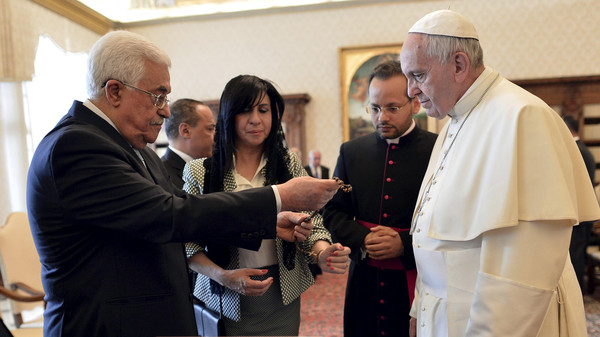
Palestinian President Mahmoud Abbas gives Pope Francis a rosary during a private audience at the Vatican City. (Reuters)

Associated Press, Vatican City
Saturday, 16 May 2026

Your Government-Approved Diet May Kill You

Congress became directly involved during the 1970s in the question of what the American people ought to eat

by Aaron Tao | Mises.org | May 22, 2026


Is there a greater tragedy imaginable than that, in our endeavour consciously to shape our future in accordance with high ideals, we should in fact unwittingly produce the very opposite of what we have been striving for? — F. A. Hayek

Most of us “know” that eating too much saturated fat (which includes red meat, dairy products, and eggs) raises our cholesterol levels and puts us at risk for heart disease.

While we’re at it, we should greatly cut down on the salt too. These lessons are reinforced in our health classes and what the media has been telling us for decades. After all, this is the consensus reflected in the “Dietary Guidelines for Americans” issued by the United States Department of Agriculture (USDA) and backed up by allegedly solid, objective science from the National Institutes of Health (NIH). As extra reassurance, the Food and Drug Administration (FDA) will use its regulatory authority to crack down on trans fats, the worst villain of them all.

Despite the appearance of a seemingly united front in the war on obesity, sharp dissent over sound nutrition policy is silently bubbling beneath the surface. It may be a sign of the times that fundamental challenges have come to the forefront and are becoming increasingly accepted. Growing numbers of scientists are expressing public skepticism toward the federal government’s official low-salt guidelines. Back in February of this year, the government’s top nutrition panel withdrew its nearly forty-year-old warning on restricting cholesterol intake and grudgingly concluded that “available evidence shows no appreciable relationship between consumption of dietary cholesterol and [blood] cholesterol.”

The Health Consensus Unravels

In one of the Wall Street Journal’s top-shared op-eds of 2014, investigative journalist Nina Teicholz threw down the gauntlet on the mainstream diet guidelines on fat:

“Saturated fat does not cause heart disease” — or so concluded a big studypublished in March in the journal Annals of Internal Medicine. How could this be? The very cornerstone of dietary advice for generations has been that the saturated fats in butter, cheese and red meat should be avoided because they clog our arteries. For many diet-conscious Americans, it is simply second nature to opt for chicken over sirloin, canola oil over butter.

The new study’s conclusion shouldn’t surprise anyone familiar with modern nutritional science, however. The fact is, there has never been solid evidence for the idea that these fats cause disease. We only believe this to be the case because nutrition policy has been derailed over the past half-century by a mixture of personal ambition, bad science, politics and bias.

Teicholz elaborates upon her thesis in her eye-opening, best-selling book The Big Fat Surprise: Why Butter, Meat and Cheese Belong in a Healthy Diet. With over 100 pages of footnotes and an extensive bibliography, it is clear that Teicholz has done her homework. In her nine-year investigation, she extensively reviewed the scientific literature and interviewed many of the key personalities in government, private industry, and advocacy groups who played influential roles in crafting official nutrition policy. While many people might be tempted to blame “the nefarious interests of Big Food,” Teicholz came to discover that the “source of the our misguided diet advice … seems to have been driven by experts at some of our most trusted institutions working towards what they believed to be the public good.”

The Rise of the Government Expert

Civic-minded Americans are generally familiar with Dwight D. Eisenhower’s famous warning in his farewell address to “guard against the acquisition of unwarranted influence … by the military-industrial complex.” Yet, there is another passage that deserves equal if not greater attention. Against the backdrop of the Cold War, numerous intellectuals were conscripted to become part of Leviathan, silencing their proper roles as critics of power:

Today, the solitary inventor, tinkering in his shop, has been overshadowed by task forces of scientists in laboratories and testing fields. In the same fashion, the free university, historically the fountainhead of free ideas and scientific discovery, has experienced a revolution in the conduct of research. Partly because of the huge costs involved, a government contract becomes virtually a substitute for intellectual curiosity. … The prospect of domination of the nation’s scholars by Federal employment, project allocations, and the power of money is ever present — and is gravely to be regarded.

Yet, in holding scientific research and discovery in respect, as we should, we must also be alert to the equal and opposite danger that public policy could itself become the captive of a scientific-technological elite.

There is no better example of “public policy … becom[ing] the captive of a scientific-technological elite” than with what happened with nutrition research and health policy. Ironically, the story of how saturated fat became demonized began in the Eisenhower years. After President Eisenhower suffered a heart attack, Washington policymakers became alarmed by the disease that was suddenly striking the ruling elite. After going into “Do Something!” crisis mode, it wasn’t long before they came under the sway of experts who offered easy answers. One such individual was Dr. Ancel B. Keys, the originator of the hypothesis that saturated fat causes heart disease. Keys went on to exercise perhaps the greatest influence in the “history of nutrition” through professional and personal dominance.

Opponents of the saturated fat–heart disease hypothesis included accomplished scientists George V. Mann and E.H. “Pete” Ahrens, who voiced many legitimate criticisms. But in the end, they were no match for the unprecedented changes rammed through by Keys and his sidekick Jeremiah Stamler. Through their efforts, these two men and their supporters blurred the line between objective scholarship and political advocacy. It wasn’t long before most skeptical nutrition researchers were browbeaten into submission, relegated to sidelines, or otherwise drowned out as the zeitgeist ultimately shifted in favor of Keys’s hypothesis and preferred solutions.

Dogma is a term that is usually associated with fundamentalist religions. But unfortunately, even scientists who are supposedly trained to think critically and independently are not immune to groupthink, the temptations offered by political prestige, and the limits of what’s “acceptable” as dictated by funding. Despite the shortcomings of various studies that appeared to provide a solid scientific backing, the saturated fat–heart disease hypothesis became a dogma when it was formally institutionalized within the US government’s public health bureaucracies. This was thanks to Keys’s relentless advocacy and intimate relations he established with the American Heart Association (AHA). The influence of the AHA over nutrition policy cannot be overstated. In fact, the “AHA and NIH were parallel, entwined forces from the start.” As the two main organizations responsible for setting the agenda and distributing millions in funds for cardiovascular research, it was increasingly difficult to “reverse course and entertain other ideas” even as the saturated fat diet–heart disease hypothesis continued to disappoint because it “had become a matter of institutional credibility.”

Congress and “Big Food”

To make matters worse, Congress became directly involved during the 1970s in the question of what the American people ought to eat. Teicholz explained how the Beltway culture allowed for bad ideas to take hold and stay entrenched (as anyone who has worked there can attest to):

With its massive bureaucracies and obedient chains of command, Washington is the very opposite of the kind of place where skepticism — so essential to good science — can survive. When Congress adopted the diet-heart hypothesis, the idea gained ascendancy as an all-ruling, unassailable dogma, and from this point on, there has been virtually no turning back.

Big Food manufacturers and lobbyists descended onto Washington and set up the Nutrition Foundation to funnel millions into research and thus were “able to influence scientific opinion as it was being formed.” Not surprisingly, “the promotion of carbohydrate-based foods such as cereals, breads, crackers, and chips, was exactly the kind of dietary advice large food companies favored.” These foods ended up receiving glowing endorsements from the official government nutrition elite. Despite what some might expect, meat and dairy interests’ lobbying efforts paled in comparison. Carbs and polyunsaturated fats (vegetable oils) were overwhelmingly favored over saturated fats. Consumption of red meat became increasingly demonized as new studies highlighted supposedly detrimental health consequences. Left-wing environmental movements also picked up steam during this time. In the name of “sustainability,” these campaigns and their advocates urged the reduction if not the complete elimination of meat from one’s diet.

The Data Doesn’t Say What Congress Thinks it Says

Throughout the book, Teicholz reviews the scientific literature by critically examining the hard data, not abstracts or executive summaries (the only sections most policymakers and researchers alike will ever read), and repeatedly points out various methodological flaws and limitations. In particular, she takes care to emphasize that epidemiological studies can show only an association between two elements, but “could not establish any casual connection.” Only clinical trials in carefully controlled settings could establish cause. Shockingly, almost all the early studies that were cited to support Keys’s hypothesis were epidemiological. The famous Seven Countries Study directed by Keys himself was an epidemiological study that appeared to show a strong correlation between consumption of saturated fat and heart disease deaths across international populations. Teicholz pointed out many confounding variables such as the fact that Keys examined the Mediterranean region in the aftermath of World War II. During this period, people were impoverished and ate abnormal diets. In addition, Teicholz revealed that Keys conducted some of his surveys during Lent (no meat for the faithful!) along with some other egregious examples of cherry-picking to fit his preferred narrative. Other prominent studies all suffered from similar defects. The Framingham Heart Study originally announced that high total cholesterol was a reliable predictor for heart disease, but a follow-up study thirty years later called those results into question.The Israeli Civil Service Study mentioned worshiping God lowered the risk of a having heart attack! Even with their weaknesses, these studies were repeatedly cited and the idea that saturated fat leads to heart disease continued to build into conventional wisdom.

Having studied anthropology, I was delighted that Teicholz highlighted glaring “paradoxes” by digging out several examples of indigenous populations that ate almost all meat and animal fat such as the Inuit and theMasai yet had virtually no recorded cases of heart disease, obesity, or any of the chronic diseases of Western civilization (that is until they added sugar and refined carbs to their diet). In her analyses of the clinical trials meant to establish cause and effect, she noted a disturbing caveat that came up repeatedly but was often buried: namely, following low-saturated fat diets did not extend overall lifespan. Speaking of clinical trials, it is worth mentioning the Women’s Health Initiative (WHI), which enrolled 49,000 women in 1993 and aimed to validate the benefits of a low-fat diet once and for all. Here are the final disappointing results as summarized by Teicholz:

[A]fter a decade of eating more fruits, vegetables, and whole grains while cutting back on meat and fat, these women not only failed to lose weight, but they also did not see any significant reduction in their risk for either heart disease or cancer of any major kind. WHI was the largest and longest trial ever of the low-fat diet, and the results indicated that the diet had quite simply failed.

As Teicholz moved toward the present day state of affairs, she cites the work of award-winning science journalist Gary Taubes and a few brave, unorthodox researchers including Stephen D. Finney and Jeff S. Volek, who challenged the taboo against red meat and fat. Thanks to high-profile pieces in Science and the New York Times as well as a comprehensive book, Good Calories, Bad Calories, Taubes was more responsible than anyone in reopening the debate that carbohydrates, not fat, are the drivers of obesity and other chronic diseases. Even as more people today become aware of the deleterious effects from consuming high amounts of refined carbs and sugars, the permanent damage has been done thanks to the long-standing bias toward the saturated fat–heart disease hypothesis. Official policymakers embraced this view, advocacy groups added fuel to the fire, and restaurants and cafeterias altered their menus. Millions of Americans changed their eating patterns and avoided meat, cheese, milk, cream, and butter. In the end, the results are not pretty:

Measured just by death and disease, and not including the millions of lives derailed by excess weight and obesity, it’s very possible that the course of nutrition advice over the past sixty years has taken an unparalleled toll on human history. It now appears that since 1961, the entire American population has, indeed, been subjected to a mass experiment, and the results have clearly been a failure. Every reliable indicator of good health is worsened by a low-fat diet. … Despite more than two billion dollars in public money spent trying to prove that lowering saturated fat will prevent heart attacks, the diet-heart hypothesis has not held up.

By the end of the book, it seemed very clear that almost everything Uncle Sam told us about the “dangers” of saturated fat is completely wrong. That being said, it is past time to demolish the USDA food guide pyramid. Let Teicholz’s exposé serve as a warning when political crusaders and their bureaucratic allies are allowed to force top-down solutions on everyone without ever having to face accountability for their mistakes no matter how egregious.

FEDS: Cancer Charities scammed $187 Million from Donors

http://www1.actionnewsnow.com/news/feds-cancer-charities-scammed-187-million-from-donors/

Feds: Cancer charities scammed $187 million from donors

Let the donor beware: A federal lawsuit alleges four cancer charities have scammed consumers out of more than $187 million.

The Federal Trade Commission and attorneys general in all 50 states and the District of Columbia announced Tuesday they have filed a lawsuit against the Cancer Fund of America, Children’s Cancer Fund of America, Cancer Support Services and the Breast Cancer Society alleging they violated federal and state regulations. All four charities are run by members of the same family or their close business associates, as detailed in the 2013 “America’s Worst Charities” joint report from the Tampa Bay Times and the Center for Investigative Reporting.

“The defendants’ egregious scheme effectively deprived legitimate cancer charities and cancer patients of much-needed funds and support,” Jessica Rich, director of the FTC’s Bureau of Consumer Protection, said in a statement. “The defendants took in millions of dollars in donations meant to help cancer patients, but spent it on themselves and their fundraisers.”

Children’s Cancer Fund of America and the Breast Cancer Society have entered into a settlement agreement and will be dissolved. Three of the groups’ executives-Rose Perkins, president and director of the Children’s Cancer Fund of America, James Reynolds II, executive director and former president of the Breast Cancer Society and Kyle Effler, chief financial officer of Cancer Fund of America and Cancer Support Services and former president of Cancer Support Services-have also agreed to settle charges against them. They will be banned from fundraising, charity management and oversight of charitable assets. Judgments against the groups and their executives total $137 million-which will be redirected to cancer patients. A lawsuit will proceed against Cancer Fund of America Inc., Cancer Support Services Inc. and their president, James Reynolds Sr.

Calls to the Cancer Fund of America and Children’s Cancer Fund of America were not immediately returned. Phone lines listed for Cancer Support Services and The Breast Cancer Society appear to have been disconnected. The Breast Cancer Society’s website has been replaced with a letter from executive director James T. Reynolds II to supporters. “While the organization, its officers and directors have not been found guilty of any allegations of wrongdoing, and the government has not proven otherwise,” he said in the letter, “our board of directors has decided that it does not help those who we seek to serve, and those who remain in need, for us to engage in a highly publicized, expensive, and distracting legal battle around our fundraising practices.”

Professional fundraisers

Over the course of 2008 to 2012, the lawsuit claims, 85 percent of the more than $187 million the four groups raised went to professional fundraisers. Operators used much of the remaining donations to cover their salaries and personal expenses, including trips to Disney World, concert tickets and dating site memberships.

Just 3 percent of the collective funds raised allegedly went to charitable purposes. According to a statement from the office of New York Attorney General Eric Schneiderman: “Among other things, the charities or their telemarketers allegedly falsely told donors that their contributions would be used to provide pain medication to children suffering from cancer, to transport patients to chemotherapy appointments, and to pay for hospice care for dying patients. None of these services are believed to have actually been provided.”

The groups also allegedly used deceptive accounting schemes, improperly reporting more than $223 million in revenue and program spending over 2008 to 2012. Doing so made them appear to be larger organizations and operating more efficiently than they were.

The lawsuit serves as a reminder to consumers to vet nonprofits carefully before donating. Americans gave $335.17 billion to charity in 2013, according to the Giving USA 2014 report, put out by the Giving USA Foundation and the Indiana University Lilly Family School of Philanthropy. Health charities received $31.86 billion of that, up 4.5 percent from 2012.

“It is heart-breaking news to learn that many Americans were deceived into contributing by charity bad actors,” H. Art Taylor, president and CEO of the BBB Wise Giving Alliance, said in a statement. “People want to help when they hear about a good cause, but donors need to be aware of potential deceptions, so their hard-earned money can go to charities they can trust.”

Looking at the larger nonprofit sector, problem organizations are rare, said Patrick Rooney, associate dean for research and academic affairs at the Indiana University Lilly Family School of Philanthropy. “It’s a very small percentage of the total charities, but it is something we have to be aware of,” he said.

Speaking broadly about cancer charities, Daniel Borochoff, president of evaluator site CharityWatch.org, said unfortunately, shady accounting practices aren’t unheard of. Pick the wrong group, and very little of your donation may make it to patients in need or medical research, he warned.

“It’s very easy for them to disguise a lot of their fundraising and solicitation costs as public services,” he said. For example, if the fund-raising volunteer reminds you to do monthly breast self-exams or urges you to quit smoking, some of the expenses related to that solicitation could be fudged as a preventative services program.

Digging through details

Figuring out which health nonprofits are legitimately helping patients or funding laboratory research comes down to digging through the details of income and spending in annual reports and financial filings. “You’ve got to hone in on, are these bona fide, legitimate programs?” Borochoff said. “And that can be tricky.” Research might mean marketing research, for example, rather than grants to laboratories and hospitals, so it’s important to look closely at the descriptions.

The faster route: Check into a prospective charity before donating using an evaluator site, said Rooney. CharityWatch.org, the Better Business Bureau’s Wise Giving Alliance or CharityNavigator.org assess groups’ finances and transparency, among other factors. It’s not a fool-proof strategy because not every nonprofit gets rated, but it can help consumers quickly sort their options.

Make sure you have the right name, too. “Some groups sound almost exactly the same, but one gets an A and one gets an F,” said Borochoff. For example, CharityWatch.org rates the Breast Cancer Research Foundation an A+, but the Breast Cancer Relief Foundation an F. (All four of the groups named in the lawsuit got an F rating on CharityWatch.org.)

Another easy tip: If you get a charity telemarketing call, hang up the phone. It’s better to research a charity and then give directly. Two of the groups targeted in the lawsuit, Children’s Cancer Fund of America and Cancer Support Services, have one-star ratings out of a possible four on CharityNavigator.org. “Looking at these groups, at least the comments we have from the public, they seem to be pretty aggressive with telemarketing,” said Sandra Miniutti, chief financial officer and vice president of marketing for CharityNavigator.org. (The Breast Cancer Society and the Cancer Fund of America are not rated on the site.)

Telemarketing is common among health nonprofits, and such aggressive phone campaigns are a red flag that the charity is operating inefficiently, said Miniutti. They’re relying on an emotional, impulse donation. “We find many times the bulk of the money collected is staying in the telemarketers hand,” she said-under some contracts, as little as 5 to 10 percent of your pledge goes to the charity. “I think if donors knew that, they’d be more willing to hang up the phone,” she said, and do their own research.

Signs Of Our Times: “Achtung Juden”

40 Person Mob Assaults 2 Jews on Paris’ Boulevard Voltaire…

Eliezer Sherman - http://www.algemeiner.com/

Two Jews were attacked by a 40 person mob on Paris’ Boulevard Voltaire on Friday.

Two Jewish residents of Paris were assaulted on the street by a gang of about 40 people on Friday, Israeli French JSS News reported, citing antisemitism watchdog the Bureau National de Vigilance Contre l’Antisemitisme (BNVCA).

The attack against the two Jewish victims, both in their 20s, occurred at about 2:30 p.m. on Boulevard Voltaire in Paris’ 11 arrondissement, according to the report.

The gang of attackers was associated with the anti-Israel groups Gaza Firm and the Boycott, Divestment and Sanctions campaign, according to security personnel responsible for protecting the Jewish community.

Police launched an investigation into the incident and warned local Jewish business owners to be extra vigilant, JSS News said.

Witnesses on the scene said that members of the Jewish community volunteered to watch over the many Jewish-owned stores on Boulevard Voltaire, according to the BNVCA.

The attack marks the latest in a growing antisemitic trend in France, and Europe as a whole. Earlier this year, an Islamist gunman seized a Kosher supermarket in Paris and killed four Jewish hostages. Just a few weeks later, a security guard was killed in Copenhagen when a lone gunman opened fire in front of the city’s Great Synagogue.

In 2006, a French Jew was kidnapped from his cell phone store on the same Boulevard Voltaire. He was tortured and ultimately killed.

Follow

Get every new post delivered to your Inbox.

Join 1,359 other followers

%d bloggers like this: