




Daily Archives: March 6, 2026

Sunday Talks - Donald Trump Sunday Interviews…

The Last Refuge

CBS Face The Nation

View original post 3 more words

NBC/WSJ Michigan Poll - Donald Trump 41%, Ted Cruz 22%, Marco Rubio 17%…

The Last Refuge

The bad news is this poll (full pdf below) comes promoted by NBC/WSJ via Mark Murray. The good news is they purchased the poll from Marist Polling, a more reliable source than prior NBC/WSJ sources (public relations firms).

However, all of that being said, the most recent polling has been substantively wrong when compared to primary election results.

(FULL POLL DATA)

It’s actually a little surprising that John Kasich would not be doing better in Michigan than these results reflect. The ‘Open’ Primary Election is Tuesday, March 8th and there are 59 Delegates proportionally available in a ‘winner-take-most’ outcome.

View original post 29 more words

Nancy Reagan 1921 - 2016

Sad…but I still liked Jane Wyman better than Nancy…

The Last Refuge

Together again:

RIP

View original post

This Is A Movement…

YES!!!!!!!!!!!!!!!

The Last Refuge

This is Our Movement:

View original post

3 problems Trump must fix to beat Hillary

3 problems Trump must fix to beat Hillary

http://nypost.com/2016/03/05/dont-panic-gop-donald-trump-can-beat-hillary/

3 problems Trump must fix to beat Hillary

At the end of “The Candidate,” the  engrossing 1972 film about the underbelly of campaigns, rookie  politician Robert Redford is  shocked by his triumph. Grabbing his handler, he pleads, “What do we do now?”

In a case of life imitating art, Donald Trump finds himself in a similar situation. His improbable run is rocking and shocking the world, but after each victory, the climb only gets steeper.

The home stretch of the nomination race is going to be ferocious, and if he survives, he faces a general-election war against Hillary Clinton that would be unlike any in modern times.

Is Trump built to go the distance? Can the author of “The Art of the Deal” close the deal of a lifetime?

Yes he can. He can get a majority of delegates and beat Clinton, too. But he’ll have to tone down the juvenile nastiness, flesh out and stick to clear policies and build a national campaign infrastructure. Oh, and he’ll need to spend real money, at least $1 billion, either his own or other people’s.

The list is a tall order, but doable. Moreover, Trump starts this new phase with advantages, not the least of which is a passionately devoted base of support and the fact that he won’t need to make the usual tricky pivot toward the center for the general election.

Despite a hard line on immigration, he’s already close to the center in other ways, with his support for the non-abortion work of Planned Parenthood a prime example. On other conservative litmus tests, including taxes and gun control, his is the most liberal record a Republican front-runner has had in more than half a century, so supporting him in the general wouldn’t be an impossible leap for moderates.

That head start would give him an edge over Clinton, who faces a lot of repair work after she finally dispatches Bernie Sanders. Her drift toward socialism to head him off leaves her far from the center, where most independents are.

But it won’t be easy for her to move right because the Sanders wing, which doesn’t trust or like her, won’t give her a free pass. Those hurdles don’t include the potentially fatal FBI probe hanging over her.

But Clinton is not Trump’s immediate problem — consolidating the fractured Republican Party is. Reports of the GOP’s imminent demise are frequent, but not yet irreversible fact. There is still time for Trump to demonstrate that he is a leader and not just a human wrecking ball.

Roughly speaking, he must fix three problems:

First: His me-me-me ego can be a turn-off to Main Street Republicans who are culturally wary of braggarts, so he needs to talk less about himself and more about the Americans he’s trying to enlist. Off the cuff is interesting until he wanders off into the weeds of TrumpLand.

Second: His stumbles and lack of knowledge on foreign affairs give cold shivers to policy and intellectual conservatives. He needs to develop a brain trust that can get him up to speed on major hot spots. Respected advisers can also act as surrogates to comfort others who don’t know or trust a candidate.

And, third: His relationship with congressional Republicans, which is somewhere between frosty and nonexistent. The aim of holding the Senate should be a common ­denominator, especially with the Supreme Court in the balance. As virtual head of his party, Trump would need to keep congressional candidates’ interests in mind.

Now is the time to address those concerns and stop making new enemies. Already he faces upwards of $20 million in negative ads in Florida that aim to hand the winner-take-all delegate pot to Marco Rubio. And there’s talk that Rubio and Ted Cruz will take a dive in Ohio so Gov. John ­Kasich doesn’t have to split the anti-Trump vote there.

The aim is to block him from getting a majority of delegates and set up a contested convention. The weaknesses of the plan are many, including that there is no broadly acceptable alternative to Trump. Mitt Romney would be run out of town by Trump’s voters, and there would be a lasting schism, and a Clinton victory, if a maneuver hands the nomination to a rival who has fewer delegates than he does.

Those factors make consolidation difficult, but necessary. One poll found that 27 percent of GOP voters would pick Clinton over Trump, a shockingly large defection he must prevent.

Luckily for him, he can kill two birds with one stone. In addition to helping him secure the nomination, beginning the hard work of uniting the party would bolster his chances in the fall.

Attracting independents and crossover Democrats is important, but there aren’t enough available, so he needs to unite the GOP and build on it.

By all indications, he realizes as much. At Thursday’s bruising debate, he stressed that he’s a negotiator and that not all his positions are carved in stone, including on immigration, which had to please some who fear he is too dogmatic.

Two days before that, on Super Tuesday night, he held a press conference instead of a victory rally, and threw a change-up instead of a fast ball. He was more gracious than usual and talked of uniting the party, leading a very skeptical friend to note that it was the first time he saw Trump looking presidential.

“Look, I’m a unifier,” the candidate said. “I know people are going to find that a little bit hard to believe, but ­believe me, I am a unifier.”

He added: “And we are going to be a much bigger party . . . That hasn’t happened to the Republican Party in many, many decades. So I think we’re going to be more inclusive. I think we’re going to be more unified.”

The numbers make his point. On Super Tuesday, Republican turnout increased by 81 percent, from 4.7 million in 2012 to 8.5 million last week, according to the Wall Street Journal. Trump is
clearly the straw stirring the GOP drink for good.

And for bad. In late January, before voting started, Gallup found that he had a 60 percent unfavorable rating among all voters, the highest it has found among any major candidate going back to 1992. By contrast, Hillary Clinton’s highest negative has been 53 percent and in 2012, President Obama and Romney both maxed out at 48 percent.

Of course, Trump must broaden his base without losing too much of the street-fighter attitude that is key to his appeal. He will have to hold his tongue and control his hyper-competitiveness by reminding himself that the election is about America.

To keep his eye on the prize, he might channel his inner Vince Lombardi, the legendary football coach who also was excellent at closing the deal. “Winning isn’t everything,” Lombardi said, “it’s the only thing.”

Cruz, Trump split four states in setback for Republican establishment

Cruz, Trump split four states in setback for Republican establishment

U.S. Republican presidential candidate Senator Ted Cruz speaks at the Kansas Republican Caucus at the Century II Performing Arts and Convention Center in Wichita, Kansas March 5, 2026.

By John Whitesides and Amanda Becker

WASHINGTON (Reuters) - Republican presidential hopeful Ted Cruz split victories in four nominating contests with front-runner Donald Trump on Saturday, bolstering Cruz’s argument that he represents the party’s best chance to stop the brash New York billionaire.

The results were a repudiation of a Republican establishment that has bristled at the prospect of either Cruz or Trump winning the party’s nomination and has largely lined up behind U.S. Senator Marco Rubio of Florida, who was shut out in all four contests.

“I think it’s time that he dropped out of the race,” Trump said of Rubio after the contests. “I want Ted one on one.”

Cruz won Kansas and Maine on Saturday, while Trump won the bigger states of Louisiana and Kentucky, holding onto his lead in the race for the Republican nomination for the Nov. 8 presidential election, even though Cruz captured more delegates on Saturday.

The next big contest, and a crucial one, will be Tuesday’s primary in the industrial state of Michigan. Republicans in three other states, Mississippi, Idaho and Hawaii, also will vote on Tuesday. Puerto Rico Republicans will vote on Sunday.

In the Democratic race, front-runner Hillary Clinton won in Louisiana, and her rival Bernie Sanders, a U.S. senator from Vermont, won in Kansas and Nebraska, in results that did not substantially change Clinton’s big delegate lead.

Mainstream Republicans have blanched at Trump’s calls to build a wall on the border with Mexico, round up and deport 11 million undocumented immigrants and temporarily bar all Muslims from entering the United States.

But the party’s establishment has not been much happier with Cruz, who has alienated many party leaders in Washington.

“It looks like it will be the angry Trump voters against the purist conservative Cruz voters,” said Washington-based Republican strategist Ron Bonjean. “The establishment is just being left out.”

A spokesman for Rubio, who spent the past week launching harsh personal attacks on Trump, said the senator would push on with an eye on the March 15 contest in Florida.

“After we win the Florida primary, the map, the momentum and the money is going to be on our side,” spokesman Alex Conant said in a statement.

Cruz, a first-term U.S. senator from Texas who has promoted himself as more of a true conservative than Trump, said the results showed he was gaining momentum in the race to catch the real estate mogul.

Cruz, 45, has run as an outsider bent on shaking up the Republican establishment in Washington. A favorite of evangelicals, he has called for the United States to “carpet bomb” the Islamic State militant group and has pledged to eliminate the tax-collecting Internal Revenue Service and four cabinet agencies and to enact a balanced budget amendment.

“A HOWL FROM WASHINGTON”

“The scream you hear, the howl that comes from Washington, D.C., is utter terror at what ‘We the People’ are doing together,” Cruz told supporters in Coeur d’Alene, Idaho, after his early win in Kansas.

“What we’re seeing is the public coming together, libertarians coming together, men and women who love the Constitution coming together and uniting and standing as one behind this campaign,” Cruz said.

Trump, 69, has a substantial lead in the delegates needed to secure the nomination at the Republican National Convention, but since winning seven of the 11 contests on Super Tuesday he has come under withering fire from a Republican establishment worried he will lead the party to defeat in November’s election.

But endorsements from establishment Republicans have failed to sway voters. Rubio won the backing of Kansas Governor Sam Brownback but still came in third there.

The four Republican contests on Saturday together accounted for just 155 delegates. Cruz won 64 delegates on Saturday, while Trump took 49.

The races on Saturday were open only to registered Republicans, excluding the independent and disaffected Democratic voters who have helped Trump’s surge to the lead.

The anti-Trump forces have a short window to stop the caustic businessman, who ahead of Saturday had accumulated 319 of the 1,237 delegates needed to win the nomination at July’s Republican national convention, outpacing Cruz, who had 226 delegates.

Latest votes deliver anything but clarity in GOP race

Latest votes deliver anything but clarity in GOP race

WEST PALM BEACH, Fla. (AP) — Offering anything but clarity, Republicans delivered a split verdict between Donald Trump and Ted Cruz in the latest round of presidential voting, offering fresh evidence of the turmoil still roiling the GOP after 19 states have had their say.

Trump, still the front-runner in the delegate count, bagged Kentucky and Louisiana on Saturday. Cruz, cementing his claim to be the Trump alternative, captured Kansas and Maine.

Trump said it was time for Marco Rubio to exit the race. But the Florida senator insisted he was still fixing to win his home state of Florida on March 15.

Democrats also split their votes on Saturday, with Hillary Clinton picking up a victory in Louisiana’s primary while Bernie Sanders grabbed caucus wins in Nebraska and Kansas. Even so, Sanders fell further behind in his effort to overtake Clinton’s commanding lead in delegates.

The state tally sheets so far: 12 wins for Trump; six for Cruz and one for Rubio. For the Democrats, 11 for Clinton and seven for Sanders. Trump and Clinton hold the edge in the more-important delegate count.

Puerto Rico Republicans will add their voices to the conversation on Sunday, as will Maine Democrats.

With the GOP race in chaos, establishment figures are frantically looking for any way to derail Trump, perhaps at a contested convention if no candidate can get enough delegates to lock up the nomination before the party meets in July.

Party leaders — including 2012 nominee Mitt Romney and 2008 nominee Sen. John McCain — are fearful a Trump victory would lead to a disastrous November election, with losses up and down the GOP ticket.

Trump, at a post-election news conference in West Palm Beach, Florida, flatly predicted he’d win the nomination outright before the convention, likening it to a knock-out blow in boxing.

“The way I guarantee victory is get enough delegates, so I don’t have to worry,” he said.

Cruz, for his part, said his strong showing was “a manifestation of a real shift in momentum.”

“What it represents is Republicans coalescing, saying it would be a disaster for Donald Trump to be our nominee,” he said.

Both men were itching to go at it one-on-one.

“Oh, do I want to run against Ted,” said Trump, ticking off a list of large states where he said Cruz had no chance. “That will be easy.”

Ohio Gov. John Kasich, also still in the mix but far behind, was holding out hope for a better showing next week in Michigan and in his home state of Ohio on March 15.

Clinton, campaigning in Detroit, said she was thrilled to add to her delegate count and expected to do well in Michigan’s primary on Tuesday.

“No matter who wins this Democratic nomination,” she said, “I have not the slightest doubt that on our worst day we will be infinitely better than the Republicans on their best day.”

Sanders, who won by comfortable margins in Nebraska and Kansas, said in an interview with The Associated Press that his solid victories were evidence his political revolution is underway.

Stressing the importance of voter turnout, he said, “when large numbers of people come — working people, young people who have not been involved in the political process — we will do well and I think that is bearing out tonight.”

The two Democrats were preparing to spar in their seventh debate on Sunday in Flint, Michigan, with trade and economic policy sure to be prime subjects.

Clinton picked up at least 55 delegates to Sanders’ 47 in Saturday’s contests, with seven delegates yet to be allocated.

Overall, Clinton had at least 1,121 delegates to Sanders’ 479, including superdelegates — members of Congress, governors and party officials who can support the candidate of their choice. It takes 2,383 delegates to win the Democratic nomination.

Cruz won at least 64 delegates Saturday, making a small dent in Trump’s lead for Republican convention delegates. Trump picked up at least 49, Rubio at least 13 and Kasich nine.

Overall, Trump led with at least 378, Cruz had at least 295, Rubio 123 and Kasich 34. It takes 1,237 delegates to win the Republican nomination for president.

How Islamic State is training child killers in doctrine of hate

My Comment:

Here again is the “Religion of Peace”. If this doesn’t scare the hell out of you nothing ever will. This is happening not only in Great Britain. Look upon the people Obozo and his NWO minions are flooding our country with and wake up and smell the falafel.

=======================================

At least Fifty U.K. youngsters are growing up in the Isis ‘caliphate’, where education means watching videos of murders

The Observer

http://www.theguardian.com/world/2016/mar/05/islamic-state-trains-purer-child-killers-in-doctrine-of-hate#img-1

An Isis video apparently depicting children in a training camp in 2015.

Saturday 5 March 2026


A new generation of Isis recruits is being developed in the Islamic State’s “caliphate”, indoctrinated with religious concepts from birth, and viewed by its fighters as better and purer than themselves, according to the first study of the exploitation and abuse of children as a means of securing the group’s future.

Researchers for Quilliam, a London counter-extremism thinktank, have investigated the way Isis recruits children and indoctrinates and trains them for jihad. As many as 50 children from the UK are growing up in Islamic State-controlled territory, with an estimated 30,000 foreign recruits, including more than 800 Britons, believed to have gone to Syria to fight.

The report, Children of Islamic State, has been endorsed by the UN and will be published on Wednesday in parliament. It was compiled through a study of propaganda released by Isis featuring children and liaising with trusted sources within the caliphate. The portrait painted is of a terrorist group eager to enlist children to help safeguard its future. Many are being trained as spies, preachers, soldiers, “executioners” and suicide bombers.

The authors state: “The organisation … focuses a large number of its efforts on indoctrinating children through an extremism-based education curriculum, and fostering them to become future terrorists. The current generation of fighters sees these children as better and more lethal fighters than themselves, because rather than being converted into radical ideologies they have been indoctrinated into these extreme values from birth, or a very young age.”

Not having been corrupted by living according to secular values, they are considered purer than adult fighters. “These children are saved from corruption,” states the study, “making them stronger than the current mujahideen [fighters] because they have a superior understanding of Islam from youth and from school curriculum and are better and more brutal fighters as they are trained in violence from a very young age”.

The foreign recruits represent a potentially significant strengthening of the group’s cohort of around 80,000 militants, 50,000 in Syria and 30,000 in Iraq. An estimated 6 million men, women and children are said to be living within its self-styled Isis caliphate.

“The aim is to prepare a new, stronger, second generation of mujahideen, conditioned and taught to be a future resource for the group,” the report adds. “The area of most concern is that Islamic State is preparing its army by indoctrinating young children in its schools and normalising them to violence through witnessing public executions, watching Islamic State videos in media centres and giving children toy weapons to play with.”

The focus on youth bears similarities, according to the report, to the forced recruitment of child soldiers in Liberia in the 1990s, when Charles Taylor seized power in 1997 with a rebel army filled with children.

The authors conclude that Isis also appears to have studied the Nazi regime, which created the Hitler Youth to indoctrinate children. The UN has received credible but unverified reports about an Isis youth wing, Fityan al-Islam, meaning boys of Islam.

The authors also point to the precedent of the Baathist regime in Iraq, which in the late 1970s established the Futuwah (Youth Vanguard) movement with the most important Iraqi child soldier units known as Ashbal Saddam, or Saddam’s Lion Cubs, made up of boys aged 10 to 15.

Researchers for Quilliam found that children were used extensively in Isis propaganda – between 1 August last year and 9 February this year they identified a total of 254 events or statements featuring images of children – to help project the impression of state-building.

Isis also uses children to try to normalise brutality, with the group encouraging children to hold up decapitated heads or play football with them. In the past six months Islamic State propaganda has depicted 12 child killers. A macabre recent video showed a four-year-old British boy apparently detonating a car bomb, killing four alleged spies trapped in the vehicle.

Recruitment of children into Isis frequently involves coercion, according to the report, with abduction being a favoured method. The UN Assistance Mission for Iraq estimates that Isis has abducted between 800 and 900 children between the ages of nine and 15. From August 2014 to June 2015, hundreds of boys, including Yazidis and Turkmens, were forcibly taken from their families in Nineveh and sent to training centres, where boys as young as eight were taught the Qur’an, the use of weapons and combat tactics.

The focus on youth bears similarities, according to the report, to the forced recruitment of child soldiers in Liberia in the 1990s, when Charles Taylor seized power in 1997 with a rebel army filled with children.

The authors conclude that Isis also appears to have studied the Nazi regime, which created the Hitler Youth to indoctrinate children. The UN has received credible but unverified reports about an Isis youth wing, Fityan al-Islam, meaning boys of Islam.

The authors also point to the precedent of the Baathist regime in Iraq, which in the late 1970s established the Futuwah (Youth Vanguard) movement with the most important Iraqi child soldier units known as Ashbal Saddam, or Saddam’s Lion Cubs, made up of boys aged 10 to 15.

Researchers for Quilliam found that children were used extensively in Isis propaganda – between 1 August last year and 9 February this year they identified a total of 254 events or statements featuring images of children – to help project the impression of state-building.

Isis also uses children to try to normalise brutality, with the group encouraging children to hold up decapitated heads or play football with them. In the past six months Islamic State propaganda has depicted 12 child killers. A macabre recent video showed a four-year-old British boy apparently detonating a car bomb, killing four alleged spies trapped in the vehicle.

Recruitment of children into Isis frequently involves coercion, according to the report, with abduction being a favoured method. The UN Assistance Mission for Iraq estimates that Isis has abducted between 800 and 900 children between the ages of nine and 15. From August 2014 to June 2015, hundreds of boys, including Yazidis and Turkmens, were forcibly taken from their families in Nineveh and sent to training centres, where boys as young as eight were taught the Qur’an, the use of weapons and combat tactics.

Am Islamic State militant shows a child how to use a gun in Kunar province, Afghanistan.

Am Islamic State militant shows a child how to use a gun in Kunar province, Afghanistan.

The organisation also uses fear as a recruitment tool, with media outlets within the caliphate issuing statements warning that children who refuse to conform with Isis orders will be flogged, tortured or raped.

Isis has been quick to seize control of the education system in Syria and Iraq, with indoctrination beginning in schools and intensifying in training camps. In the camps, children between the ages of 10 and 15 are instructed in sharia, desensitised to violence, and taught specific skills needed to serve the state and take up jihad.

Boys learn a rigid Islamic State curriculum, from which drawing, philosophy and social studies – described as the “methodology of atheism” – have been removed.

Children memorise verses of the Qur’an and attend jihadi training, which includes shooting, weaponry and martial arts. Girls, known as the “pearls of the caliphate”, are veiled, hidden, confined to the home and taught to look after the men.

The report’s authors recommend the creation of a commission to protect future generations from radical violence and to help monitor and reintegrate children within the EU who are at risk. According to a spokesperson for the Roméo Dallaire Child Soldiers Initiative, which co-wrote the report, life under Isis is “one of the gravest situations for children on Earth. It is hoped that this report will provide a critical perspective on the plight of these children, that will then create essential reflections for policymakers, child protection agencies, governments, multilateral organisations, and those concerned with ending conflict in Iraq and Syria.”

Topics

Probable Cause

My Comment:
This Stasi-like activity is prevalent all over the US and is becoming de rigueur in police departments around the country. Many innocent men, women and children have been killed or seriously injured in the course of such ill conceived and viciously executed raids. In far too many cases the police seem to take pleasure flexing their muscles and terrifying people who are already subdued and can only cower in fear as the party is played out around them. Many cops apparently get a high out of such tactics and should never be placed in positions of power… But they are… And to an obvious purpose.
Welcome To Police State America!
============================================

Pursuing drugs and guns on scant evidence, D.C. police sometimes raid wrong homes — terrifying the innocent

-The Washington Post-

http://www.washingtonpost.com/sf/investigative/2016/03/05/probable-cause/


“They came in like Rambo,”

Sallie Taylor was sitting in her apartment in Northeast Washington one evening in January 2015 watching “Bible Talk” when her clock fell off the wall and broke. She turned and looked up. Nine D.C. police officers smashed through her door, a shotgun was pointed at her face and she was ordered to the floor

“They came in like Rambo,” said Taylor, a soft-spoken 63-year-old grandmother who was dressed in a white nightgown and said she has never had even a speeding ticket.

The heavily armed squad thought they were searching the residence of a woman arrested two miles away the previous night for carrying a half-ounce vial of PCP.

Taylor, who did not know the woman, was terrified. Trembling, she told police that the woman did not live there. Officers spent 30 minutes searching the house anyway, going through her boxes and her underwear drawer. They found no drugs and left without making an arrest.

Sallie Taylor, 63, recalls of the night in January 2015 when nine D.C. police officers broke through the door of her Northeast Washington apartment to search for drugs. Taylor found herself facing a shotgun. Police thought they were searching the home of a woman arrested on a drug charge the previous night, but Taylor did not know the woman.

The search warrant executed at Taylor’s apartment cited no evidence of criminal activity there. Instead, in an affidavit to a judge, police argued that they should be able to search for drugs there based on their “training and experience” investigating the drug trade. They relied on an address they found in a court-records system for the woman arrested with PCP.

A Washington Post review of 2,000 warrants served by D.C. police between January 2013 and January 2015 found that 284 — about 14 percent — shared the characteristics of the one executed at Taylor’s apartment. In every case, after arresting someone on the street for possession of drugs or a weapon, police invoked their training and experience to justify a search of a residence without observing criminal activity there. The language of the warrants gave officers broad leeway to search for drugs and guns in areas saturated by them and to seize phones, computers and personal records.

In about 60 percent of the 284 cases, police executing the warrants found illegal items, ranging from drug paraphernalia to guns, The Post found. The amounts of drugs recovered were usually small, ranging from residue to marijuana cigarettes to rocks of cocaine. About 40 percent of the time — in 115 cases — police left empty-handed.

In a dozen instances, The Post found, officers acted on incorrect or outdated address information, subjecting such people as Taylor to the fright of their lives.

Almost all of the 284 raids occurred in black communities. In 276 warrants in which The Post could determine a suspect’s race, just three originated with arrests of white suspects. The remaining 99 percent involved black suspects. In the District, 94 percent of people arrested in 2013 for gun or drug charges were black, according to FBI crime data.

The 284 warrants reviewed by The Post differ from the usual pattern of police warrants. D.C. police have said at public hearings that the typical raid happens only after undercover officers or confidential informants have purchased drugs or guns from inside a home or police have conducted surveillance there.

The searches are occurring at a time when public attention is highly focused on interactions between police and blacks nationwide, with the rise of the Black Lives Matter movement and concern about the aftereffects of the drug war. In Maryland this month, lawmakers proposed legislation that would require police to reimburse residents for damage to their property when police execute a warrant and find nothing. In Philadelphia, police were criticized in October by the executive director of the city’s citizen review board for harsh treatment of residents during raids.

The Fourth Amendment to the U.S. Constitution protects citizens from “unreasonable searches,” generally requiring government agents to obtain a warrant from a judge by showing they have probable cause to think that they will find a specific item at a specific location. In recent decades, police have been given wide latitude by the courts to conduct searches aimed at removing drugs and guns from the streets.

D.C. police officers return to their cars after searching for the source of a marijuana odor on Clay Terrace in Northeast Washington in April 2015. Some search warrants have been issued even when no criminal activity at the targeted location.

Attorney Alec Karakatsanis, of the nonprofit group D.C.-based Equal Justice Under Law, said warrants that rely on training and experience as justification for a search subject the black community to abusive police intrusion based on flimsy investigative work. In the past two years, he has filed seven civil rights lawsuits in federal court challenging D.C. police’s practice of seeking search warrants based solely on an officer’s training and experience.

“They have turned any arrest anywhere in the city into an automatic search of a home, and that simply cannot be,” said Karakatsanis, who spent three years studying the issue, starting when he worked at the Public Defender Service for the District of Columbia. “It would work a fundamental change in the balance of power in our society between government agents and individual rights.”

D.C. police, the U.S. Attorney’s Office and the D.C. Attorney General’s Office defend the use of warrants based on police training and experience.

In a written statement to The Post, D.C. Police Chief Cathy L. Lanier did not distinguish between warrants based primarily on training and experience and those based on more-extensive investigation. She said that all of the warrants the department executed last year were constitutionally sound and that each warrant was reviewed by a police lieutenant as well as prosecutors and ultimately approved by a judge.

“In the vast majority of those warrants, contraband and evidence was recovered in furtherance of criminal prosecutions, and gave MPD [the Metropolitan Police Department] the ability to bring closure to multiple victims of crimes in our city,” she said. “During that same time frame, MPD received very few complaints regarding the execution of those warrants.”

Lanier said residents who are dissatisfied with police should speak with a supervisor at the department or the Office of Police Complaints. “We remain committed to unbiased constitutional policing,” she said.

The U.S. Attorney’s Office said in a written statement that its prosecutors carefully review thousands of warrants each year to determine whether they meet the standards for probable cause.

“Probable cause merely requires that the facts and circumstances available to the officer provide the basis for a reasonable person to conclude that evidence of a crime exists at a location,” the statement said. “Although no system is perfect, the law and the multiple layers of review provide safeguards to minimize the potential for errors.”

Lee F. Satterfield, chief judge of the D.C. Superior Court, declined to comment, citing pending cases.

Karakatsanis studied a year of warrants in which police searched for drugs based on training and experience and found that they recovered drugs one-third of the time. In response to Karakatsanis, then-D.C. Attorney General Irvin B. Nathan argued in 2014, “While Plaintiffs treat this success rate with contempt, finding drugs in one-third of similar police searches is strong evidence of probable cause.”

Nathan also pointed out that the Supreme Court has held that probable cause cannot be reduced to a “precise definition or quantification.”

In January, U.S. District Judge James Boasberg allowed the first of Karakatsanis’s cases to go forward, saying that “a talismanic invocation” of “training and experience” does not automatically satisfy constitutional requirements.

The raids for which police do more investigative work appear to bring better results, The Post found. In February 2015, police searched a house in Southeast and seized an AK-47 assault rifle, two semiautomatic handguns and 100 grams of marijuana. In April 2014, police in Northwest found 25 grams of heroin, 330 grams of marijuana, a revolver and an assortment of ammunition. They also found $60,000 in cash.

Perhaps the most successful raid among the 284 identified by The Post occurred after police made a traffic stop and found a revolver and four hollow-point bullets in the glove box. A search of the suspect’s house turned up two shotguns, a semiautomatic handgun and an assortment of ammunition. The suspect received a 10-month suspended sentence for firearm charges and served no time in jail.

Most of the time, police find much less.

Police told a judge that their training and experience investigating drug cases led them to think that they would find evidence of a PCP-trafficking operation when they raided the house of Margaret Brown in April 2014.

Brown’s son had overdosed on PCP at a building across the street from her apartment in Northwest Washington. A vial containing a small amount of the drug, an eighth of an ounce, was found in his clothes. Police arrested him for possession of PCP, a felony, and he was later sentenced to four months in jail.

The evening after his arrest, police in body armor burst through Brown’s front door.

“They slammed me to the ground,” said Brown, 47, who had just returned home from her job in billing at a hospital and has never been convicted of a crime. “They were fully armed — guns pointed in my face like there was a major drug deal going down.”

Brown said she sat handcuffed while police went through her belongings, knocking over furniture and even opening an urn containing her mother’s cremated remains.

The search turned up a partially burnt marijuana cigarette. Brown told police that it belonged to her son, who she said has a marijuana card allowing him to legally possess the drug for medical reasons.

They arrested her for misdemeanor possession, and she spent five hours in jail.

Eight weeks later, prosecutors dropped the charge against her.

People move among apartments south of East Capitol Street, just east of the Anacostia River on Ridge Road in Southeast in April 2015. Warrants that rely on training and experience as justification for a search subject the black community to abusive police intrusion based on flimsy investigative work, says attorney Alex Karakatsanis of the group Equal Justice Under Law.

Relying on others’ word

The warrants The Post identified began with arrests made during traffic stops or street encounters where officers observed suspicious behavior. In all of those cases, suspects were caught with illegal guns or amounts of drugs sufficient for charges of possession with intent to distribute — usually an ounce or more of marijuana or several grams of cocaine.

During the arrests, police obtained suspects’ addresses by relying on the person’s word, a driver’s license or databases from law enforcement, schools, utilities or courts. After receiving the approval of the U.S. Attorney’s Office, usually within a day, police then secured warrants by going to a Superior Court judge with a sworn affidavit making their case that they had probable cause to think they would find drugs, guns or other criminal evidence at the residences.

The warrant gives police 10 days to conduct the search and details when and how the raid is to be carried out.

The responsible judge — the duty rotates among Superior Court judges — must decide whether the information would allow a person of “reasonable caution” to conclude that police are more likely than not to find evidence of a crime during the search.

“Police are going to push the limit,” said Eugene O’Donnell, a professor at the John Jay College of Criminal Justice in New York City who is also a former NYPD officer and prosecutor and has worked as a police academy instructor. “But police are not civil libertarians, and these types of warrants are counter to what the Fourth Amendment is all about.”

Such warrants, O’Donnell said, can easily be abused.

“It’s a mass-produced, search-and-recovery operation. It’s an assembly line. It’s not a progressive policy, and it imperils police and people alike,” he said.

Academic experts said the weight of such warrants falls disproportionately on minority communities. Andrew Crespo, a law professor at Harvard, recently studied D.C. warrants and found them almost exclusively executed in black communities.

One of Karakatsanis’s clients is Shandalyn Harrison.

On April 5, 2013, police pulled her ex-boyfriend over for having an obstructed license plate and found five ounces of marijuana, a misdemeanor. He had two prior misdemeanor convictions for selling marijuana. Police got an address for him in Northwest from his suspended D.C. driver’s license and a utility listing from December 2012, according to the affidavit.

But the house was rented to Harrison, and she said she had previously told police that he had never lived there.

Shortly after 10 p.m. on April 18, as Harrison watched a rerun of “Grey’s Anatomy” with two of her daughters, she glanced up from the television to see a line of 20 police officers assembled on the porch of her house. She opened the door.

“Everyone was running in. No one told me what was going on,” Harrison, 35, later told The Post.

Harrison’s 11-year-old daughter was taking a shower when an officer pushed aside the curtain and pointed a gun at her, according to the mother and daughter. Police also held Harrison’s 21-year-old brother, Sterling, at gunpoint, Harrison and Sterling said.

“What they did was not right,” Harrison said. “I work hard to take care of my daughters and to protect them and raise them right, but they treated us like we committed a crime.”

Harrison said it took the family days to clean up after the raid. At one point, an officer told the children that their father “did not care about them” and said the search was happening only because he was a “bad man,” according to the lawsuit.

In November 2013, the ex-boyfriend pleaded guilty to a misdemeanor charge of possession with intent to distribute marijuana. He was sentenced to serve 20 days in jail and paid a $50 fine.

In August 2014, Harrison filed a federal lawsuit against D.C. police.

Attorneys for the District say the case should be dismissed because a judge approved the warrant.
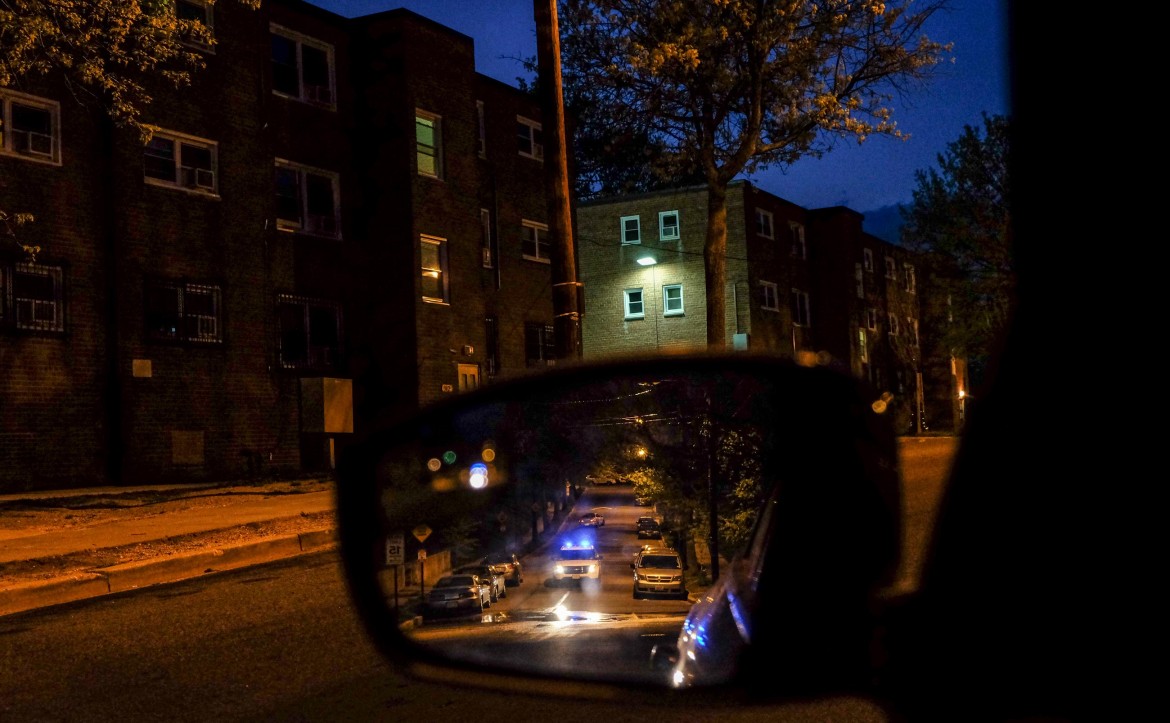
A D.C. police car cruises along 54th Street NE, near Clay Terrace, in April 2015.

The wrong address

Patrice Sulton, a lawyer who chairs the legislation committee for the D.C. Association of Criminal Defense Lawyers, said that addresses in the D.C. court system can be unreliable. In a report in April, the department’s Police Complaints Board expressed concern “about the lack of verification of address information in warrants executed by MPD officers.”

Failure to properly verify an address led police to the home of Patricia Dandridge on Jan. 27, 2015. She returned from work to find her apartment in Southeast ransacked. The door was beaten in and her bed frame was broken, she said. Clothes and personal papers were strewn across the floor.

“I thought I’d been robbed, but my neighbor told me it was the police,” said Dandridge, 45.

On the kitchen counter, she found a copy of a D.C. police search warrant. Three officers had forced their way in to look for firearms. They left empty-handed.

The warrant was based on a drug complaint at a housing complex in Southeast more than five miles from Dandridge’s apartment, according to the affidavit police used to justify the search.

Police called to the complex had arrested a man, who fled when they arrived. After a brief struggle with the suspect, Christopher Palmer, police found a handgun nearby on the ground.

Officers told a judge that they needed to search Palmer’s apartment for evidence proving that the gun was his. Palmer gave his address as Apartment 102 in a building in Anacostia, according to the police affidavit. Police said they confirmed the address with a probation supervisor, Warren Leggett, who said Community Supervision Officer Melissa Shelton had visited the apartment earlier in the month.

Shelton declined to comment, referring a reporter to the general counsel of the Court Services and Offender Supervision Agency, who said that the agency is prohibited from releasing information to the public about people on probation.

Palmer lived down the hall with his parents in Apartment 103.

Dandridge lives in 102.

“103 does not look like 102,” Dandridge said. The apartments are on opposite ends of the building.

After the raid, Dandridge was furious. She said she contacted Sgt. Jaron Hickman, one of the officers who conducted the search. He told her that they had arrested a man they thought was her son and received a warrant to search for guns and ammunition, she said.

Dandridge told him that it couldn’t have been her son.

“My son is deceased,” she said.

Hickman declined a request for an interview.

Dandridge said that for weeks, she pressed police for compensation for the damage. She said they owed her at least $1,200.

She submitted a claim to the city’s Office of Risk Management. She said she ultimately received a check for $260.

D.C. prosecutors indicted Palmer on firearm charges and two counts of assault on a police officer. In December, a jury acquitted him of the firearm charges but found him guilty of the assault charges. He received a 180-day suspended sentence.


One morning in January, police raided Darrell Gilmore’s house in Southeast Washington looking for evidence in an armed-robbery case. Gilmore said he did not know the suspect and that police had the wrong house. He said he was in the shower when more than 20 heavily armed officers arrived and that he was handcuffed naked during a half-hour search. Police also handcuffed three of his six children, including his 9-year-old son, he said.

The price some pay

Among the few who succeeded in getting police to pay for damage done during an errant raid are David Cranor, a satellite engineer, and his lawyer wife.

Cranor wrote about the 2009 raid of his home on Kentucky Avenue in Southeast on his blog on the Greater Greater Washington website. He said police spent 45 minutes disassembling steel bars on his back door while trying to execute the search.

The warrant was based on a traffic stop of two suspects: a female driver and her son. The young man was charged with possession of an illegal firearm, according to the warrant, and told police that he lived at the Kentucky Avenue address. Police said his mother verified the address, which was also checked in a pretrial-services database intended to monitor court appearances.

The young man had been arrested in 2004, when his family lived at the house. Cranor and his wife bought the house in 2007.

The city initially refused to pay for the damage to Cranor’s back door, which he said cost $3,140. In March 2010, the couple, then in their 30s, sued police. When it became evident that the case would go to trial, Cranor emailed Lanier seeking a resolution. The next morning, Lanier wrote to say she was getting involved, he said, and the city agreed the following day to pay for the repairs.

“A slow, mysterious bureaucratic process is not a productive way to handle these kinds of situations,” he wrote in his blog in 2011.

Marietta Robinson said that police relied on outdated information about her grandson to obtain a warrant in 2010 to search her house in Northwest. Police stopped her grandson after hearing him curse loudly while he was standing in the courtyard of a building down the street from her home. They arrested him for disorderly conduct, a misdemeanor, and found 18 grams of marijuana in his pocket, a little more than half an ounce. He was charged with possession with intent to distribute.

Police said that he gave them Robinson’s address, which appeared as the grandson’s address in several other databases.

But Robinson, 62 at the time, said her grandson, then in his late 20s, had not lived with her since 1987.

When police arrived, Robinson put her 13-year-old shepherd-pit bull mix, Wrinkles, in a bathroom and allowed officers to conduct their search. She said that a police officer opened the bathroom door and shot the dog, and as the animal ran into the living room, several more officers opened fire, hitting the dog 13 times, according to a lawsuit she filed. Blood splattered across her artwork and photographs. Robinson said the officers threw bedsheets and clothing on the floor to soak it up. Robinson said she was forced to wait outside for four hours during the officers’ search.

Police did not find drugs or other contraband. Paperwork documenting the results of the search list only “drug paraphernalia (empty ziploc with residue).”

Last March, a federal judge dismissed Robinson’s lawsuit against police, saying that the officers used reasonable force in killing an aggressive dog.

Robinson has appealed the ruling.

Outdated information also figured in the case of Rameka Waters, 24, who passed drug testing and a background check for her job as a licensed home-health aide. But a close friend has a long history of mostly misdemeanor arrests for drugs, dating back to the 1990s. Several years ago, he used her address in Northeast to receive mail from the courts.

In April 2014, police pulled over a car, in which the friend was a passenger, on a seat-belt violation. Officers said they smelled marijuana and found an ounce of the drug in a plastic bag. The man admitted that he intended to sell the drugs, and he gave his address as Waters’s apartment in Northeast, the warrant states.

After he was arrested, Waters saw police sitting outside her four-unit apartment building, where she lived in a unit on the second floor. She said she told detectives that he had used her address in the past but that he did not live there anymore.

A few days later, as she was leaving to take her daughter to school, she opened the front door to her apartment building and was met by a dozen police officers. Waters said she gave them her key to open her unit.

They found nothing.

“They told me I should be more careful about who I let use my address,” she said.

Prosecutors eventually dropped the charges against her friend. A month after the search, police arrested him again on drug charges. They searched a home a block away from Waters’s apartment and found 29 grams of marijuana and five small plastic bags of crack cocaine. He pleaded guilty to two misdemeanor drug charges in that case and received a 60-day suspended sentence and six months of probation.

Sallie Taylor moved into an apartment on 36th Street Northeast that was the former residence of a man whose ex-girlfriend was later charged with possession of PCP. Taylor did not know the woman, whose address D.C. police said they corroborated in a court database before searching Taylor’s apartment in January 2015.

It’s ‘like they didn’t have’ rules

Sallie Taylor still can’t understand how police got it wrong.

The search of Taylor’s apartment in January 2015 on the second floor of a four-unit building on 36th Street in Northeast began with an arrest two miles away. Tia Jackson, 34, was charged with sexual solicitation. A search of her handbag turned up a half-ounce vial of PCP, according to the affidavit police filed to obtain the warrant.

Before the raid, police said they corroborated an address for Jackson at 36th Street in the pretrial services database and unspecified “law enforcement databases.” In addition, Robert M. Van Dyke, the lead investigative officer in the case, stated that he had firsthand knowledge of the residence.

“Your affiant has been inside of 181 36th street, NE,” Van Dyke said. “This area is known for prolific narcotics use, trafficking, and is responsible for habitual narcotics complaints from the community.”

Van Dyke did not respond to requests for comment for this article.

The address had once belonged to Jackson’s ex-boyfriend, court records show. In 2013, Jackson was charged with attacking the man there with a knife. He obtained a court order prohibiting her from coming to the residence after the assault. The charge against Jackson was later dismissed.

Jackson ended up pleading guilty to a misdemeanor drug charge in her 2015 arrest.

No drugs were found in Taylor’s apartment, but her front door was smashed in during the police raid. Although it was patched by a repairman, Taylor wants officials to pay for a proper repair. “I had respect for the police,” she said. “It’s obvious they should have checked things out before they did this.

Taylor had moved into the apartment in April 2014. Her sister remodeled it for Taylor, who was returning from taking care of her grandchildren in Colorado while her son was in the military. The apartment seemed perfect. Her daughter and grandchildren lived in a unit on the first floor.

After the raid, a repairman used a thin piece of plywood and drywall screws to patch the door. Taylor and her daughters went to the 6th District police station, filed a complaint and requested that the door be repaired.

“It made me sad. I had respect for the police, but it was like they didn’t have any rules,” she said. “It’s obvious they should have checked things out before they did this.”

When a search based on erroneous information occurs, police rules require the department to provide an explanation and “repair the damage as soon as possible.”

A year later, Sallie Taylor is still waiting to hear from them.

This article was produced in partnership with the Investigative Reporting Workshop at American University. Students Mariam Baksh, Miranda Strong, Christina Animashaun, Meldon Jones, Katie Le Dain, Ke (Amber) Liu, Samantha Hogan and Kate McCormick contributed to this report.


The Goal - “There Was A Time” (Video)…