Written by Warren Mass for THE NEW AMERICAN MAGAZINE
Speaking before the internationalist Council on Foreign Relations in New York on May 13, senator and presidential candidate Marco Rubio (R-Fla.) defended “America’s role as a security guarantor” for the world. While denying that he advocated making the United States “the world’s policeman,” Rubio said that America should “ “convene the world to take action” during international crises.”
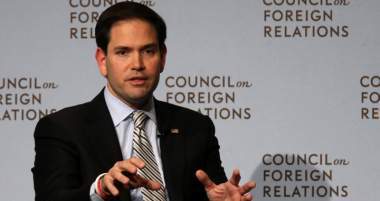
Speaking before the internationalist Council on Foreign Relations in New York on May 13, senator and presidential candidate Marco Rubio (R-Fla.) defended “America’s role as a security guarantor” for the world. While denying that he advocated making the United States “the world’s policeman,” Rubio said that America should “convene the world to take action” during international crises.
Senator Rubio made it clear that he advocated using U.S. military power beyond the mandate given to the president as commander-in-chief, to the federal government (in general) to “protect each [state] against invasion,” or even to Congress, to “repel invasions,” “define and punish piracies and felonies committed on the high seas,” and to “declare war.” Each of these actions presumes cooperation between the president and Congress to defend American interests, not the interests of the world. He said:
As president, I will use American power to oppose any violations of international waters, airspace, cyberspace, or outer space. This includes the economic disruption caused when one country invades another, as well as the chaos caused by disruptions in chokepoints such as the South China Sea or the Strait of Hormuz.
The above statement not only indicates that, despite his denials, Rubio would use the U.S. military as “the world’s policeman,” but by failing to mention Congress in his game plan, apparently would assume unilateral presidential power to do so.
Rubio approvingly summarized U.S. foreign policy in recent years as “a passionate defense of human rights, the strong support of democratic principles, and the protection of the sovereignty of our allies.”
The Constitution is clear that the obligation of the federal government is to “guarantee to every state in this union a republican form of government, and [to] … protect each of them against invasion.” It says nothing about supporting “democratic principles” (which are far different than a republican form of government) or about protecting “the sovereignty of our allies.”
Rubio, however, sees a different mission for the United States, stating that “vulnerable nations still depend on us to deter aggression from their larger neighbors.”
George Washington, our first president and president at the 1787 convention where our Constitution was drafted, strenuously opposed involving the United States in defending allies instead of our own interests. In his oft-quoted “Farewell Address,” Washington stated, “It is our true policy to steer clear of permanent alliances with any portion of the foreign world.”
Rubio lamented that the interventionist foreign policy he champions has been “replaced by, at best, caution, and at worst, outright willingness to betray those values for the expediency of negotiations with repressive regimes.”
At the time Washington delivered his Farewell Address (1796) France was still under the thumb of the bloody French revolutionists, who could have given the worst of today’s tyrants a lesson in repression. France’s “republican” government that year put down a peasants’ revolt in Vendée in such brutal fashion that it has been described as genocide.
Yet, though Washington (as expressed in his 1793 Proclamation of Neutrality) had refused to ally himself with France in its war against Great Britain, the United States did recognize the new government and maintained diplomatic relations with France.
By so doing, Washington was practicing the advice he gave in his Farewell Address: “Observe good faith and justice towards all nations; cultivate peace and harmony with all.”
Though the CFR’s primary interests are related to foreign policy, Rubio also addressed other topics. In what CNN described as “a knock on GOP presidential opponent Rand Paul, who is working to reign in government surveillance programs and opposes extending the PATRIOT Act.” Rubio asserted that “we cannot let politics cloud the importance of this issue.” He stated:
A strong military also means a strong intelligence community, equipped with all the tools it needs to defend the homeland from extremism both home-grown and foreign-trained. And key to this will be extending section 215 of the Patriot Act. We cannot let politics cloud the importance of this issue. We must never find ourselves looking back after a terrorist attack and saying: We could have done more to save American lives.
The National Security Agency (NSA) has used Section 215 of the Patriot Act to justify its bulk collection of U.S. phone records, but this section is set to expire on May 31. New legislation, the USA Freedom Act, which passed the House by 338-88 on May 13, purports to limit those powers, but does so only modestly and extends some portions of Section 215 for five more years. For this reason, it would not be a surprise if Paul again opposes the bill when it comes to the Senate, as he did last year. Paul favors not just partial limitations of the NSA’s surveillance powers justified by the Patriot Act, but elimination of them.
If Rubio sought a sympathetic venue to outline his interventionist foreign policy, he could hardly have done better than the CFR. Founded in 1921 by a group tasked several years earlier by President Woodrow Wilson to formulate new U.S. foreign policy after World War I, a major impetus for those founding the CFR was the rejection of the Treaty of Versailles that provided for the League of Nations by the Senate on November 19, 1919. These internationalists were determined to counter the perceived “isolationism” of those who had rejected the treaty and the league, and usher in a new era of interventionist U.S. foreign policy.
Within a decade, CFR members had begun to dominate the State Department, and all but a few secretaries of state from the Roosevelt administration until our present time have been CFR members. Secretary of State John Kerry is not a CFR member, but his wife, Teresa Heinz Kerry, is. Presidential candidate and former Secretary of State Hillary Clinton is not a member, but her husband, Bill, and daughter, Chelsea, are both members. The administration of George W. Bush, under which the United States invaded Iraq, was dominated by CFR members: Vice President Dick Cheney, Secretary of State and National Security Advisor Condoleezza Rice, Secretary of State Colin Powell, and Defense Secretary Robert Gates.
The most notable characteristic of CFR influence on presidential administrations is an interventionist foreign policy that had led to U.S. involvement in a succession of wars, including World War II, the Korean War, the Vietnam War, the Gulf War, and the invasion of Afghanistan and Iraq. These wars have produced approximately half a million U.S. battle deaths.
Senator Rubio is not a member of the CFR, but he is certainly on good terms with the organization and shares their outlook. His picture appeared in the 2012 CFR annual report and he prefaced his talk on May 13 with these words: “It is an honor to be back at the Council on Foreign Relations, and — I appreciate very much the opportunity to address you here today.”
Were the 2016 election to be a contest between Marco Rubio and Hillary Clinton, the future of U.S. foreign policy would be clear. It would mean a continuation of the same policies that have dominated our nation since the onset of World War II — interventionism, more war, and more casualties.
Photo of Sen. Marco Rubio (R-Fla.) addressing the Council on Foreign Relations: AP Images
Like this:
Like Loading...



 Cathy
Cathy chulai1968
 Truth Prevailing
 Publius Huldah
 Freedom Rider
 kathleen
 radioroger2015
 Steve
Steve truckjunkie