Per Department of Homeland Security Form I-9;
1. Any EMPLOYEE who provides fraudulent ID.
2. Any EMPLOYER who accepts fraudulent ID.
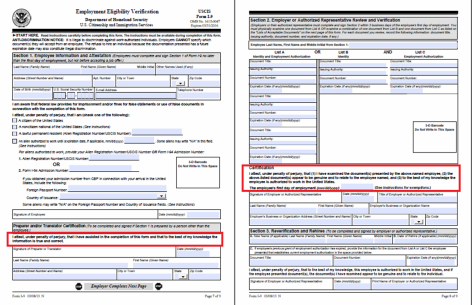
http://www.uscis.gov/sites/default/files/files/form/i-9.pdf

http://www.uscis.gov/sites/default/files/files/form/i-9.pdf
BY ALLEN WEST FOR ALLENWEST.COM
We’ve recently brought to your attention two instances of nebulous language: the comments of retired General Wesley Clark about putting extremists in internment camps, and the new order making parts of our immigration naturalization oath optional for certain “religious” groups.
Words have meaning, and when they’re not specific, they’re left to interpretation. The Supreme Court of the United States (SCOTUS) has demonstrated such by redefining the taxing authority of the Congress, as well as what a State means when it comes to the Affordable Care Act. And now we have yet another example of dangerously nebulous language emanating from Capitol Hill.
If you’ve not read House Bill 2899, you should. This legislation would authorize the creation of a new government agency in the Department of Homeland Security (DHS) — as if we needed another. Incredibly enough, this new agency is being sponsored by the Chairman of the House Homeland Security Committee, Representative Mike McCaul (R-Tx). The agency is charged with Countering Violent Extremism (CVE). Here are the troubling excerpts from the text of the bill:
(b) Assignment Of Personnel.—The Secretary shall assign or hire, as appropriate, permanent staff to the Office for Countering Violent Extremism. In carrying out this subsection, the Secretary shall, to the maximum extent practicable, seek to assign to or hire for the Office an individual who has a demonstrated background in technical matters, on and offline media, or marketing.
(d) Responsibilities.—The Assistant Secretary for Countering Violent Extremism shall be responsible for the following:
1) Coordinating the Department’s efforts to counter violent extremism across all the components and offices of the Department that conduct strategic and supportive efforts to counter violent extremism. Such efforts shall include the following:
(A) Identifying risk factors that contribute to violent extremism in communities in the United States and potential remedies for Government and non-government institutions.
(B) Identifying populations targeted by violent extremist propaganda, messaging, or recruitment.
(C) Managing the outreach and engagement efforts of the Department directed toward communities at risk for radicalization and recruitment for violent extremist activities.
(D) Ensuring relevant information, research, and products inform efforts to counter violent extremism.
(E) Developing and maintaining a Department-wide strategy guiding policies and programs to counter violent extremism. Such strategy shall, at a minimum, address each of the following:
(i) The Department’s counter-messaging program pursuant to paragraph (2), including a plan to leverage new and existing Internet and other technologies and social media platforms to counter violent extremism, as well as the best practices and lessons learned of other Federal, State, local, tribal, territorial, and foreign partners engaged in similar counter-messaging efforts.
(ii) The Department’s countering violent extremism-related engagement efforts.
(iii) The use of cooperative agreements with State, local, tribal, territorial, and other Federal departments and agencies responsible for efforts relating to countering violent extremism.
(iv) Ensuring all activities related to countering violent extremism fully respect the privacy, civil rights, and civil liberties of all Americans.
(F) Identifying and recommending new research and analysis requirements in coordination with the Under Secretary for Science and Technology and the Under Secretary for Intelligence and Analysis and ensure the dissemination of information and methods for Federal, State, local, tribal, and territorial countering violent extremism practitioners, officials, law enforcement, and non-governmental partners to utilize such research and analysis.
(G) Assessing the methods used by violent extremists to disseminate propaganda and messaging to communities at risk for radicalization and recruitment.
(2) Establishing a counter-messaging program to craft strategic counter-messages to the propaganda and messaging referred to in subparagraph (G) of paragraph (1) which shall—
(A) explore ways to utilize relevant Internet and other technologies and social media platforms; and
(B) maximize other resources available to the Department.
(3) Serving as the primary representative of the Department in coordinating countering violent extremism efforts with other Federal departments and agencies and non-governmental organizations.
(4) Serving as the primary Department-level representative in coordinating with the Department of State on international countering violent extremism issues.
(5) In coordination with the Administrator of the Federal Emergency Management Agency, providing guidance regarding the use of grants made to State, local, and tribal governments under sections 2003 and 2004 under the allowable uses guidelines related to countering violent extremism.
(g) Violent Extremism Defined.—In this section, the term ‘violent extremism’ means ideologically motivated terrorist activities.
Here’s what I take issue with in this legislation: what, exactly, is violent extremism? Who will determine what actually qualifies as violent extremism?
Let’s be very honest here, the liberal progressive left has been very adept at defining as extremists and extremism anyone or anything that doesn’t agree with them. I’ve been called an extremist. Members of the House of Representatives have been referred to as extremists. Constitutional conservatives have been referred to as extremists. Veterans returning from overseas contingency operations — that is how the left redefined combat — have been referred to as extremists by the Department of Homeland Security under Janet Napolitano. Funny, the Obama administration held a conference on Countering Violent Extremism and invited groups related to the Muslim Brotherhood and certain Islamic clerics — but no Christian pastors.
This is a dangerous bill, and the vague language here is almost Orwellian with what could be severe ramifications.
Now, let me share with you the inside-the-beltway procedural issue. This legislation is supposed to be brought to the House floor under what is called, suspension of the rules. That means it’ll be a basic coming back to town roll-call vote with two-thirds majority. Everyone who knows House procedures realizes that you bring up legislation under suspension procedure because you believe that way, it won’t have major opposition. There is little to no committee vote and deliberation, and certainly not much House floor deliberation and debate. So, all of a sudden, the American people will awaken to learn there’s a new agency in the DHS to “counter violent extremism” — which, as you can see, is defined by a single lackluster sentence.
Someone tell me, what is “ideologically motivated”? Could it be construed that conservatism is ideologically motivated? No, I am not a conspiracy theorist. But I find this rather interesting in that President Obama cannot bring himself to say Islamic terrorism, Islamic jihadism, Islamism, or Islamo-fascism. Paragraph (g) is truly left open to anyone’s interpretation. What about environmental terrorists? What about the Occupy Wall Street crew or anarchists?
Why is there even a necessity to create another government agency — don’t we have an FBI responsible for such activities? Perhaps this just exists to allow this administration to target any belief system not willing to cow to their “fundamental transformation” of America. So, could this website even be considered violent extremism?
The is the last week for the House to be in session before recess adjournment in August. My recommendation is that you contact the House Homeland Security Committee and the House GOP leadership and share your concerns about this legislation. My issue is that “violent extremism” is just too vague. Consider this: the actions of Nidal Hasan — as well as the beheading of a woman in Moore, Oklahoma — wouldn’t even fit into this categorization, since the administration declared it “workplace violence.” Matter of fact, the Obama administration is even struggling to condemn the Islamic terrorist attack in Chattanooga as “violent extremism” — certainly President Obama has not said so.
Ladies and Gents, U.S. House of Representatives Bill 2899 (HB 2899) should not see the light of day; it must be killed. We do not need another agency in the DHS. Moreover, we certainly don’t need to give the government carte blanche to declare “ideological” enemies in such a nebulous manner.
Posted in Politics, Uncategorized
Tagged DHS, General Wesley Clark, HB 2899, Islamic Jihadism, NIDAL HASAN, Occupy Wall Street, violent extremism
Iowa Senator Chuck Grassley, Chairman of the Senate Judiciary Committee, blew a gasket this past week when he learned that The Department of Homeland Security (DHS) extended “Executive Amnesty” to an illegal alien last year that officials knew was under investigation for child molestation.
The illegal alien, Edgar Covarrubias-Padilla, was arrested on May 7 and charged with four felonies including child molestation and the distribution of child pornography.
Besides the recovery of 600 child porn images from his computer, Covarrubias-Padilla was accused of sexually abusing a 10-year-old boy. Authorities believe he was involved in the production of child pornography as well.
At the time of his arrest, Covarrubias-Padilla was working as a California camp counselor known to kids at the camp as “Papa Bear”. DHS knew local authorities were investigating Covarrubias-Padilla on child molestation and child pornography charges but did nothing about it prompting Sen. Grassley to fire off a letter full of question to DHS Secretary Jeh Johnson this past week.
Grassley sent the letter after the Santa Clara County Office of Education told Grassley’s office that it had received over 100 phone calls and 50 emails from parents concerned that their child may have been victimized.
In his letter to Johnson, Grassley said it took whistleblowers with U.S. Immigration and Customs Enforcement (ICE) – an agency within DHS – to inform him that federal authorities knew as early as mid-November that Covarrubias-Padilla was under investigation for child sex abuse charges and that DHS did nothing about his immigration status until his recent arrest.
The whistleblowers claim that on Oct. 8, 2012, Covarrubias-Padilla applied for amnesty protection under President Obama’s Deferred Action for Childhood Arrivals (DACA) program. His “Executive Amnesty” status and work eligibility were in effect through the end of May at which point he could re-apply under the president’s program.
In his letter to Secretary Johnson, Grassley wrote:
“These allegations are deeply troubling because, if true, they suggest that DHS was aware for months or years that Mr. Covarrubias-Padilla posed a public safety threat to the children he was monitoring, yet took no action to revoke his DACA authorization…”
“These allegations are particularly alarming because they suggest that Mr. Covarrubias-Padilla would not have been placed in a position to abuse and exploit children had DHS properly vetted DACA recipients…”
Grassley recently complained about other cases involving felonious “Executive Amnesty” recipients including the failure of DHS to defer the deportation of Emmanuel Jesus Rangel-Hernandez. Rangel-Hernandez applied for amnesty in February 2013 and was approved even though U.S. Customs and Immigration Services (USCIS) knew he had gang-affiliations.
In his latest letter to Johnson, Grassley asked 11 questions about Covarrubias-Padilla’s DACA application, immigration status, and known criminal history. Secretary Johnson has until May 29 to respond.
In particular, Grassley wants to know how ICE and USCIS coordinated and shared information about Covarrubias-Padilla. Grassley writes:
“Did USCIS know or have reason to know that ICE was investigating Edgar Covarrubias-Padilla in connection to crimes involving either possession or distribution of child pornography or child exploitation, including molestation?”
“If Edgar Covarrubias-Padilla was under investigation by ICE, please provide the procedures in place for when, and in what manner, ICE would have notified USCIS.”
In a statement about the case posted on Senator Grassley’s official Senate website, Grassley concludes his comments about the case up until now this way.
“A number of recent cases involving recipients of deferred (deportation) action who were subsequently charged with serious crimes have raised questions about how applicants are vetted.”
“The Covarrubias-Padilla case raises more questions about how the Department of Homeland Security addresses cases involving alleged criminal activity that occurs after a deferred action application is approved.”
Whether or not DHS Secretary Johnson answers Grassley’s questions about deferred deportation raised in the letter and does so by Grassley’s deadline remains to be seen. For now, it appears that the American people will continue to suffer the repercussions of the president’s illegal “Executive Amnesty” and the criminal aliens it condones.
Posted in Obama
Tagged arrest, child sex abuse charges, DHS, Obama grants amnesty to illegal alien, Senator Chuck Grassley
Reposted from Forbes
By David Bier
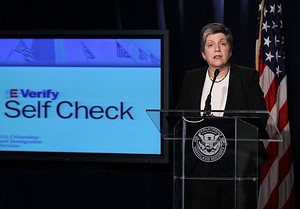
U.S. Secretary of Homeland Security Janet Napolitano speaks during a news conference to announce the launch of E-Verify Self Check service March 21, 2026 in Washington, DC. The service will allow individuals in the United States to check their employment eligibility status before formally seeking employment. (Image credit: Getty Images via @daylife)
Ken Nagel thought it would be no problem to hire his daughter at his Phoenix restaurant. He had not considered that Arizona’s new employment verification system, E-Verify, would deem her ineligible to work. E-Verify, which attempts to screen out unauthorized immigrants by checking employees against federal databases, failed his daughter, a U.S. citizen. “It was just another frustration,” Nagel told The Arizona Republic.
Despite its problems, Congress and the president will consider a national E-Verify mandate in immigration reform proposals this spring. President Obama called for “a system to give employers a reliable way to verify that their employees are here legally.” But E-Verify is not reliable and shifts enforcement costs onto citizens.
According to E-Verify’s government audit, a national mandate would deem 1.2 million to 3.5 million legal employees, like Ken Nagel’s daughter, initially ineligible to work. In 2008, Intel, the computer chip maker, put its new employees through E-Verify and 12 percent were declared ineligible. A firm representative told officials that resolving the errors took a “significant investment of time and money, lost productivity and many hours of confusion, worry and upset.”
The government’s numbers also project 770,000 erroneous final non-confirmations (FNCs), which require employers to fire the worker. For example, E-Verify denied employment to Juan Carlos, a naturalized U.S. citizen, after the State Department failed to notify the Social Security Administration of his status change. He lost his job and had to pay $400 for a new naturalization certificate to clear his name.
When informed of these facts, the Illinois legislature barred the state’s employers from voluntarily using E-Verify until the SSA and Department of Homeland Security (DHS) can demonstrate that they could clear errors within three days. Rather than attempt to demonstrate the program’s reliability, DHS has sued the state over the law.
As the Obama administration has increased workplace fines for hiring unauthorized workers, businesses are understandably interested in a “safe harbor” from such threats. Unfortunately, E-Verify is not it. The administration is already fining employers in states that mandate E-Verify for technical violations of its regulations, which are costing employers thousands of dollars.
E-Verify forces employers to take responsibility for immigration enforcement—a governmental responsibility. A 2011 Bloomberg Government report found that a national E-Verify mandate would cost businesses $2.7 billion. “Employers have to spend money on training or staff time,” said Jason Arvelo, the report’s author. Economic research has shown employees pay these costs with lower wages.
For all the costs it imposes, employers cannot even rely on E-Verify to prevent unauthorized hires. In 2009, E-Verify’s audit found about 50 percent of them slipped through. In fact, the largest raid of unauthorized workers in U.S. history happened in 2006 against an employer that used E-Verify. “It is not a magic bullet for every kind of problem,” explained then-DHS Secretary Michael Chertoff.
E-Verify’s most serious threat is to privacy. The system’s guilty-until-proven-innocent approach could be applied to any activity, not just employment, and to any area of law, not just immigration law. It would be Americans’ cyber-passport that, like a regular passport, is used to prove identity and restrict access.
Arizona and Alabama have made it unlawful to rent to unauthorized immigrants, or to transport them, or, more nebulously, “to aid” them. If it is worth imposing E-Verify’s flawed, costly system on law-abiding citizens to prevent unauthorized employment, why not unauthorized transportation, rent, or sales?
E-Verify’s application has no logical limit. If the government fails to stop illegal downloads, should they require every American to verify their identity before accessing the Internet? What about monitoring gun ownership? Do not believe that E-Verify will not succumb to the same mission creep as the Social Security card, which left its original purpose in the dust long ago.
In 1986, Congress asked for a small privacy concession from Americans: just fill out the I-9 form and hand over copies of personal identification. Now it wants a much more intrusive measure, E-Verify. When E-Verify fails to end illegal immigration, Congress will be back with a national biometric ID, as already proposed by Sen. Charles Schumer (D-NY).
All these measures admit that the U.S. government does not believe it can create a system that stops illegal immigration at the border. Rather than admit defeat, America needs the only proven solution to the problem: an accessible legal pathway for immigrants. What it does not need is more surveillance, more regulations, and more bureaucracy between employers and employees.
David Bier is an immigration policy analyst at the Competitive Enterprise Institute.
 | Christian Zionist on Rest in Peace Dr. Douglas… |
 | williamjamesward on Rest in Peace Dr. Douglas… |
 | Barbara on Madonna’s Gay Brother De… |
| Barbara on The Donald Trump phenomenon: h… |
| Christian Zionist on Madonna’s Gay Brother De… |
| Christian Zionist on SPLC dumps ‘extremist… |
| Christian Zionist on The Donald Trump phenomenon: h… |
| Barbara on Global Warming Alert |
| williamjamesward on Global Warming Alert |
| Barbara on The Donald Trump phenomenon: h… |
| Barbara on Madonna’s Gay Brother De… |
 | MeThePeople on SPLC dumps ‘extremist… |
| Christian Zionist on Rest in Peace Dr. Douglas… |
| Christian Zionist on SPLC dumps ‘extremist… |
| MeThePeople on SPLC dumps ‘extremist… |
 Cathy
Cathy chulai1968
 Truth Prevailing
 Publius Huldah
 Freedom Rider
 kathleen Christian Zionist
 radioroger2015
 Steve
Steve truckjunkie