
 THE HOLOCAUST: WE MUST REMEMBER
30-Hour Series of Interviews broadcast on the Roger Fredinburg Radio Program
10-27-1997 - First Program in Series
Guest: Dr. Michael Berenbaum, author
The World Must Know: The History of the Holocaust as Told in the United States Holocaust Memorial Museum
ISBN-10: 080188358X and ISBN-13: 978-0801883583
United States Holocaust Memorial Museum
100 Raoul Wallenberg Place Southwest, Washington, DC, 20024
(202) 488-0400
This is the first interview in the “Holocaust, We Must Remember” Series by Roger Fredinburg with Dr. Berenbaum, who oversaw the structure of the Holocaust Museum in Washington D.C.. His book is titled: The World Must Know. 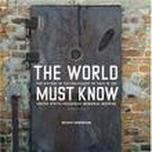
Roger: Good evening, ladies and gentlemen! I am Roger Fredinburg, radio’s “regular guy and I’m glad to have you here with us this evening. First and foremost, ladies and gentlemen, I want to thank my good friends, Chey Simonton and Kelleigh Nelson, for their hard work and endurance in helping me put together what will become an approximately 20 week investigation and exploration of the whole subject of the Holocaust that we must not forget.
As I’ve been in talk radio these many, many years, one of the things I have learned, and it’s and unfortunate discovery, is that the American people are totally and completely without knowledge on the subject; easily manipulated, easily dragged off into some of these so-called patriot camps which are nothing but Nazi cults, Hitler-loving groups. You don’t know that going in. It takes time to work you up to that. In my opinion, and I think many of you share the opinion, that ignorance is not good.
So we will set out on a journey over the next twenty weeks. We’re going to talk with people who survived some of the most incredible atrocities man’s conceived. We’re going to talk with people covering every aspect of this holocaust issue because We Must Remember.
Joining us this evening is Dr. Michael Berenbaum, one of the foremost authorities. His book is, The World Must Know: The History of the Holocaust as Told in the United States Holocaust Memorial Museum. It’s a wonderful book that takes you on a journey through everything! You need to order this book and I’ll explain later how to do that. First, I’d like to welcome our guest. Dr. Berenbaum, welcome!
Dr Berenbaum: Thank you so much! It’s a pleasure to be with you.
Roger: It’s a pleasure to have you aboard, sir! I know you are traveling and it’s not the most convenient circumstances for you. You are, whether you know it or not, the first guest in a series of about twenty where the whole subject of the holocaust will be covered so that people won’t forget.
First of all, I’d like to ask about the Holocaust Museum. What is the goal of the Holocaust Museum?
Dr. Berenbaum: Well, the goal of the Holocaust Museum was two-fold; one, to memorialize the victims; but, more importantly, to be a living memorial, to teach the current generation the story of the holocaust, to transmit the story to this generation and all future generations. So it’s task was to commemorate the past, to educate and thereby transform the future.
Roger: The message is clear, that we must never forget.
Dr. Berenbaum: That’s one of the messages. What we deliberately did was not to be a propaganda machine; but, to literally tell you the story. The remarkable thing is that once the story is told the messages are multiple to many people. The remarkable thing we found in the first years of the museum was that message was also deeply and profoundly American. By that I mean that here was an account of an essentially European event that underscored the importance of fundamental American values; the idea that all persons are created equal and endowed by their creator with certain inalienable rights that the state can’t take away, the notion that absolute rights and separation of powers and checks and balances which, after all, are the antitheses of dictatorship. They are the guarantor of all these freedoms.
Roger: I concur. I want to ask you to help me with something because who knows how many listeners are in the audience this evening. Many of them will never get to see the Holocaust Museum. I though what you might do, as best you can, is simply take us on a tour. What will we see there?
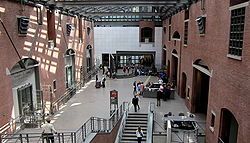
Dr. Berenbaum: Let us begin, first of all, with the setting. The setting of the Holocaust Museum is adjacent to the National Monuments, adjacent to the National Mall. One of the very interesting things is that we were asked, why did we put this museum in the center of the National Mall that celebrates all the great triumphs of American democracy and accomplishment in art, literature and technology, the power of government. The Holocaust represents what happens when the power of humanity is detached from moral responsibility.
Enter the museum and you will get an identification card of someone who went through the holocaust so you have a companion on your trip through the museum. The companion will be a person whose life story is unfolding before you as you enter the ethical historical event.
You ride the elevator, and in the elevator you meet an American liberator who’ll say to you what he said then, ” we don’t know what it is, people are dying, they’re starving everywhere. People don’t do this to other people!”
Then the elevator doors open and you see what the American soldiers experienced on the day of liberation, the shock! The catastrophe of all the dead bodies, piles of bodies and bones! You begin there and then conclude at the little section from Dwight David Eisenhower who said, ” I made the visit (to these camps) deliberately in order to be in a position to give first-hand evidence of these things if ever, in the future, there develops a tendency to charge these allegations merely to ‘propaganda.” That section will conclude with a question which how could this happen?
The rest of the museum is literally an answer to that question…. not why, but how?
On the top floor we took you through the evolution of Nazi policy; through the rise of Hitler, to the beginning of terror, the creation of concentration camps, to the boycott of Jewish businesses. On May 10, 1933, literally Hitler’s 100th day in office, they burned books. You will read a statement by Heinrich Heine who said, “a people who burn books, in the end, will burn people.” The distance from book burning to people burning in the Holocaust was eight years!
You will then ask the question, “How did the nation of Goethe, Schiller, Bach and Beethoven become the worshiper of the mad corporal and would see the power of propaganda, would see the ideology of race and the science of race? 400 laws were passed that isolated, segregated and stigmatized the Jews and removed them from the heart of society and made them a segregated minority.
Then we’d see the power of technology by seeing the granddaddy of the computer; the card sorter, showing the degree of technology that powered this regime.
We’d see the indifference of the world that is a form of antisemitism, then we’d go to a turning point in the holocaust which was called The Night of the Broken Glass, “Kristallnacht,” November 8, 1938. On November 9, 2025 eleven hundred synagogues were burned in Germany and Austria, 7,000 stores were looted and 30,000 Jewish men and boys were arrested. It would seem that was the end of German Jewry.
We’d continue on to see the Nazi assault against other victims. We’d see the triumph of Hitler in which he not only created a Nazi state but a police society and the desperate attempt to convince the refugees to leave.
Finally, we’d see the beginning of killing, the beginning of war against the Polish nationals and the first mass murders which didn’t happen to the Jews; but, the first mass murders happened to the mentally retarded, to those who were an embarrassment to the myth of Aryan supremacy.
We’d cross a bridge and see what did America know and when did it know it? What was the response of the United States between 1933 and 1939?
We’d descend a floor, and this is the floor that’s most difficult. This is a floor of death! As you move through I can take you through to the ghetto, to all the killing units, all the mobile units that went out and shot Jews; 1,250,000 jews shot, one by one by one!
Roger: Now what was the mobile killing unit? What did it look like?
Dr. Berenbaum: The mobile killing units consisted of a series of SS officers and personnel. Their job was to come into a town and round-up Jews, some gypsies and communists, bring them to the edge of a valley or a gulch and literally shoot them one by one by one. They murder 90,000 people in the first four and a half to five weeks of duty! How do we know that? They sent back reports indicating the dates and the numbers of people they killed. At Babyar they murdered 32,000 people within a three-day period between Rosh Hashanah and Yom Kippur in 1941, the High Holy Days! It would seem that these were ordinary soldiers who acted as part of an extraordinary unit. We’d look at their pictures and even see the films that they took! When you look at the films they strike you, primarily, because even though you know what happened they seem surrealistic. Your eyes can’t believe what they are seeing!
We go from there to the decision of killing. The decision to kill was taken January 20, 1942. It was taken at a beautiful villa on a lakeside area in Berlin. It was taken by 15 men, what we of the Viet Nam generation would call “The Best and the Brightest”.
We then see the ghetto resistance in Warsaw and we’d walk right to the railroad train that was used to transport Jews from Austria to Treblinka. With the idea that the mobile killing units were the first stage of killing, the first state of killing was to take the killers to the victims. But, that became too difficult; psychologically, they couldn’t kill all day long and still handle the rest of their humanity. So they reversed the order; that is, if you can’t send the killers to the victims, you have mobile victims and stationary killing centers. The instrument of that was the railroad car.
If you were in the museum you’d learn that Auschwitz had 44 parallel railroad tracks. I didn’t know what a parallel railroad track was but I’d once been trained as a journalist. I called Amtrak and asked, “How many parallel railroad tracks do you have a Pennsylvania Station?” Then I fell off my chair when the guy answered, 21! I realized that Auschwitz was chosen because the infrastructure was in place; 44 parallel railroad tracks which meant they needed intersecting railroad lines for this to work. That’s why they created the death camps of Birkenau and Auschwitz.
Roger: So the railroad provided the nucleus!
Dr. Berenbaum: It was the nucleus of the transportation system. The idea was to have stationary killing centers. Therefore, you have places like Treblinka. Here again, I can give you statistics; Treblinka 850,000 Jews were killed in about 18 months. They were killed by a staff of 120 of whom 30 were SS and the rest were Ukrainians and Lithuanians.
Then you walk into the actual barracks of Auschwitz and see the unfolding of the world of the death camps. Within the barracks you see the way people slept. You see the medical experiments that were done. You see the slave labor efforts. Then you see the crematoria that was the epicenter; the undressing room, the gas chamber, the elevators, the dissecting rooms and the ovens.
Then you cross the bridge and walk face to face with death. You’d see a room full of shoes, a room of human hair and tattoos.
Finally, you’d get to a room about three stories high in which you’d see about 1,800 faces of people who lived in the village that died one day.
Instead of presenting you with dead bodies, we present you with wonderful pictures of living people; kids on an outing, a father with his daughter, a grandfather with his grandchild, two lovers in bathing suits at a beach party, soccer practicing. We show you the presence of the people and you begin to sense their absence.
We descend again and then you see people in difficult attempts at rescue; Denmark which saved their Jews, Poles who tried to assist Jews. We see resistance then we see liberation again.
Walk and then see on one side the ultimate crime;that the killers which were the children and on the opposite the side the attempt of the world to address this crime that involved the trials of Nazi war criminals, then see the struggles of the people to recover from this, their attempt to rebuild their lives in the United States and Israel.
Finally it concludes in a very incredible way, by listening to the voices of those who were there, who lived in that world and spoke to all the world. We listen to a film of survivors talking with the idea that each fragment of memory is the embodiment of the total experience. Continue reading


 Cathy
Cathy chulai1968
 Truth Prevailing
 Publius Huldah
 Freedom Rider
 kathleen
 radioroger2015
 revaustinmiles
 Steve
Steve truckjunkie