
THE HOLOCAUST: WE MUST REMEMBER
30-Hour Series of Interviews broadcast on the Roger Fredinburg Radio Program
3-11-2025 Twentieth Program in Series
Guest: Dr. Daniel Jonah Goldhagen
Book: HITLER’S WILLING EXECUTIONERS: Ordinary Germans and the Holocaust
ISBN-10: 0679772685 and ISBN-13: 978- 0679772682
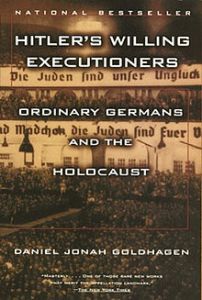
Roger: Welcome, ladies and gentlemen! Thank you once again for joining us on our continuing Wednesday night series. We’re just about through this series on the holocaust. It’s been a long and arduous process, trying to get all this information out to you. I think we’ve focused quite a bit on the tragedies of Europe during World War II, the horror of the holocaust. We’ve heard the stories of people who were themselves the victims of some of the most incredible evil that mankind has ever bestowed on his fellow-man. We’ve heard numerous stories about the victims; how they survived, why they survived, those kinds of things.
Tonight we explore something quite different than we’ve talked about in the past. There is a wonderful, wonderful book, ladies and gentlemen, outlining some of the more intricate details about the people who actually did the killing, a wonderful book written by Daniel Goldhagen, titled “Hitler’s Willing Executioners: Ordinary Germans and the Holocaust.” Powerful stuff! I want to bring Professor Goldhagen up right now. Daniel, how are you?
Dr. Goldhagen: I’m fine, how are you?
Roger: I’m really good tonight. Listen, could you tell the folks just a little bit about who you are and where you come from, Daniel?
Dr. Goldhagen: Professionally, I’m a professor at Harvard University. I’m a political scientist. I grew up in the Boston area and lived most of my life here. I lived for about 3 years in Germany studying and doing research for my work.
Roger: Thank you very much! The book takes a little different slant on the issue of the holocaust, as you’re well aware. It’s quite a controversial book; but, compelling! It’s won a lot of awards and comes highly recommended. What were you trying to accomplish? I mean, the title is fairly broad; but, “Hitler’s Willing Executioners”? Tell us about that! Who were they?
Dr. Goldhagen: First, let me tell you the reason I wrote the book was to fill in a gap in our knowledge. When I began this study in the mid-1980s, you could read the entire scholarly literature on the holocaust and you would have learned almost nothing about the people who were the killers! It seems obvious that until you know a great deal about these people; who they were, where they came from, what their lives were like in the institutions of killing, what they thought about what they were doing, why they acted as they did, what choices they made, and many other things, you can’t possibly explain how and why the holocaust happened. So, I just set out to learn whatever I could and this book is the result of that.
When I went to Germany to do the research, the principal source of which is the testimony of the killers themselves, the perpetrators. Most of my book is told in their own words. I discovered things that led me to conclude that we needed to revise our understanding of the holocaust in central ways. I’ll just tell you of three of the things very quickly.
One is that many of the killers were not SS men, contrary to how they’ve often been presented. They were ordinary Germans from every walk of life.
A second fact is that, contrary to how they’ve often been represented, the number of killers was by no means small. There were at least 100,000 Germans who were intimately involved in the slaughter of Jews. The number may have been far higher.
The third fact is that in the history of the holocaust, never was a single German perpetrator himself ever killed, sent to a concentration camp, jailed or punished in any serious way for refusing to kill Jews. It simply never happened! Many of the killers knew they didn’t have to because their commanders told them they did not have to!
All of this together conveys a portrait of the perpetrators as a large number of ordinary Germans who essentially chose to slaughter Jews and chose to brutalize them as well. The question of the book is ‘Why did they do it?”
The answer, which I’ll just say briefly now, is that it is clear that it was because they were Hitlerian anti-Semite-anti-Semites of the sort that Hitler was; who really believed that Jews were evil, that they had to be eliminated, in this case exterminated, if Germany was to survive and prosper.
Roger: Let’s start at the beginning of your book and talk about what you term as “recasting” the view of anti-Semitism. I’m not even sure people realize what anti-Semitism is. It’s the hatred of Jews; but, it’s more than that!
Dr. Goldhagen: Right. What I’m going to say about anti-Semitism pertains to other kinds of prejudice as well; so we can think about prejudice against African-Americans, prejudice against Latinos, prejudice against any other group. We have a linguistic problem, a conceptual problem which is that even though anti-Semitism or other kinds of prejudice has enormously wide ranges and differences, we only have one term to describe all the different kinds of antisemitism and that term is “anti-semitism”. So, a person says that “Jews are stingy”, a common stereotype; unflattering, but not the worst thing in the world, you could say.
Roger: Powerful enough to have adjectives in popular society like, “he jewed me down.”
Dr. Goldhagen: Yes, but this person is called an anti-Semite and so is Hitler. Now, a person who thinks Jews are stingy and Hitler are worlds apart in what they believe about Jews and the things they would do. Yet, we only have this one term. We use the term racism, too. A person who makes a prejudicial remark is called a racist. Someone like David Dukes is a racist.
So, we have to get beyond this initial terminology and try to focus more on the content of people’s anti-Semitism. Always ask what exactly do they believe about Jews. What do they believe the Jews alleged evil nature is and why do they believe Jews are the way they say Jews are? We can ask these questions about racism of other kinds, too. Only when we do that will we begin to understand the character and nature of anti-Semitism in a given society.
Roger: When I think of anti-Semitism I always think of the Nazis. I mean, that’s the first thing that flashes through my mind. anti-Semite = Nazi.
Dr. Goldhagen. Sure!
Roger: But, you’re saying that comparison is not necessarily accurate.
Dr. Goldhagen: I see. You’re saying when you meet an anti-Semite, when you hear of one in the U.S., you think he’s a Nazi. Is that what you’re saying?
Roger: Right.
Dr. Goldhagen: You know, it’s not entirely fair. Well, fair is not the issue. It’s not entirely accurate because there are people who think, “I don’t like certain characteristics of Jews.” You know, there are lots of group prejudices in our country. There are people who don’t like certain characteristics of Italian Americans. This can be a mild form or prejudice, bad as it is; but, a mild form. But, these same people would abhor what the Nazis did.
Roger: How could someone go from, “Gee, those bad, dumb Jews” in Germany in 1937 – to killing Jews in 1942? How could someone evolve to that level?
Dr. Goldhagen: Because in 1937 they already had very deep prejudices, I mean they had a really enormous hatred for Jews which they didn’t really act upon because there was not opportunity to act upon them. When Hitler began a program of extermination and these people found themselves in institutions of killing and were told that the Jews have to be killed, then they usually accepted these orders, believed they were right and acted upon them.
Let me give an example from American history that will make this a bit clearer. In the American south before the Civil War, whites, the vast majority of whites, believed that blacks were inferior and fit to be slaves. Right? Subhuman! Fit to be slaves! A deeply racist view of blacks that led them to do terrible things! After all, that’s almost as bad as it gets! So, this first indicates how beliefs can motivate people to do really terrible things. Then you could say, “Look, there are a lot of whites who didn’t have slaves.” They still shared the views— they just didn’t have the opportunity to have slaves, to be slaveholders, they didn’t have the money. When the opportunity arose, perhaps, when they got more money, then they were happy to own slaves.
Germans in 1937 who hated Jews had no opportunity to kill them because their leadership was not persecuting Jews in this way; but, when a program of persecution began they found they had no difficulty participating in it.
Roger: This had to be fairly gradually implemented. I mean, they didn’t just all of a sudden one day decide they were going to kill Jews! There had to be some psychological process…
Dr. Goldhagen: No, it’s not really so! The fact is that the radical persecution of Jews began in 1933 with all kinds of laws to remove them from German life, with attacks on them, but no systematic killing. The killing systematically only began in 1941, so there was a gradual escalation of the persecution. However, what you finally say about the killers, which is what my book is mainly about, you find that most of these guys were drafted into the units, they were given no particular training for the killing and they were suddenly told by their commanders one day that their job was to slaughter Jews! We have their own testimony that indicates that they did it willingly, without any process of habituation where there was ever more psychological involvement.
Roger: Alright. Try to explain to me how they viewed Jews. How did they see these people?
Dr. Goldhagen: Okay. As I was saying before, whenever you confront anti-Semitism or another kind of prejudice or racism you should always ask— the first question should always be what exactly do they believe about Jews. That’s what you asked me.
There was a basic model of Jews which existed in Germany that most Germans accepted, not all Germans. In fact, there are exceptions to everything I’ll probably say this evening. The model had the following properties:
- First, Jews were believed to be fundamentally different than Germans. They were not Germans of the Jewish religion. They were deemed to be Jews, not Germans.
- Second, their differences were believed to reside in their biology, conceptualized in terms of race, what people today would call genetic. This meant that the nature of Jews could not be changed. They genuinely believed that Jews were the way they were because of their biology.
- The third element of this model was that Jews were evil, essentially devils in human form.
- The fourth element was that they were enormously powerful and therefore capable of doing great harm, and were responsible for many of the harms that had befallen Germany.
When you put all this together you have a fearsome image of Jews which says that they are extremely powerful, malevolent by nature and can never be changed. If you believe this about a group of people, you think first, “We’ve got to somehow get rid of them” which is what Germans were for a long time thinking of doing. Then when someone said that the only way to do it effectively- permanently — finally, is to kill them; you could see how this could make sense to people who held these views.
Roger: But, where does that hatred, that antisemitism, that death to the Jewish people come from?
Dr. Goldhagen: Initially, the principal source of anti-Semitism in the Western world has been Christianity. This is very well documented. In medieval Christian society anti-Semitism in Europe was virtually universal. It was preached that Jews were Christ-killers, everyone has heard this old canard before, that they were in league with the devil, actually the servants of the devil, that they were responsible for many of the ills that befell European society. This was really axiomatic. It was preached from virtually every pulpit in Christian society. Jews were ghettoized. They were not allowed to be citizens or take full part in the life of the places where they lived.
Why Christianity developed such a deep hatred for Jews has to do with the ancient history of Christianity and the psychological need, if you want to put it that way, of the early Christians to differentiate themselves from Jews, to deprecate Judaism because the Christian claimed and believed that Christianity was supposed to replace Judaism. It was a contest, they had a common tradition, a common set of sacred texts, a common God and so built into the fabric of Christianity was a deprecation of Jews. So, this is the original source. Of course, I’m giving you a very brief account of it because it would take a long time to lay it out thoroughly.
In the modern world, this modern racial anti-Semitism which I described was a somewhat transformed form of this medieval anti-Semitism which had been pan-European. So, it’s really Christianity which produced this deep-seated, long lasting hatred in the Western world, although in the modern times this hatred of Jews has taken on its own life aside from and divorced from Christianity.
Roger: Well, I don’t know if people realize just how prevalent that it is out there. It’s unbelievable to me! It’s part of the reason we’re doing this series. I’m amazed that in 1990s America these kooks are sitting around with their little newsletters and write back and forth to each other as though they are authorities on some subject and carry on this concept of anti-Semitism to very great extremes. I don’t know how or why in the modern world when we have so much information, so much history, so much knowledge and ability, that we still find these fairly large pockets of the same kind of anti-Semitism.
Dr. Goldhagen: Well, you know, I concur with what you say. I would just want to broaden it a bit which is, when you think about the world you think, “There are people who hate another person just because his skin is darker than theirs, or hate another person because he looks different, or hate another person he happens to go to a different kind of religious building and they have different texts that they use to worship God.” As you said, when you think about it in those terms and it’s just kind of hard to believe on some level, that people actually hate for these reasons. But, as you say, the sad fact is that many do. A fundamental thing to be said about that and about the nature of prejudice is that people are prejudice not because of any real characteristics of the people who are hated; but, because of characteristics of them, the people who hate, which lead them to hate. Most people who hate Blacks, who hate Jews or hate other groups don’t really know very much about Blacks and Jews. The hatred comes from sources within themselves and within their own groups or cultures. So if you want to try to understand the source of this hatred, you don’t look to Jews for anti-Semitism, you don’t look to African-Americans for racism to try to understand it, you don’t look to Hispanics to try understand anti-hispanic hatred, you look to the hearts and minds of the people who hate.
Roger: Which brings us back to the core subject in your book which is those people who actually perpetrated the acts against other people in Germany. I think we’ve laid a fairly good foundation as to how the hate originally developed and carried on into the modern age; but, it still doesn’t explain to me -when you have a country, and I think Germany was widely known as a very Christian country in the 1920s and 1930s, I think even far more civilized than the United States in some ways at that time— lots of culture and theater and art and dance-Dr. Goldhagen: The pinnacle of Western civilization.
Roger: Absolutely! So, to me it just confounds the mind that those people who were really quite sophisticated and modern ended up in this incredible moral abyss that we call the holocaust.
Dr. Goldhagen: Yes; but, you see, when you live in a society where these kinds of views are the common sense of the society, where most of the people believe it, you find that what we would like to believe, mainly that education is an inoculation against prejudice, we find that it is simply not true. Many of the people who were the killers, the leaders of the killing operations were people with PhD’s, people who were lawyers, doctors were deeply involved in this, highly educated people!
If we think of the American south in our own country, we see again how this is possible. So many slave owners, white southern society had many highly cultivated, literate men and women, many of whom were slave owners, many of our founding fathers, Thomas Jefferson, George Washington and others held slaves.
Roger: It was part of the culture!
Dr. Goldhagen: Part of the culture-they shared many of the views that were common in their time. Some of them came to reject it ultimately because, fortunately in the U.S., there was another view of slavery, a view that existed in the North and grew ever stronger, that such was an abomination. In Germany there was no view that contested the dominate anti-semitic one which also had powerful institutional support. Therefore, most Germans were not exposed to views which would lead them to doubt the anti-Semitism they learned at home and all the institutions of society.
Roger: I understand that; but, since we’ve brought up American history, I want to look at another aspect of American history, that is the way in which we treated the American indians. The American indians were certainly the recipients of certain acts of genocide. No question about that! But, I don’t know that there was an ingrained, religious-based hatred of indians!
Dr. Goldhagen: Well, it doesn’t have to be religious-based. There are many things that can motivate people to kill other people. I mean, hatred also means a variety of different things. The American indians or native Americans were deemed to be non-Christian heathens who were barbaric-so there was often a religious component to it. This is what was believed. And, who were a threat to the well-being of the settlers and also an impediment to the settlers desires to settle territory, farm and do whatever else they were going to do. Killing of people, genocide, is often motivated by the belief that another group is a threat that has to be eliminated. That’s what was believed about indians.
Roger: Okay, Daniel, we’ve got to take a break here. When we come back I want you to tell some of the stories in your book; but, first I want you to talk about fear. I hear that word used a lot to describe some of the anxieties in our society, whether it’s the gay population or whatever. I’m not sure that’s an accurate depiction of the reality so I want you to address that as well. Ladies and gentlemen, Professor Daniel Goldhagen is with us this evening. His book, “Hitler’s Willing Executioners” is fascinating! We’ll tell you how to get the book later in the program. We’ll be right back.
COMMERCIAL BREAK
Roger: Welcome back! We’re here with Dr. Daniel Goldhagen. His book is “Hitler’s Willing Executioners” is fascinating suff! Daniel, on the subject of fear, we hear that people are “phobic”; homophobic or whatever the case may be. But, I don’t find in my encounters with people who there’s an underlying fear. I wonder if you’d found that in your investigative work.
Dr. Goldhagen: You don’t find there’s an underlying fear of…..whom?
Roger: In other words, when someone says you’re homophobic, I don’t find that there’s a phobia.
Dr. Goldhagen: You know, those terms are very loosely put together. When the term homophobia, a term that has just come to be used for people who don’t like or hate people who are gay. There’s some whose obsessive hatred borders on a phobia; but, there are many who hate without having this kind of obsessive quality.
As it happened in Germany, there was a great deal of phobia that existed towards Jews, I mean the kinds of things said about Jews, the hallucinations-things that sound hallucinatory to us, which were just taken to be common sense at the time, can accurately be described as being “phobic.” Believing that Jews controlled all the levers of power in the world! The ran the Soviet Union, so it was believed! They ran the capitalist countries, so it was believed! It was said they lured German Christian children — unsuspecting girls -to defile them and use their blood for ceremonies! This kind of thing! So there was really a phobic quality in Germany of the kind that we don’t find that often in our own society, even among people who are deeply prejudiced, though in certain groups you find it, like among the militia groups sometimes, the KKK.
Roger: The guy waiting in the garage in his camouflage for the mailman because he knows he’s a spy! Ha, ha, ha!
Dr. Goldhagen: Yes! So, we know it exists here too.
Roger: So, take me, if you can, on a journey through the minds of some of these people in your book; what they were about, what did they care about, what did they believe in? Did they have standards of morality? Did they have convictions and ethical beliefs and those kinds of things? I’m curious about that.
Dr. Goldhagen: Sure. They had morality, just not the same morality that you and I share. They had moral views of the world, it’s just their moral views, that means that their views of what was right and wrong, were simply different from our own because they had a different map of the world, map of the social world. So, those who believed that Jews were really evil could at once be good Christians at home, treat their families well, treat their neighbors well, live most of the time good Christian lives, yet also say, “We have to get rid of the Jews and even violence and killing is permissible!”
Again, just like in the American south, there were many God-fearing people – or so they thought—who were slave owners. They just didn’t see the Blacks, the Africans, to be deserving of the same moral respect that other people were. So, you even have, for example, and this was exceptional-it wasn’t the norm; but, it’s worth presenting because it highlights this, you have the example of seven regional protestant churches in 1941 Germany putting out a public proclamation which said, “The Jews are the born enemy of Germans and mankind.” They could not be saved, therefore, by baptism because they were racially evil! Think of what a radical renunciation of fundamental Christian tenet this is, to renounce the power of baptism! They then went on to urge that the state take the severest measures against the Jews. It’s clear that these people knew that the German government had already begun to slaughter Jews systematically! So, what you have with this proclamation is something which is probably unique in the history of Christendom which is that major Christian leaders are endorsing the slaughter of other people! There were exceptions. There were many Christian leaders who disapproved of this. I just point to this as an indication of how people can at once believe that they are God-fearing, even live by their principles in regard to their own group; but, treat people who are deemed to be not in their group, or deemed to be inferior, or deemed to be an evil danger in ways that are profoundly anti-Christian!
Roger: It just absolutely stands the hair up on the back of my neck, trying to visualize this good German soldier heading home at night for a pot roast and potatoes, hanging out with the family, saying table grace, going to Bible study or church and then going back to the camps and killing Jews! I just can’t imagine what kind …. the dichotomy in the thinking process! I don’t get it! I just can’t get it!
Dr. Goldhagen: Yes, but you know it happened. It doesn’t make sense to you because you find it hard to imagine that people who were God-fearing could believe such things about Jews and then be willing to act upon them. But, I think you know…. I mean, tell me if I’m wrong; but, I think you know that these things existed, not just in Germany; but, in the American south.
Roger: My greatest fear is that we don’t learn the lesson of history. I’m afraid, Daniel, looking at the world as I view it, we haven’t learned much. When I think about…. and I’ve asked this question before, had the President of the United States and the mass media told the American citizenry what was happening in Germany, no one would have cared!
Dr. Goldhagen: Well, I don’t know about that….
Roger: It would not have been enough, it would not have been the catalyst to drag us into the war. It took Pearl Harbor and then the Japanese was the enemy and the War was fought in the south Pacific and we continued to ignore, even with the knowledge of what was going on in Hitler’s Germany.
Dr. Goldhagen: I’m not so sure that nobody….that most Americans wouldn’t have cared in some sense; but, I think your general point is well taken, or that your point is well taken and that it can even be generalized. It’s not just during the holocaust; but, in every genocide that has occurred since then, that the nation states of the world, including our own country, have done little or nothing to intervene in order to put an end to the systematic killing of men, women and children.
Roger: Alright. But, does that bring about a greater question which is; is it our place to do that? Is it our obligation to humanity?
Dr. Goldhagen: Well, you know, I certainly think that when a state or a group of people is slaughtering other people by the tens of thousands, hundreds of thousands, including little children, it is the moral obligation for all people to use whatever means they can in order to stop that. Yes, our obligation is to….
Roger: Alright! Now having said that, the obvious question is; why don’t we?
Dr. Goldhagen: Why don’t we? Because the decision to do so is taken by a very small number of people; the President, the Secretary of Defense, the Secretary of State and so on. These people act upon what they consider to be our “ national interests” and if a few hundred thousand people in Africa are being slaughtered, that doesn’t intrude into our “national interest”— or in Asia or lots of other places in the world. It is because our leadership has a very cold, calculating, self-interested view of the world that what I assert to be actually necessary moral action on the part of anyone who wants to consider himself to be a good Christian, a good Jews, a good moral being, that such action is not taken!
Roger: We first heard a term which was talked about in right-wing circles today called the New World Order. Adolf Hitler really spurred on this concept of a global power being the global governing nucleus of the world.
Dr. Goldhagen: That’s right.
Roger: When I look at the world today I see us heading in that direction. Of course, if we were a global community we would probably react differently to these circumstances, right?
Dr. Goldhagen: Sure.
Roger: So there’s a motivation by some to move us in that direction, and yet there’s this concept of sovereignty, especially if you’re an American, a country founded on principles far different from any other place in the world, no one wants to let go of their individuality as a nation, as a sovereign person. So, how do we hope….. because at any time in history when people have tried it’s been referred to as Machiavellian or whatever, when people have tried to conceptualize this global government where these problems might be handled differently. We always end up in great wars and things kind of collapse as we approach that concept.
Dr. Goldhagen: Right.
Roger: And yet, I think people make a legitimate argument when they say if we don’t let go of that sentiment like “this is America, it’s none of our business—- who the heck cares if a half million Rwandans are killed today,” then we’ll never get past the very thing that we object to with regard to Nazi Germany.
Dr. Goldhagen: Well, you know, you’ve raised very difficult problems. First, let me emphasize a point that you said or what you implied when you said….
Roger: We have to take a break, Daniel. Can you hold on and we’ll get back to it on the other side of the break. Don’t lose track of where we’re at here!
COMMERCIAL BREAK
Roger: Alright, ladies and gentlemen, the book Dr. Daniel Goldhagen is a wonderful book, “Hitler’s Willing Executioners: Ordinary Germans and the Holocaust.” We’ll just barely get to this subject tonight, Daniel, as you can well imagine; but, we started in a direction and I want to go back there.
Dr. Goldhagen: Okay. I was just going to say that people should ask themselves why the life of a Rwandan child, a member of the Tutsi people in Rwanda, is any less valuable than the life of an American child.
Roger: Well, that’s a real hard question to ask yourself because we’re so detached from that.
Dr. Goldhagen: Well, one has to ask it in these terms; is that child’s life any less valuable?
Roger: Let’s go back into the minds — In your book you point out that a lot of these people who were killing agents for Hitler were not just SS officers; but, they were battalion policemen and all kinds of different …
Dr. Goldhagen: Just guys who were drafted to the duty….
Roger: Yeah! Just people! They got the orders to kill, “Hey! It’s okay to kill! We’re supposed to kill ’em!” Boom! We’ll kill them, okay?
It’s sad and hopeless; but, is there some kind of mindset where we find ourselves seeing the uselessness of other people? In other words, if I can identify — let’s say I’m a German battalion policeman with this order — if I can identify the Jew as a “useless eater” — they’re just garbage, they’re not even really people. If that now transfers through time, evolves so to speak, that subtle thinking process; now I’m an American in Hoboken and I’m watching my television set hearing about a half million colored folks in Rwanda killing each other machetes, do I find myself with that sentiment in the back of my mind? That they’re just useless people?
Dr. Goldhagen: Well, if one does, then one is deeply prejudiced against those people. We should just say….
Roger: But, how could we sit back and watch that and not think that, and yet react, respond and act upon…
Dr. Goldhagen: But, many people do see that and they think this is an enormous, grave crime; but, the capacity of isolated individuals in this country to do much about it is really very small. If people would rouse themselves and clamor for the decision-makers in Washington….
Roger: Daniel, I’ve been here on the radio for years and I was certainly on the radio when the Rwandan incident came up, the Bosnian and the Balkan crisis. I am not at this moment recollecting any great moment of worry or calls of concern from the American people. They just didn’t seem to respond to it.
Dr. Goldhagen: You know, it’s not clear how much most people knew about it. I don’t know when you’re talking about your radio station.
Take Somalia, for example. When it became clear that there was mass starvation going on in Somalia, when we saw it every night on the news, a lot of pressure began to develop on Washington to do some intervention. Then a halt was put to it when the American soldier was dragged through the streets of Mogadishu. Nevertheless, when people were confronted by the horror, they said this is something that is just abominable!
Part of the problem is that news organizations, opinion leaders, politicians simply don’t work to inform the American people about the horrors taking place in many countries around the world. I’m not saying that if they did, everybody would immediately say that we should do something about it. In fact, many people don’t want to do anything about it. But, there are still many people in this country who would be willing to back some kind of action.
Roger: You know, Daniel, in almost every major city in our country we have horrible inter-racial and cross-racial killings of people every day! We have the gang bangers. We have the drug culture. We have this whole new strange kind of urban jungle that’s developed in the inner-cities of America. The people that I talk to really consider that when Blacks drive by and kill each other in gang-related shootings as the “good riddance” factor! Is that something that comes from hatred? Or have we just determined, as these German men that you talked about in your book, we’ve just determined for ourselves that these people are useless anyway?
Dr. Goldhagen: First of all, there again are distinctions. Sometimes people are deemed to be “useless eaters” as the Germans put it; but, in Germany it was actually something different. The Jews were not considered to be “useless eaters.” They were considered to be a powerful force of evil who actually needed to be destroyed.
Roger: Alright, but; how would we treat inner-city blacks in America if they were on top of the obvious lack of concern for their well-being, thought of them also as evil?
Dr. Goldhagen: If they were thought of as evil, that’s a big “If” that would be acted upon. Let me ask you, do you actually think that if the government drafted just some cross-section of white American society and told people, “Go slaughter children!” Black children, Hispanic children, whoever they’re prejudiced against, any group, do you find that most people would just do this if they knew they had an option not to do it?
Roger: I think people charged with the duty would.
Dr. Goldhagen: Everyone?
Roger: I think people charged with the duty would do it.
Dr. Goldhagen: Even if they were told they didn’t have to do it?
Roger: I think whether it’s the BATF or FBI man in Waco, Texas….
Dr. Goldhagen: Not a BATF or FBI….
Roger: Or a sniper in Ruby Ridge, Idaho….
Dr. Goldhagen: I’m talking about regular guys who are just drafted into the duty.
Roger: Well, you know, I don’t know. I should know! I should say to you flatly, No Way! Never in America! But, I don’t know that I believe it. I believe that some would, many would.
Dr. Goldhagen: Okay. But, many would not, right?
Roger: I think that’s true.
Dr. Goldhagen: Don’t you think there would be a large segment of the American population who would be outraged by this?
Roger: I would hope so!
Dr. Goldhagen: Well, I’m convinced of it!
Roger: I think we’d probably end up in Civil War over it which would be the same thing.
Dr. Goldhagen: Look at the scenario we’re spinning.
Roger: No! I mean because when I see these things, I’m trying to look at the whole world and put it in perspective with what I can touch, feel and see in my own country. We could care more about each other, Daniel.
Dr. Goldhagen: Um hum.
Roger: And if we could find a way to care more about each other than these things wouldn’t ever happen; but, I’m afraid, my friend, as I’ve been through about 18 weeks of this now, that it could happen again.
Dr. Goldhagen: We’ll it has happened again, not to Jews but to other people.
Roger: To any segment of the world that someone decided to set aside.
Dr. Goldhagen: You know, there are many groups that are vulnerable because there are great hatreds and because they have enemies who contemplate doing these kinds of things.
Roger: Yes, we have our work cut out for us. Daniel, we’ve run out of the hour here, my friend. Could you tell folks real quickly how to get your book?
Dr. Goldhagen: My book is available at www.amazon.com and at every Barnes & Noble. It’s called, “Hitler’s Willing Executioners.” It’s really very, very widely available in paperback from Vintage Books.
Roger: Alright. Thank you, sir. God Bless! It’s been great to have you here. Continue of with your good work. It’s a wonderful book.
Dr. Goldhagen: Thank you! You’re doing a wonderful job, too! I enjoyed it, bye-bye!
Roger: Ladies and gentlemen, that will conclude this week’s presentation of The Holocaust: We Must Remember. Thank you so much for participating and being here tonight. Dr. Goldhagen’s book really is a worthy read because it takes a close, intricate look into the minds of the people who actually did the killing in Nazi Germany. Whew! Powerful stuff!
Transcription is from MP3 file converted from original cassette with minimal editing by Chey Simonton.
Errors, if any, may be due to unintelligible sections of original 1997 audio technology. Unknown/unintelligible words are spelled phonetically.)


 Cathy
Cathy chulai1968
 Truth Prevailing
 Publius Huldah
 Freedom Rider
 kathleen
 radioroger2015
 revaustinmiles
 Steve
Steve truckjunkie