
My Comments: Remember, this is from a leftist print media..so read with a jaundiced eye.
BY JOHN SIDES FOR THE WASHINGTONPOST.COM
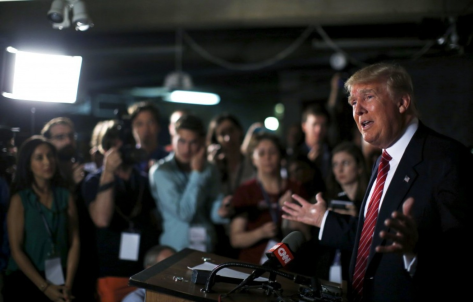
U.S. Republican presidential candidate Donald Trump speaks at a news conference at the Family Leadership Summit in Ames, Iowa, United States, July 18, 2015. REUTERS/Jim Young
Donald Trump’s surge to the front of the GOP presidential polls has occasioned not a little media attention and endless speculation as to why. You can disregard most of that speculation. The answer is simple: Trump is surging in the polls because the news media has consistently focused on him since he announced his candidacy on June 16.
Below is a graph that I made with UCLA political scientist Lynn Vavreck using social analytic tools provided by Crimson Hexagon. These tools are devised to gather and reveal the volume and tone of media coverage on major news sites. Vavreck and I are analyzing the news coverage of presidential candidates as part of our joint work on the 2016 election.
[Trump’s attack on McCain marks a turning point for him — and the GOP]
The graph shows you how much coverage Trump got in the week before he announced his candidacy, and in the 30 days after. For comparison, there is a line for the other Republican candidates who have announced their candidacy in the past 2 months: Jeb Bush, Chris Christie, Ted Cruz, Rick Perry, Rick Santorum, and Scott Walker.
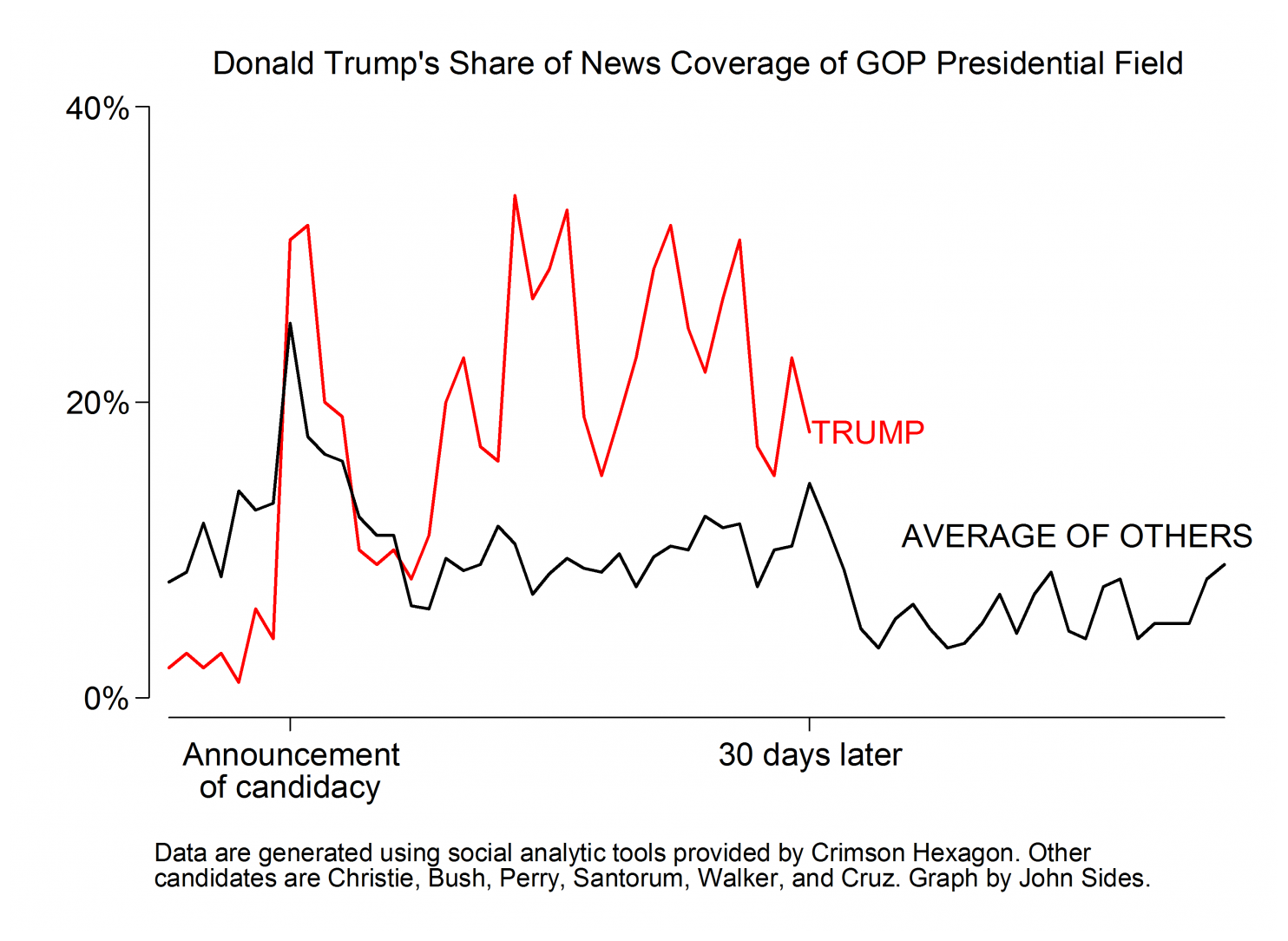
The graph shows two important things. First, Trump’s announcement generated a much larger spike in media coverage than these other candidates received. The day before he announced his candidacy, Trump received 4 percent of the media coverage devoted to these candidates. The day after, he received 31 percent.
Second, the news media’s attention to Trump hasn’t faded away, as is typical. He has consistently attracted 20-30 percent of the news coverage of these candidates. Only Jeb Bush comes close. In the month since Trump’s announcement, Trump has received 21 percent of the news coverage. Bush has received 20 percent.
[What Donald Trump was up to while John McCain was a prisoner of war]
Has this attention to Trump driven his poll numbers? Almost certainly. Think about it this way: voters don’t change their minds without new information. No one wakes up on June 17 and randomly decides on their own that Donald Trump should be the Republican nominee for president. People’s minds change because they are hearing information that they haven’t heard before.
In Trump’s case, his remarks about John McCain have finally elicited strong criticisms from the other GOP contenders. Now the question is whether Trump will feel the full scrutiny of the press—which, as political scientist Matthew Dickinson argues, necessitates more than simply enabling Trump to traffic in controversy. Dickinson suggests this:
Instead, journalists should take his candidacy seriously by pressing him on the details of his policy pronouncements, and helping the public understand the differences between the public and private sector. The sooner the media begins evaluating The Donald on the details of his policies and his governing expertise, rather than on his deliberately provocative comments designed to mobilize a disaffected public, the sooner The Donald’s political bubble is likely to burst.
In other words, the media giveth, and the media can taketh away. This is what underlies the seemingly unpredictable Republican presidential primary of 2015.


 Cathy
Cathy chulai1968
 Truth Prevailing
 Publius Huldah
 Freedom Rider
 kathleen
 radioroger2015
 Steve
Steve truckjunkie