
Tag Archives: Willis Stone

Misrepresenting The John Birch Society

by JBS President John F. McManus

The organization known as Convention of States (COS) wants a constitutional convention although its advocates claim that they want only a limited Convention of the States. Altering the terminology used for a constitutional convention, however, does not alter what is being sought by COS advocates. And the claim by COS or anyone that a constitutional convention can be limited to a single amendment, or to several named amendments, cannot be supported. Article V says that a convention may be called by the states “for proposing Amendments.” No number is given. Once a convention is underway, the number of amendments it produces can be limitless, and the current ratification method by the states could be altered or even abolished.

In addition, a recent COS release entitled “John Birch Society Denies Its History and Betrays Its Mission” accuses the Society of reversing the stands taken by JBS Founder Robert Welch and former Chairman Larry McDonald relative to The Liberty Amendment. It also claims that current John Birch Society President John McManus (this writer) has misrepresented Founder Robert Welch and former Congressman Larry McDonald. This is completely erroneous and irresponsible.

In August 1963, Robert Welch urged JBS members to ask legislators in Alabama to approve a resolution favoring the Liberty Amendment. In his urging, Robert Welch made no mention of the Constitution’s second method for gaining amendments, the constitutional convention. He favored the first choice mentioned in Article V which seeks two-thirds approval of both Houses of Congress before a measure is sent to the States where ratification by three-quarters would be needed to complete the process. This method for adding an amendment to the U.S. Constitution happens to be the only method ever employed. For over 200 years, fear of a runaway convention (as occurred in 1787 during deliberations at a convention called to repair the Articles) has kept the amendment process strictly through the first method.

Similarly, Congressman Larry McDonald favored adding the Liberty Amendment to the Constitution. On October 9, 1973, his interview about the matter was published in the Congressional Record. In it, he mentioned that the Amendment was being “advanced in both ways” but he never advocated the convention route. As a member of Congress, he introduced the resolution containing the Liberty Amendment for passage by Congress in the traditional manner. He mentioned but did not favor the existence of the amendment route that would involve a constitutional convention.

Several years before he was slain in 1983, Larry McDonald wrote the 1976 book entitled We Hold These Truths. In it, Larry McDonald capably noted the two routes spelled out in the Constitution for adding amendments. How could he or any constitutional scholar (McDonald was indeed such a scholar) fail to note the existence of these two procedures? But, in the portion of his book discussing amendments, Congressman McDonald expressed explicit choice for neither. To claim that he favored one or the other when he was simply noting both is a complete misrepresentation of what he wrote. The COS release has engaged in misrepresentation, not The John Birch Society.

The COS release notes that, in 1983, Congressman Ron Paul joined with Congressman McDonald in introducing the Liberty Amendment in the House of Representatives. The two men obviously favored the route calling for the amendment to be passed by Congress. They had already introduced the resolution calling for Congress to pass the amendment several times. On no occasion did they express any favor toward the route of a constitutional convention.

On April 30, 2009, Congressman Paul and two co-sponsors again proposed that Congress pass the Liberty Amendment. There is no mention of the constitutional convention route to amend the Constitution in that move.

It is true that state resolutions calling for the Liberty Amendment mentioned the constitutional convention route. And it is equally true that Liberty Amendment author Willis Stone counseled state legislators to call for a constitutional convention on behalf of the Liberty Amendment. But during my own very friendly relationship with Willis Stone, the Liberty Amendment author clearly bared the strategy he was employing. Fearing that such a convention might actually occur if sufficient number of states (34) made the convention call, I asked him point blank, “Do you actually want a constitutional convention?” His very prompt and forceful response to me was, “No, I don’t worry about that because no one would be stupid enough to want a Con-Con.” He was relying on fears of many – including members of Congress – that the existing Constitution would be in jeopardy similar to what befell the Articles of Confederation in 1787. He further explained that if his work among the various state legislatures succeeded in getting close to the number 34 (the number that would trigger a convention), members of Congress would move quickly to pass approval of the measure themselves in order to keep a constitutional convention from becoming a reality.

In 1963, the Liberty Amendment Committee headed by Willis Stone published Action For Americans: The Liberty Amendment, a book promoting the Liberty Amendment. No book on this topic could be issued by the Liberty Amendment Committee without Willis Stone approving of every word. In their book, authors Lloyd G. Herbstreith and Gordon van B. King stated:

Some people have expressed fear of what a Convention might do. They point to the fact that the 1787 Convention was convened to amend the Articles of Confederation; however, it did not do this. It wrote an entirely new Constitution. A convention called now might similarly re-write the entire Document, instead of merely proposing an amendment….

As soon as twenty or more State Legislatures have approved the Liberty Amendment, Congress will approve it, and return it to the States for ratification.

There you have the opinion of the chief promoters of the Liberty Amendment, certainly including Willis Stone. What Mr. Stone told me of his plan is what these two authors, both friends and supporters of Mr. Stone and the Liberty Amendment, have confirmed.

Conclusions:

1. Neither Larry McDonald nor Robert Welch ever favored the route of a constitutional convention for adding amendments to the Constitution. Both merely knew that the Constitution allowed such a method.

2. Larry McDonald’s book We Hold These Truths does not place him in the camp of those favoring a constitutional convention.

3. Willis Stone’s strategy is clear. He wanted to force Congress to act to pass the Liberty Amendment resolution in order to prevent creation of any constitutional convention.

4. The book by Herbstreith and King confirms the Stone strategy.

5. An apology for accusing The John Birch Society for denying its history and betraying its mission directed to me and to the memory of Robert Welch, Larry McDonald, and Willis Stone should be issued by COS. It would be received with gratitude.

Learn of other false accusations made by Con-Con supporters here.

Are you receiving our free weekly e-newsletter? Keep up with our latest news by signing up at JBS.org or on our Facebook page.


A former U.S. Marine officer, Mr. McManus joined the staff of The John Birch Society in August 1966 and has served various roles for the organization including Field Coordinator, Director of Public Affairs, and now President. He remains the Society’s chief media representative throughout the nation and has appeared on hundreds of radio and television programs. Mr. McManus is also Publisher of The New American magazine and author of a number of educational DVDs and books.
Liberty Amendment Distortions

My comments: Hal dispels the lies and distortions being propagated by the proponents of a new Constitutional Convention. These people use Alinsky tactics perfectly. They never answer the charges. Instead, they attack the messenger speaking against their false statements.

Make sure you also watch for and read JBS President, John McManus’s letter explaining where JBS has always stood on a Con-con and why the proponents of same are lying.

By Hal Shurtleff, a Coordinator for the John Birch Society

“Desperate times call for desperate measures” must be the mantra of some of those organizations working to get a constitutional convention. Their desperate measures include whipping their supporters into a frenzy to malign JBS as their main enemy, responsible for all evils that have befallen this great Republic. Their wild claims include blaming JBS for abortion, the massive U.S. debt, and partnering with George Soros!

Their latest claims are typical of what you would see when a fighter is on the ropes: to try anything and everything to get out and ahead. Distorting history must be an art form to them as they are making it appear that JBS has supported a Con-Con during our support for the Liberty Amendment, as formulated by Willis Stone.

Stone’s Liberty Amendment called for further clarification of keeping government out of any business, professional, commercial, financial or industrial enterprise except as specified in the Constitution. Any existing entities that violated this would be liquidated within three years.

It called for keeping the Constitution and laws in each state free from subjugation from any foreign or domestic agreement. And the amendment repealed the 16th Amendment three years after ratification.

The amendment was first introduced in 1952 and eventually came to the attention of JBS Founder Robert Welch.

The JBS did endorse the Liberty Amendment and in our official member publication, “The John Birch Society Bulletin”, urged our members to work for its adoption back in the 1960s and 1970s. One of the means by which this amendment was promoted was to have states call for a constitutional convention. No JBS official dreamed that this would happen. Rather, agreeing with Mr. Stone, JBS leaders believed that this route to ratification would scare Congress into adopting the Liberty Amendment and then send it to the states for ratification. No one connected to the amendment wanted a Con-Con believing always that it posed a threat to the entire Constitution.

When asked about whether he wanted a Con-Con, Mr. Stone privately told JBS staff that he always felt that Congress would never let it go that far and that no one would be that stupid to actually want to do it . It was a calculated tactic that Mr. Stone promoted.

In the “Bulletin” of January 1963, Mr. Welch reprinted a news release issued by the National Committee for Economic Freedom, led by Mr. Stone, which spelled out the strategy for passing the amendment:

“When 28 more States approve the resolution for the LIBERTY AMENDMENT, Congress will be compelled to submit this basic question of public policy to the American people for decision.”

“Congress will be compelled to submit … ” does not mean to call a convention. “Convene” means to call a convention. “Submit” means passing the proposed amendment to the state legislatures for ratification.

Beginning in the early 1970s, the JBS started to tone down its support for the Liberty Amendment because we felt that it was not wise to use this dangerous strategy of playing chicken with the Constitution.

Neither Mr. Welch nor Congressman Larry McDonald (who became Chairman of the Board of JBS in 1983) wanted to embarrass Willis Stone and his committee with a public disagreement, since we were friends and wanted nothing to prevent us from working together in the future. So the JBS went silent on the issue in our Bulletin after October 1978.

None of our office or field staff personnel worked to promote the Liberty Amendment after this time. Our total efforts on staff had steadily diminished after 1971, the last year that the Liberty Amendment was a stand-alone agenda item in our Bulletin not because we disagreed with its provisions, but from the danger of allowing people to think that we supported a Con-Con and the possibility it may even be initiated.

From 1972 to 1978 we segued into infrequently asking our members to support bills originating in the Congress calling for the Liberty Amendment, but never outside of Congress, or through a convention.

Congressman McDonald continued to support the amendment by trying to get Congress to move the amendment toward ratification in the traditional manner and this led to him entering into the Congressional Record the entire background of the need for the amendment, its provisions, and how it was moving forward in 1975. It was not an endorsement of the Con-Con method but simply a statement of how the process had been moved forward as part of a comprehensive synopsis of the Liberty Amendment movement, what the intent of the Amendment was and how it would curtail government spending, debt, and control over the economy.

He, again, was trying to get the amendment added in the traditional way by submitting a bill in Congress to do so, not by a Constitutional Convention.

The distortionists are claiming that after Congressman McDonald was killed in 1983 that JBS drifted away from supporting a Con-Con. But the Society never wanted a Con-Con in the first place and could never have been said to have “drifted away from supporting one.”

These distortionists have lifted a sentence out of Congressman McDonald’s report (again, a synopsis of the movement) and are relying on it as proof that he supported a Con-Con — a highly unethical and desperate move to win over support. It’s a demonstration of their inner character and motivation.

Unfortunately, members and supporters of The John Birch Society have been doing much of the heavy lifting nearly alone in its 55+ years of educating and organizing for limited government under the Constitution. It’s a slap in the face that these great people are being set up as the enemy by some Con-Con proponents, but then again, we are used to being attacked by both sides. Why? Because we are effective, even though our plan is a hard sell to others. The only way it can be done is to inform the people, teach the principles that led to the Constitution, and do so by organizing enough people to get the job done. This is the whole purpose of The John Birch Society.

This work comes with a measure of headaches. It is work that no one else seems to want to do.

What we are witnessing in the attack against The John Birch Society by some Con-Con proponents is the use of the same tactics of the socialists, establishment party leadership, and media in the 1960s and 1970s in their attempt to try to negate the tremendous influence of the JBS. In reality, what they are doing looks more like what they accuse the JBS of doing. There are many people on the left and right, Democrat and Republican desiring a Con-Con. They work together for a Con-Con but have different goals once the Con-Con is convened. Who’s to say which side will win and who’s to say that the ratification process won’t be rewritten as it was in 1787? We hope this helps to bring to light the desperate tactics of a few.

Editor’s note: As we prepared to finalize this, we were alerted that Senator Coburn and Mark Meckler of the Convention of States were discussing an Article V Convention on the Sean Hannity Show. The two guests made disparaging remarks about JBS and further propagated the false rumor that JBS was working with George Soros. Again, desperate tactics. We contacted the Hannity Show for an interview.

My comments: And unfortunately, the Faux Media Channel and talking head Hannity, will probably never return the call. Putting a true anti-Communist who wishes to save the Republic on his program would be verbotin.


Falsehoods Mark the Campaign for a Constitutional Convention

by JBS President John F. McManus

For one excellent reason, The John Birch Society has always opposed the creation of a constitutional convention (Con-Con) as authorized in Article V of the Constitution. The Society isn’t opposed to amendments and would support any that would cancel existing Amendments 16 (Federal Income Tax) and 17 (Popular Election of Senators). This could be done via the other route to adding an amendment noted in Article V, the passage of the measure by two-thirds of each house of Congress and then ratification by three-fourths of the states. This is the only route to adding an amendment that has ever been employed in the 228 years of the Constitution’s existence.

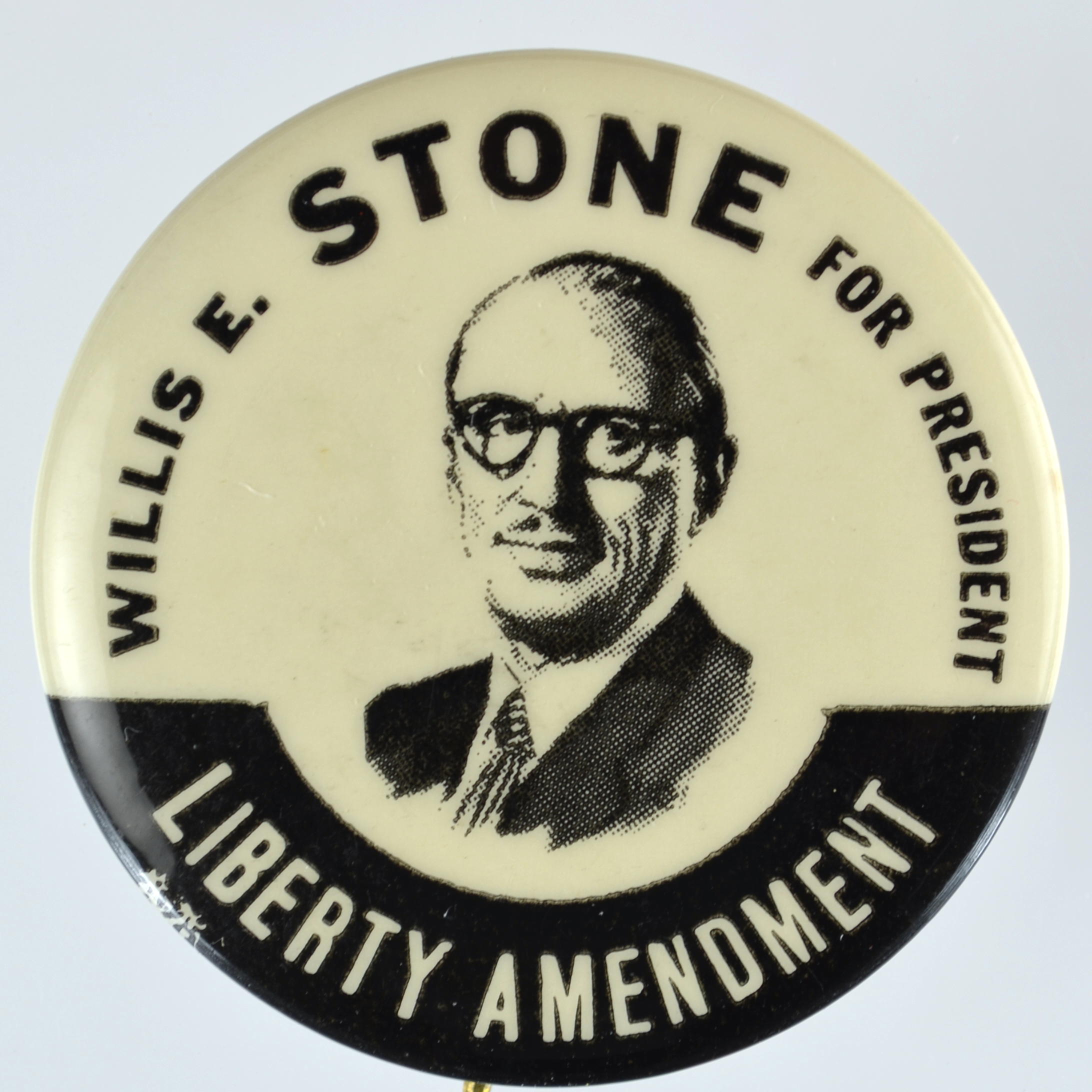
Willis Stone wrote the original Liberty Amendment 50+ years ago. Image from Old Politicals Auctions.

Having both houses of Congress agree to an amendment before sending it to the states for ratification is the safe route to adding any amendment. It was the route taken when Amendment 18 (Prohibition) was erased by Amendment 21. A Con-Con, however, would open the entire Constitution for change, even total erasure – which is what occurred in 1787 when a Con-Con assembled under the Articles of Confederation met with the sole assignment to revise the Articles. But because a Con-Con cannot be limited, America’s Founders used the power any Con-Con would have and scrapped the Articles. They then proceeded to write an entirely new Constitution, even changing the state ratification requirement from unanimous (under the Articles) to three-fourths in the new Constitution. Such a runaway could happen again because a Con-Con can’t be limited.

Most of today’s proponents of a Con-Con want to use it to add a Balanced Budget Amendment to the Constitution. Calling their proposal a “Convention of the States,” they claim that it can be limited. But, in reality, what they claim for a Convention of the States is a nothing but a Con-Con which can’t be limited to a single topic. Some of these proponents also claim that John Birch Society Founder Robert Welch and Congressman Larry McDonald, his 1983 successor, advocated the Con-Con route in favor of the “The Liberty Amendment.” This proposed amendment, written more than 50 years ago by Willis Stone, is a brief proposal whose most appealing feature would require the federal government to divest itself of every “business, professional, commercial, financial or industrial enterprise except as specified in the Constitution.” The money saved would enable the Federal government to abolish the federal income tax – another clause in the proposed amendment.

But neither Robert Welch nor Larry McDonald nor this writer (current JBS President) has ever advocated a Con-Con on behalf of the Liberty Amendment or any other amendment. After sponsoring Willis Stone for a speech in 1965, I became quite friendly with him (he is deceased). He even implored me to accept appointment as a state chairman for the amendment; a request I declined because I was already overloaded with other commitments. But I discussed the matter with Mr. Stone at length and knew that his plan sought to have state legislatures pass a resolution asking Congress to create a Con-Con was simply a tactic to call attention to his proposal. He very clearly explained to me that he feared a Con-Con. He expected that members of Congress, themselves fearful of what might happen if a Con-Con were created, would use their Article V authorization to propose the amendment directly and singly in both houses of Congress (the alternate method for starting the amendment process spelled out in Article V). When the number of state legislatures calling for a convention approached 34, he was certain that Congress would act and turn to the far safer portion of Article V to accomplish the first step toward passage of the Liberty Amendment.

I vividly recall questioning Willis Stone about the danger that 34 states would indeed call for a Con-Con. I noted that if that number of state applications for a convention were reached, then the Constitution requires that Congress “shall call a convention for proposing amendments.” He emphatically assured me, “No, I don’t worry about that because no one is stupid enough to want a Con-Con. We know what happened when the Con-Con met in 1787; its members cancelled the Articles of Confederation. If a Con-Con were held today [1965], it could and likely would lead to cancellation of the present Constitution and put in its place something far different.”

I know that Robert Welch never wanted a Con-Con. I know of no JBS official who wanted it. I never discussed the matter with Larry McDonald, but I’m sure he discussed it with Robert Welch. Anyone who claims that JBS leaders (past or present) ever intended to have Congress create a constitutional convention either doesn’t know what he or she is talking about or is being deceitful.


Mr. McManus joined the staff of The John Birch Society in August 1966 and has served various roles for the organization including Field Coordinator, Director of Public Affairs, and now President. He remains the Society’s chief media representative throughout the nation and has appeared on hundreds of radio and television programs. Mr. McManus is also Publisher of The New American magazine and author of a number of educational DVDs and books.

And from Arthur Thompson, CEO of the John Birch Society comes this video on the dangers of a Constitutional Convention.